The Global Close: November 19, 2026 — Anthropic’s record debut cannot hold the market
U.S. stocks fell 2% for a sixth straight day as Anthropic's record IPO debut reversed, the Dow closed below 50,000, Europe and most of Asia fell, and the 10-year Treasury yield held above 5%.
7 min read
Anthropic opened 34% above the price of the largest initial public offering on record and the market still closed near its lows — investors will pay up for a new way into the artificial intelligence trade, but they are no longer willing to hold the existing one at the same price. That distinction travelled through every handoff of the day: Tokyo and Seoul rose on the chip story while Hong Kong and Sydney fell, Europe gave back an Anthropic-led open under the weight of its own inflation problem, and New York’s reversal left the Federal Reserve, preparing to raise rates into slowing activity, as the constraint every region now shares.
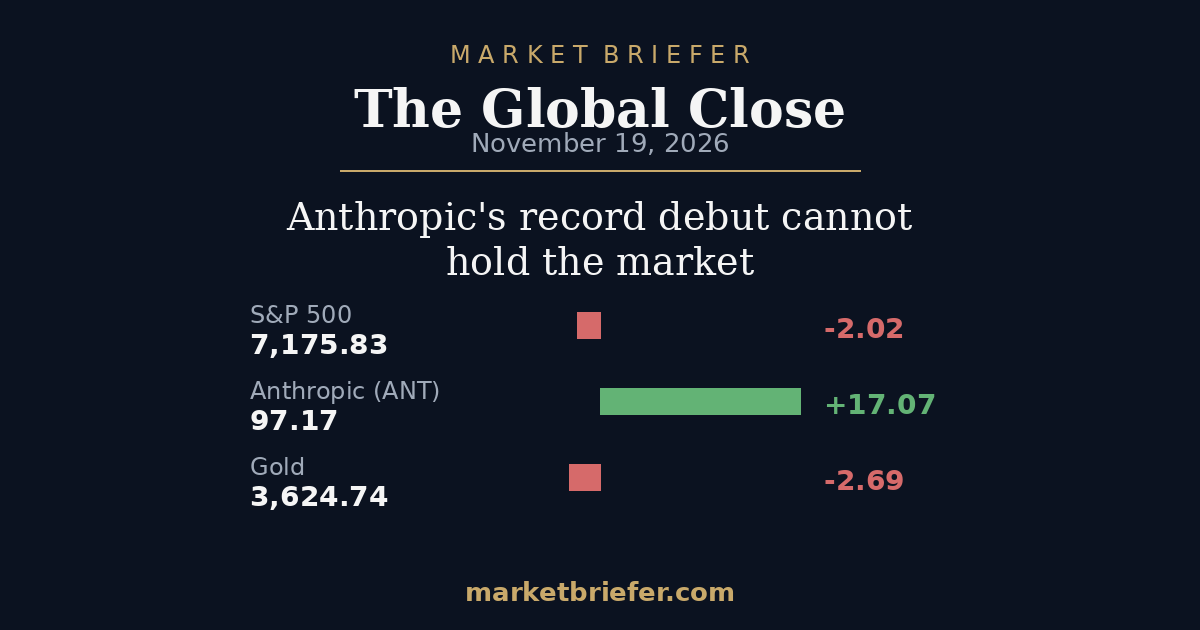
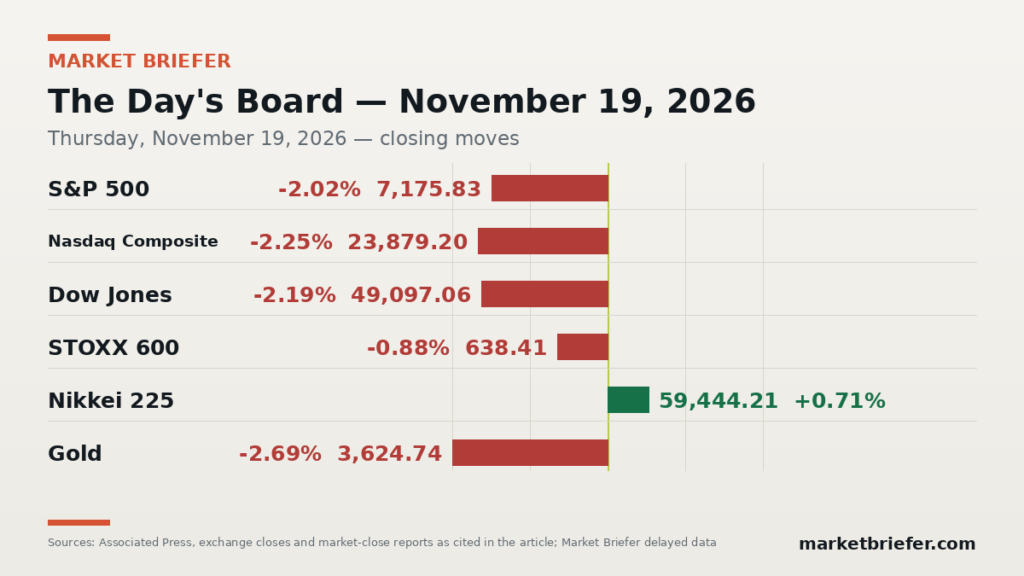
U.S. stocks fell sharply on Thursday. The S&P 500 fell 147.80 points, or 2.02%, to 7,175.83, its sixth straight loss and its longest losing streak since April 2024, while the Nasdaq Composite fell 550.69 points, or 2.25%, to 23,879.20 after rising more than 2% at its high, and the Dow Jones Industrial Average fell 1,101.11 points, or 2.19%, to 49,097.06, its first close below 50,000 since June, according to the Associated Press and exchange closing data. Anthropic, which raised about $81.3 billion selling 980 million shares at $83, opened at $111.50, touched $115.10 and closed at $97.17, up 17.07% from the offer price. The day’s economic data gave the Federal Reserve two problems at once: the Philadelphia Fed’s manufacturing index fell to 6.3 from 20.9, with new orders slipping into contraction and prices paid jumping, while initial jobless claims rose to 203,000 and continuing claims climbed 70,000 to 1.763 million. The VIX rose 15.78% to 28.44, and the S&P 500 now sits 8.2% below its October 6 record close of 7,819.04.
The Number That Matters: 5.05%. That is where the 10-year Treasury yield ended Thursday, at 5.048%, down less than 2 basis points on a day when equities fell 2% and volatility jumped — the flight to quality was real but shallow, because the same inflation pressure driving the selloff also limits how far yields can fall. It is the key number because it transmits everywhere at once: a 10-year above 5% keeps the discount rate on the AI trade high and keeps borrowing costs elevated, leaving no offset for equity valuations when guidance disappoints. It matters more than the headline index fall because it explains why a record-breaking debut could not lift the market. A decisive close in the 10-year below 5% while equities stabilise would make the S&P 500’s breadth the more important signal instead.
The day’s single story was a reversal. The major indexes reached their session lows almost as soon as Anthropic began trading, and the early leaders became the afternoon’s drag: Nvidia reversed a gain of as much as 4.7% to close down 3.30% at $145.98, and breadth was one-sided, with 446 S&P 500 stocks lower against just 37 higher. Readers can follow the full board on our markets desk.
United States: every sector lower, guidance punished
In the United States, all eleven S&P 500 sectors closed lower. Energy held up best, down 0.65%, while consumer discretionary fell 2.79% and communication services 2.67%, with technology down 1.90% and health care down 2.05%. Palo Alto Networks was the index’s best performer, rising 6.42% to $361.73 after beating expectations and raising its outlook, and Insmed rose 20.58% on reports that Sanofi is considering an acquisition. At the other end, Williams-Sonoma fell 15.16% to $220.66, the index’s worst performance, after a quarter that landed in line — revenue of $1.99 billion, up 5.8% — but brought a reiterated, rather than raised, outlook. Advanced Micro Devices fell 7.72% to $489.19 after Hunterbrook Capital disclosed a short position and alleged ties to a blacklisted Chinese server maker, a claim AMD denied; our short selling explainer sets out how a disclosed short of that kind works. Walmart fell 1.04% to $126.04 even after earnings and revenue beat estimates and full-year guidance was raised to $2.84 to $2.89 a share, because that range implies a fourth quarter below the $0.79 a share analysts had pencilled in.
The policy backdrop hardened through the day. Chicago Fed President Austan Goolsbee said inflation remains well above the Fed’s 2% target with no clear path back, and described the AI boom as a “pig through the python” that risks overheating the economy. A day after the October minutes showed almost all officials backing a December increase, futures now price a 25-basis-point increase on December 9 as near certain. For workers, the claims data carried the softer edge: first-time filings stayed low at 203,000, but the rise in continuing claims suggests those already out of work are taking longer to find it.
Europe gives back its open, Asia splits on the chip trade
Europe opened firmer on the Anthropic debut and then followed the same arc as New York, in miniature and a few hours earlier. The pan-European STOXX 600 closed down 0.88% at 638.41, Germany’s DAX fell 272.43 points, or 1.06%, to 25,463.81, France’s CAC 40 lost 66.09 points, or 0.81%, to 8,080.74, and London’s FTSE 100 fell 98.49 points, or 0.93%, to 10,452.68, with all nine major European indexes lower and health care, down 1.79%, among the weakest sectors. Oil prices climbed during the session amid escalating tensions between Iran and the United States.
Asia, trading before the debut on the strength of Nvidia’s guide, split along the same lines as the day before. Japan’s Nikkei 225 rose 419.93 points, or 0.71%, to 59,444.21 and South Korea’s Kospi rose 1.39% to 5,137.89, while Hong Kong’s Hang Seng fell 453.13 points, or 1.95%, to 22,841.62, China’s Shanghai Composite eased 10.21 points, or 0.28%, to 3,577.62, with the CSI 300 essentially flat, up 0.03% at 3,984.84, and Taiwan’s Taiex fell 4.40% as chipmakers retreated. Australia’s S&P/ASX 200 fell 91.40 points, or 1.04%, to 8,730.40, as the country’s unemployment rate rose to 4.9%. India was Asia’s clear exception: the Nifty 50 rose 286.35 points, or 1.14%, to 25,514.30, led by automobile and consumer durable shares, with foreign investors buying a net ₹7,411 crore of shares on provisional data.
Rates, currencies, commodities and crypto
Treasuries caught a bid as the equity selloff deepened, but a shallow one: the 10-year yield eased 1.8 basis points to 5.048% and the 2-year fell 3.4 basis points to 4.766%, leaving the gap between them near 28 basis points. The Dollar Index rose 0.07% to 103.94. The euro slipped 0.04% to $1.0969, sterling fell 0.49% to $1.3082, and the dollar rose 0.22% to 159.68 yen after coming within four pips of 160. The Australian dollar fell 0.89% to $0.6657 on the higher unemployment reading. In credit, the latest ICE BofA spreads available through FRED, for November 18, widened to 93 basis points for investment-grade debt and 347 basis points for high-yield, up 3 and 17 basis points over the week — lenders are charging more for corporate risk, though not yet at levels that signal a funding problem.
Oil barely moved at the settlement. December WTI settled at $83.21 a barrel, down $0.05, and January Brent settled at $91.98, up $0.03 from Wednesday’s $91.95 settlement for the same January contract — no contract roll distorts either figure. Shipping disruptions in the Strait of Hormuz supported prices while rising U.S. inventories and expectations of a global surplus capped them; our oil prices explainer sets out how that surplus is being priced. Gold fell for a second day, down 2.69% to $3,624.74, with silver down 4.71% to $42.92 and copper down 1.40% to $5.5890, the firmer dollar outweighing the fall in yields. In crypto, bitcoin fell about 2.2% to near $61,592 and ether fell about 1.6% to near $1,746 in late trading, moving with equities as the early appetite for risk faded and the $60,000 level for bitcoin came into view.
What Would Change This Read: This interpretation would weaken if the 10-year yield closes decisively below 5% while Anthropic holds above its $111.50 opening price and S&P 500 breadth recovers, suggesting Thursday’s fall was positioning around one very large listing rather than a rate-driven de-rating. In particular, watch Friday’s breadth against the yield, because it would distinguish between the current interpretation — that a 5%-plus 10-year is repricing the whole AI complex — and the alternative that the market simply over-committed to a single debut.
What to watch on Friday starts in Asia, where Tokyo, Seoul and Sydney will trade on New York’s reversal rather than on the debut itself, then turns to British retail sales, European Central Bank President Christine Lagarde speaking in Frankfurt, and, in the United States, the final University of Michigan consumer sentiment reading for November at 10 a.m. Eastern, with preliminary sentiment at 51.0 and one-year inflation expectations at 4.3%, alongside speeches from Fed Governors Christopher Waller and Lisa Cook and BJ’s Wholesale reporting before the open.
This is not investment advice. The Global Close is AI-assisted market research produced with automated data checks; figures are verified against market-close reports and the site’s delayed data feeds at publication time.
See Market Briefer first in Google
Add to Preferred Sources