The Global Close: October 30, 2026 — Intel’s worst day in 52 years caps the AI rout
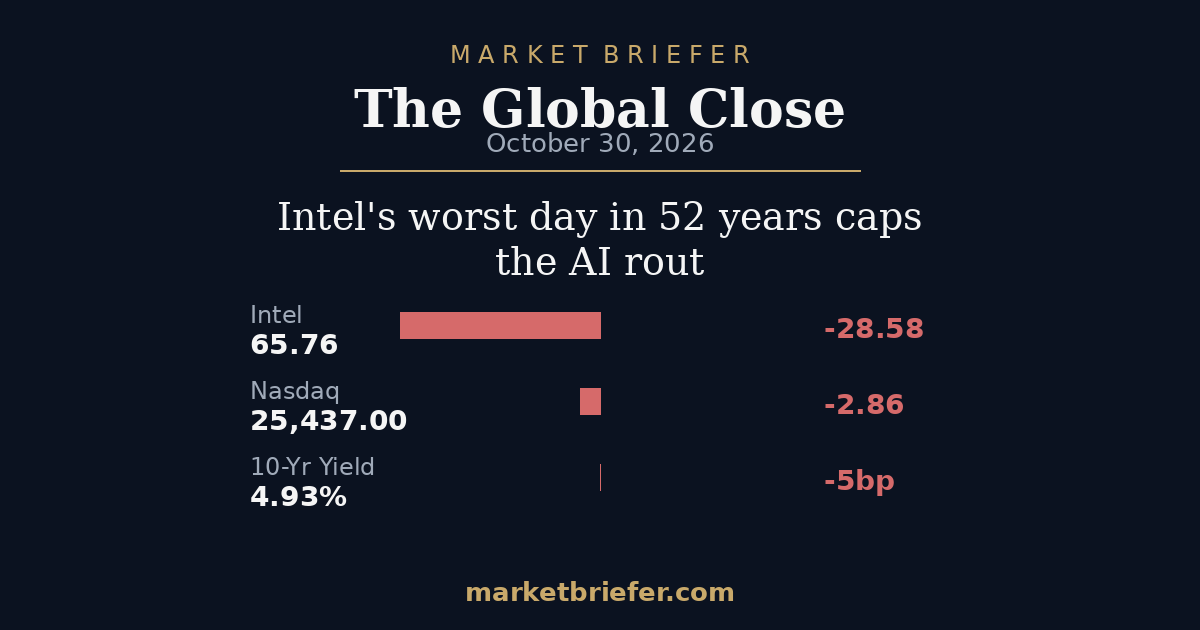
The Nasdaq fell 2.86% to 25,437.00 and the S&P 500 lost 1.82% to 7,580.07 as Intel plunged 28.58% in its worst session since the 1970s, the 10-year Treasury yield eased to 4.93%, gold fell 3.63% to its lowest level in a year, and Bitcoin slid below $77,000 after a $6.3 billion hack at Binance.
7 min read
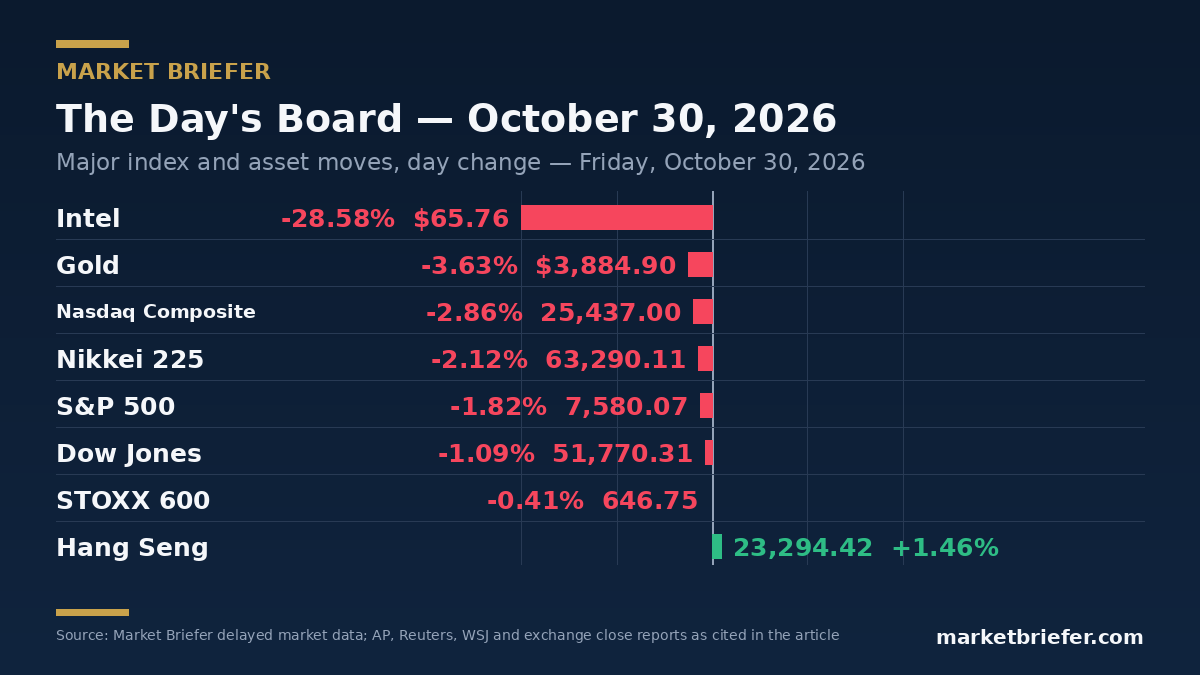
U.S. stocks closed sharply lower on Friday as the week’s reassessment of artificial intelligence spending turned into a rout in the chip sector, ending October with the Nasdaq Composite’s biggest monthly decline since March 2025. The Nasdaq fell 747.72 points, or 2.86%, to 25,437.00, the S&P 500 lost 140.32 points, or 1.82%, to 7,580.07 in its worst session since June, and the Dow Jones Industrial Average dropped 572.25 points, or 1.09%, to 51,770.31. Intel plunged 28.58% after guiding fourth-quarter revenue below expectations, leading a semiconductor selloff that took the Nasdaq 100 down 3.46% and the iShares Semiconductor ETF down more than 8%. Yet the selling stayed concentrated in the AI complex: six of the S&P 500’s eleven sectors rose, led by energy and consumer staples, Treasury yields fell in a flight to safety that gave the 10-year its largest monthly decline since December 2023, and the day’s labor-cost data came in exactly as expected. Europe followed technology lower, Asia split between chip-heavy markets that fell hard and Hong Kong and India, which rose, gold dropped to its lowest level in a year, and Bitcoin slid below $77,000 after a $6.3 billion hack at crypto exchange Binance.
The Number That Matters: 28.58% — the one-day fall in Intel, which closed at $65.76 in what CNBC described as the stock’s worst session since the 1970s. It matters more than the index declines because it converted an abstract worry — that AI capital spending may not earn its cost — into a specific, reported failure: a bellwether chipmaker whose better-than-expected third-quarter results were ignored the moment its outlook disappointed. The transmission ran exactly along the AI supply chain, from Intel through Qualcomm, down 11.12%, and Nvidia, down 4.22%, into the Nasdaq 100, and then outward to chip names in Tokyo, Seoul and Frankfurt. A decisive recovery in the semiconductor ETF on Monday, holding Friday’s lows, would make the Nasdaq’s monthly loss of 5.3% the more important signal instead.
Intel turned a spending worry into a rout
The United States session was decided the night before, when Intel and Amazon reported after Thursday’s close. Intel’s weak fourth-quarter guidance, blamed on continuing personal computer softness, overshadowed a third-quarter beat and sent the shares down 28.58%, the steepest fall in the S&P 500 and the Nasdaq 100. Amazon fell 1.41% after missing expectations and reporting a decline in free cash flow as its own AI spending mounted — the same cash-flow test that cut Alphabet by 12.64% on Thursday. Advanced Micro Devices and Marvell Technology fell by double digits, Broadcom and Micron each lost more than 5%, and technology was the S&P 500’s weakest sector by a wide margin, down 4.24%. The full index board is on our Markets desk.
The rest of the market told a calmer story. Energy rose 1.91%, consumer staples gained 1.38%, and utilities, health care, real estate and materials also finished higher, while the small-cap Russell 2000 fell 1.66% to 2,811.84, ending a four-session climb, and the Cboe Volatility Index rose to 19.42. For the month, the Nasdaq’s 5.3% fall was its largest since March 2025, when markets cratered amid concerns about the Trump administration’s tariff policies, and the index now sits more than 8% below its record closing high of October 6; the S&P 500 fell 0.9% in October while the Dow added 1.7%. The broader earnings season remains healthier than the headlines: of the 299 S&P 500 companies that had reported third-quarter results through Friday, 82% beat consensus estimates, according to LSEG data cited by Reuters. The morning’s data added nothing to the bears’ case: the employment cost index rose 0.8% in the third quarter, in line with expectations and down from 0.9% in the second, as wages and salaries climbed 0.7%; over the year, wages rose 3.1% but fell 0.6% after inflation, according to the Bureau of Labor Statistics — a squeeze felt directly by workers even as it relieves the Federal Reserve’s concern that labor costs are feeding prices. The Chicago Business Barometer eased 3.5 points to 55.3 in October, a second month in expansion.
Europe followed tech lower while Asia split on the same trade
Europe’s four-session rise ended as its technology shares followed Wall Street lower. The pan-European STOXX 600 fell 0.41% to 646.75, Germany’s DAX dropped 221.47 points, or 0.85%, to 25,818.21, France’s CAC 40 was essentially flat, down 0.58 points to 7,969.42, and London’s FTSE 100 edged up 7.71 points, or 0.07%, to 10,729.78 for a third straight gain. Technology was Europe’s weakest sector, down 2.73%, and banks lost 2.31%. Eurostat’s flash estimate put euro-area growth at 0.4% in the third quarter, slowing from 0.6% in the second, with output 1.3% higher than a year earlier.
Asia had already priced the chip selloff before New York opened. Japan’s Nikkei 225 fell 1,369.36 points, or 2.12%, to 63,290.11, snapping three straight gains as Advantest, Tokyo Electron and Kioxia fell between 5% and 7%, and South Korea’s KOSPI dropped 3.48% to 5,730.74. The Bank of Japan held its policy rate at 1.25% on an 8-to-1 vote, capping a week of central bank meetings. China extended its slide: the Shanghai Composite fell 52.41 points, or 1.44%, to 3,599.02 and the CSI 300 lost 1.39% to 3,985.50, a twelfth straight weekly decline for the blue-chip index and its steepest monthly fall in about a decade, according to Reuters. The exceptions were the markets least tied to the chip trade. Hong Kong’s Hang Seng rose 335.77 points, or 1.46%, to 23,294.42 as internet platforms gained, India’s Nifty 50 climbed 116.35 points, or 0.51%, to 23,053.10, and Australia’s ASX 200 added 16.30 points, or 0.18%, to 8,908.10.
Yields fell, gold broke, and oil rose
Bonds were the day’s refuge. The 10-year Treasury yield eased to 4.93% from 4.98% on Thursday and the 2-year fell to about 4.58%, leaving the 10-year down roughly 36 basis points in October — its largest monthly decline since December 2023, according to the Wall Street Journal — as investors bought safety. Our explainer on why bond yields move stocks sets out how that fall in long yields cushions equity valuations even on a day when the cushion was not enough. The dollar was little changed, with the dollar index at 101.96, the euro at $1.1166, sterling at $1.3389 and the dollar at 157.52 yen. Credit markets produced no verified spread move we can source by publication time, and the week’s debt story remained the volume of AI-linked borrowing rather than any single print.
Commodities split between fear of the energy market and rejection of the year’s haven trade. WTI crude climbed 2.4% to settle above $104 a barrel and Brent gained about 3%, with front-month futures rising above $114, as the Iran war’s risk premium persisted — strength that supports energy shares and squeezes fuel buyers while it lasts. Gold went the other way, falling 3.63% to $3,884.90 an ounce, its lowest level in about a year, and silver dropped 5.86% to $49.14. Copper eased 1.09% to $6.51 and natural gas fell 2.34% to $2.88. The full energy board is tracked on our Commodities desk. Crypto had its own shock: a hack at Binance that the Wall Street Journal put at $6.3 billion, the largest digital-currency heist on record, and Bitcoin fell 2.99% to $76,746 while Ethereum lost 1.42% to $2,239. Crypto-linked shares fell harder, with Coinbase down more than 10%, Strategy down nearly 8% and Robinhood off 7.2%.
What Would Change This Read: This interpretation would weaken if Intel and the semiconductor ETF recover a meaningful share of Friday’s losses on Monday while the Nasdaq 100 holds above Friday’s close, suggesting the rout was a one-stock guidance shock rather than a widening verdict on AI spending. In particular, watch Monday’s ISM manufacturing prices index and Apple’s results, because they would distinguish between the current interpretation — a cash-flow test spreading through one supply chain while the wider market and the bond market stay orderly — and the alternative explanation, that Friday’s sector rotation was simply defensive positioning ahead of a broader earnings reset.
What to watch next: Markets are closed over the weekend, and the test of Friday’s rout comes on Monday, November 2, when the ISM manufacturing index for October is expected at 54.7 against 54.5 in September, September construction spending is released, and Apple and Palantir report earnings. The Reserve Bank of Australia decides on rates late Monday U.S. time, with a quarter-point rise to 4.85% expected, U.S. midterm elections follow on Tuesday, and the week ends with the October jobs report on Friday, November 6. Asia opens first on Monday, where Tokyo’s chip shares will show whether the selling that began with Intel’s guidance has run its course. U.S. clocks go back one hour on Sunday, November 1.
This is not investment advice. The Global Close is AI-assisted market research produced with automated data checks; figures are verified against market-close reports and the site’s delayed data feeds at publication time.