The Global Close: October 29, 2026 — Alphabet plunges, the market rotates
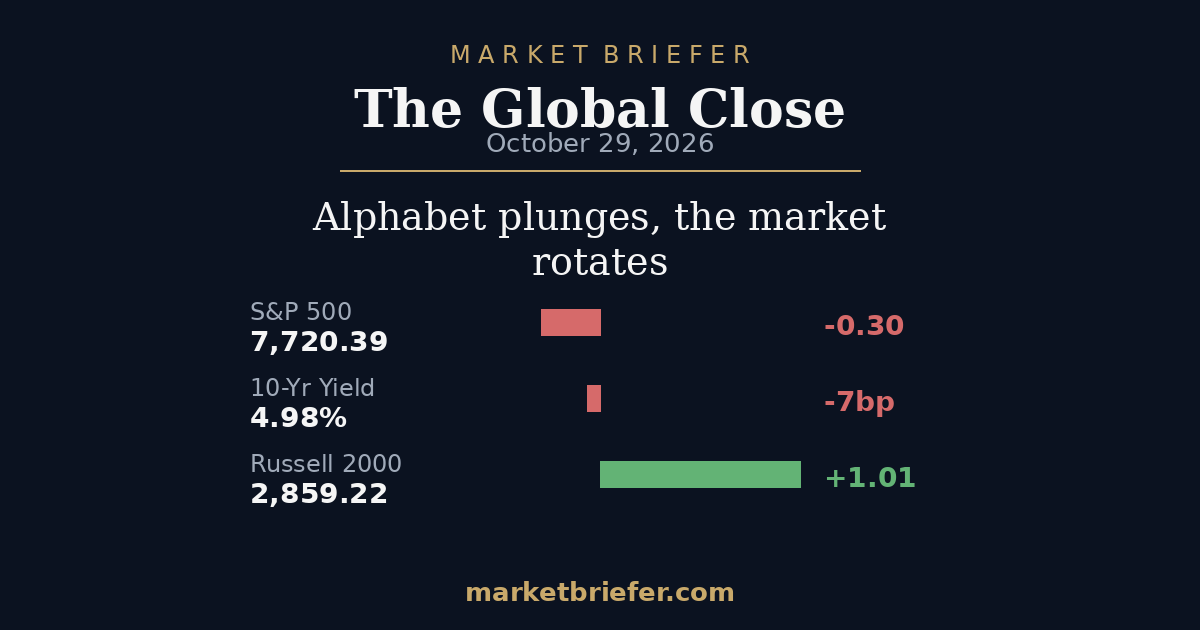
The Nasdaq fell 1.38% to 26,184.72 as Alphabet plunged 12.64% on its AI cash burn, but nine of eleven S&P sectors rose, the Russell 2000 gained 1.01%, the 10-year yield slipped back below 5% to 4.98% despite 3.4% GDP growth and core PCE inflation of 3.1%, and Europe rallied after the ECB held rates.
7 min read
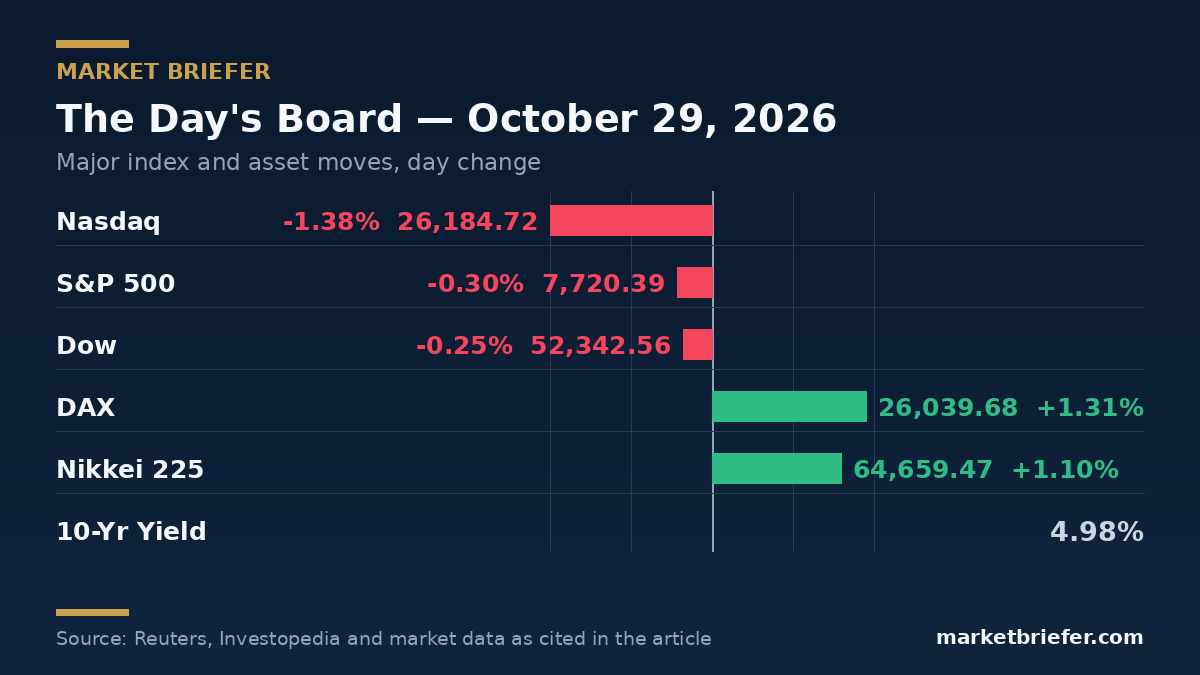
U.S. stocks closed lower on Thursday, but the headline declines hid a market that mostly rose. The Nasdaq Composite fell 365.13 points, or 1.38%, to 26,184.72 after Alphabet plunged 12.64% in the wake of its earnings, while the S&P 500 lost 23.59 points, or 0.30%, to 7,720.39 and the Dow Jones Industrial Average slipped 132.54 points, or 0.25%, to 52,342.56, weighed by a drop of more than 9% in Caterpillar. Beneath those indexes, nine of the S&P 500’s eleven sector funds rose, advancers outnumbered decliners on both major exchanges, and the small-cap Russell 2000 gained 1.01% to 2,859.22. The day’s economic data argued for tighter policy, not looser: third-quarter GDP grew at a 3.4% annual rate, beating the 3.2% consensus, and September core PCE inflation held at 3.1% from a year earlier, with headline PCE rising 3.6%. Yet the 10-year Treasury yield fell back below 5%, Europe rallied after the European Central Bank held rates, and the selling stayed concentrated where the AI spending bill came due.
The Number That Matters: 4.98% — the closing yield on the 10-year Treasury, down roughly 7 basis points on the day. It matters more than Alphabet’s plunge because it fell on a morning when growth beat forecasts and inflation stayed well above the Federal Reserve’s 2% goal, a combination that should have pushed it higher after Wednesday’s close at 5.05%. Its retreat below the 5% line is what let the rest of the market breathe: lower long yields ease the discount rate on equities and the borrowing costs tied to it, which is why small caps and rate-sensitive shares could advance while megacap technology fell. A decisive move back above 5.05% on Friday’s employment cost data would make that release, rather than the yield itself, the more important signal.
A megacap rout that most of the market sat out
Alphabet was the day’s story in the United States, and the reason was cash, not demand. Revenue grew 25% and Google Cloud revenue more than doubled, rising 103%, but free cash flow turned negative by $9.1 billion as AI capital spending mounted, and the shares fell 12.64%. The damage spread through the AI complex: ServiceNow plunged about 27%, Fortinet lost more than 20%, Marvell Technology fell 13.24% after a Bloomberg report that it is in advanced talks to acquire optical products maker Lumentum, and memory names Micron and SanDisk each fell around 5%. Communication services was the S&P 500’s weakest sector, down 1.87%, and technology fell 1.18%. Microsoft edged lower despite the strong cloud results it reported Wednesday evening, and Amazon fell more than 4% ahead of its own results after the bell. The full index board is on our Markets desk.
The other side of the tape was genuinely strong. Health care led the market, gaining 2.40%, as Eli Lilly rose 6.63% after raising its full-year revenue outlook on the strength of its obesity and diabetes treatments, and Merck gained about 4%. Chipotle jumped nearly 9% after its results, DoorDash rose 5.6% on news it is buying delivery rival Instacart for $17 billion in cash and stock, and eBay added almost 3%. That breadth is the day’s central fact: this was a repricing of a handful of very large AI spenders, not a broad loss of confidence, and it arrived alongside data that gave investors no reason to expect relief from the Fed. With the policy rate held at 3.75% to 4.00% on Wednesday in a 10–2 vote, traders still saw about an 80% likelihood of a quarter-point hike at the December meeting, according to CME FedWatch. Weekly jobless claims fell to 194,000, underscoring a labor market that is not cracking.
Europe rallied on an ECB hold while Asia split
Europe had its best day of the week. The pan-European STOXX 600 rose 0.83% to 649.43 after the ECB kept its deposit rate at 2.50%, pausing its run of hikes while warning that higher energy prices create upside risks for inflation. Germany’s DAX climbed 1.31% to 26,039.68, its fourth straight gain, helped by strong moves in Adidas, Bayer and Deutsche Bank, while France’s CAC 40 rose 1.05% to 7,970.00 and London’s FTSE 100 added 0.26% to 10,722.07. Autos were Europe’s strongest sector for a second day, rising 1.57%, and banks were the only decliners, easing 0.22%. The day’s other European news was institutional: ECB President Christine Lagarde confirmed she will step down early, leaving her post in February, and Reuters reported that ECB policymakers see a December rate hike followed by a pause — a path that kept the euro firm even as the central bank stood still.
Asia split along the chip trade. Japan’s Nikkei 225 rose 705.28 points, or 1.10%, to 64,659.47 as semiconductor names extended their run into Friday’s Bank of Japan decision. India’s Nifty 50 climbed 237.90 points, or 1.05%, to 22,936.75, with the Sensex up 1.24% to 74,151.04 as Mumbai shrugged off Wednesday’s decline. Australia’s ASX 200 rose 44.50 points, or 0.50%, to 8,891.80. The losers were the markets most exposed to the previous day’s excesses: South Korea’s KOSPI fell 1.24% to 5,937.66 after Samsung Electronics’ results cooled the rally that had carried it up 6.63% a day earlier, Hong Kong’s Hang Seng lost 136.18 points, or 0.59%, to 22,958.65, and the Shanghai Composite fell 0.82% to 3,651.43, with China’s CSI 300 down about 1% to 4,041.84.
Yields eased, the dollar softened, and oil’s risk premium wobbled
In rates and currencies, the bond market refused to follow the data’s hawkish script. The 10-year yield fell to 4.98% and the 2-year eased to about 4.61%, a move our explainer on why bond yields move stocks frames as the market pricing the December hike as likely but not yet a cycle. The dollar index slipped 0.25% to 101.93, with the euro up to $1.1179, sterling at $1.3378 and the dollar at 157.67 yen ahead of the Bank of Japan. Credit markets printed no verified spread move we can source by publication time, though the week’s background concern remains AI-linked borrowing: Bloomberg has reported insurers, pension funds and direct lenders lifting exposure to data-centre debt just as public credit markets show early signs of strain absorbing the volume of AI issuance — the same spending wave that Alphabet’s cash flow laid bare in equities.
Energy held its risk premium without extending it. WTI crude settled near $102 a barrel, little changed, while Brent fell 3.28% to $111.54 on the site’s delayed feed, easing even as Iran’s Revolutionary Guards said three tankers had hit mines south of the Strait of Hormuz and British maritime officials reported one vessel on fire without confirming the cause; no source established a full closure of the strait or a sustained interruption to flows. A Wall Street Journal report that Vice President JD Vance had written to Iranian security chief Mohsen Rezaei hoping to restart peace negotiations gave traders a diplomatic counterweight to the mine claims, and the energy board is tracked on our Commodities desk. Gold slipped 0.45% to $4,033.30 an ounce and copper eased 0.78% to $6.59, while U.S. natural gas fell toward $2.90. Crypto followed the megacap mood lower: Bitcoin dropped 2.34% to $79,287, back below the $80,000 line, and Ethereum fell 3.46% to $2,279.
What Would Change This Read: This interpretation would weaken if the 10-year yield climbs back above 5.05% while the Russell 2000 gives up Thursday’s gain, suggesting the advance outside megacap technology was a one-day yield dip rather than a durable rotation. In particular, watch Friday’s employment cost index and the regular-session reaction to Amazon’s and Intel’s after-hours declines, because they would distinguish between the current interpretation — a cash-flow test applied to a few AI spenders while the wider market absorbs a hawkish Fed — and the alternative explanation, that Thursday’s breadth was simply the calm before the repricing spreads.
What to watch tomorrow
Friday closes the central-bank week. The Bank of Japan concludes its meeting and publishes its Outlook Report, with its policy rate expected to stay at 1.25%; the yen’s sensitivity here is not theoretical — the BoJ’s surprise increase in late July 2024 triggered a sudden unwind of the yen carry trade that briefly drove Bitcoin below $50,000 on August 5 of that year. In the United States, the third-quarter employment cost index is expected to rise 0.8%, down from 0.9%, and Amazon’s and Intel’s results — both stocks fell by double digits in after-hours trading Thursday, according to investingLive — get their regular-session verdict. Europe publishes flash third-quarter GDP and preliminary October inflation for Germany and France, and a monthly Bitcoin options expiry adds a volatility risk to crypto. Asia opens first, with Tokyo’s reaction to the BoJ the earliest signal of whether the chip rally survives the weekend.
This is not investment advice. The Global Close is AI-assisted market research produced with automated data checks; figures are verified against market-close reports and the site’s delayed data feeds at publication time.