The Global Close: October 28, 2026 — Fed holds, the 10-year does the tightening
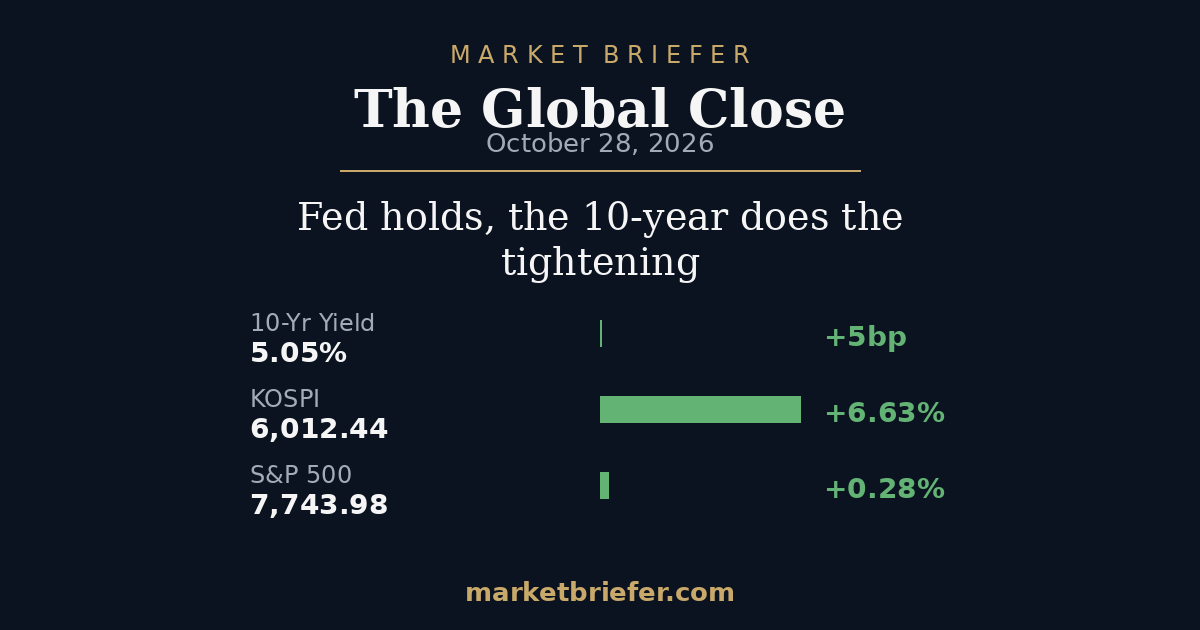
The S&P 500 rose 0.28% to 7,743.98 as the Fed held rates at 3.75%–4.00% in a 10–2 vote, the 10-year yield climbed to 5.05%, the KOSPI surged 6.63% on SK Hynix, and Brent settled near $115 after a claimed refinery strike.
7 min read
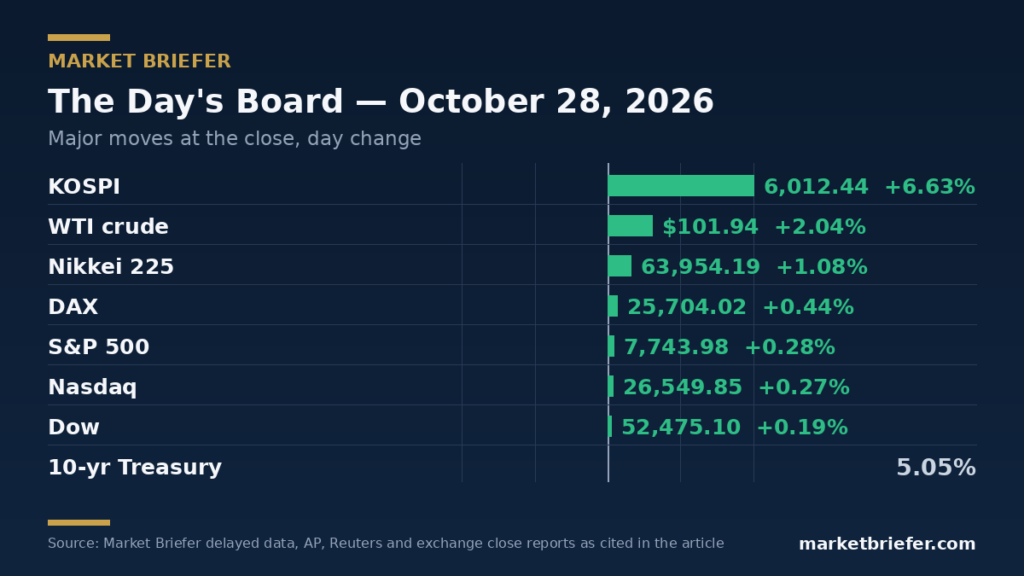
U.S. stocks closed modestly higher on Wednesday after the Federal Reserve held its benchmark rate at 3.75% to 4.00% and left the tightening to the bond market, where the 10-year Treasury yield rose 5 basis points to 5.05%. The S&P 500 added 21.38 points, or 0.28%, to 7,743.98, the Nasdaq Composite climbed 72.04 points, or 0.27%, to 26,549.85, and the Dow Jones Industrial Average rose 97.53 points, or 0.19%, to 52,475.10. Chip stocks carried the session on both sides of the Pacific after South Korea’s SK Hynix posted record results — Seoul’s KOSPI surged 6.63% — while oil climbed on a claimed missile strike against Saudi Arabia’s largest refinery, with Brent settling near $115 a barrel. With two officials dissenting in favor of an immediate hike and futures pricing roughly an 85% chance of a December increase, borrowers face a long end of the curve that keeps moving against them even when the committee stands still.
The Number That Matters: 5.05% — the closing yield on the 10-year Treasury. It matters more than the Fed’s widely expected hold because it is the rate that actually prices mortgages, corporate bonds and equity valuations, and it rose on a day when the policy rate did not move at all. The transmission ran through the whole session: a steeper curve, with the 2-year easing to about 4.70% after Chair Kevin Warsh’s press conference while the 10-year and 30-year pushed higher, kept pressure on rate-sensitive shares even as the headline indexes advanced. A decisive break in Thursday’s inflation data — the September PCE price index — would make that release, rather than the yield itself, the more important signal.
Chips did the lifting in the United States and Asia
The U.S. advance was narrow and technology-led. Eight of the S&P 500’s eleven sectors rose, with technology the strongest at +0.5% and real estate the weakest at -0.7%, while the Nasdaq 100 gained 0.55% to 29,813.16 and the small-cap Russell 2000 added 0.41% to 2,830.51. Micron Technology rose 5.9% and was the strongest single force lifting the S&P 500 after SK Hynix reported bumper memory-chip results and said AI demand should outpace supply through 2030, and Oracle climbed about 11%. Outside technology, Wendy’s jumped 15.1% after Nelson Peltz’s Trian Fund Management offered to buy the chain. On the downside, Boston Scientific fell 5.8% after its current-quarter profit forecast missed expectations, and Robinhood Markets sank 3.3% after reporting weaker profit and revenue than analysts expected. The full index board is on our Markets desk.
The real force of the day, however, was in Asia, where the AI trade produced its most dramatic session of the year. South Korea’s KOSPI leapt 374.10 points, or 6.63%, to 6,012.44, reclaiming the 6,000 level as SK Hynix soared 10.9% in Seoul on its record profit and a plan to return $75 billion to shareholders. Japan’s Nikkei 225 rose 685.82 points, or 1.08%, to 63,954.19 as semiconductor equipment makers advanced. The Shanghai Composite gained 33.17 points, or 0.91%, to 3,681.47 and Hong Kong’s Hang Seng added 53.51 points, or 0.23%, to 23,094.83. India moved the other way: the Nifty 50 fell 50.90 points, or 0.22%, to 22,698.85, pressured by a 1.98% drop in the Nifty IT index — Infosys lost more than 3% — and by rising crude prices for a major oil importer, even as Jio Platforms surged nearly 27% on its listing debut.
After the close, the AI test split in two. Microsoft beat expectations — earnings of $4.92 a share against $4.72 expected, revenue of $92.3 billion, and Azure growth of 48% excluding currency effects — and its shares rose about 6% in after-hours trading. Alphabet disappointed, with earnings of $2.12 a share well below the $3.03 expected, and its shares fell about 10% after hours. The divergence sets up Thursday’s session: the market is still willing to pay for AI revenue that arrives, and quick to punish spending that does not yet show up in earnings.
Europe split, oil climbed, and the curve steepened
Europe closed mixed and mostly little changed, with Frankfurt the exception. Germany’s DAX rose 0.44% to 25,704.02, a third straight gain powered in part by Deutsche Bank’s third-quarter profit beat, while the pan-European STOXX 600 added just 0.06% to 644.09, France’s CAC 40 was flat at 7,886.96, and London’s FTSE 100 edged up 0.07% to 10,694.50 on the day of the UK Budget. Autos were Europe’s strongest sector, rising 1.33% after Stellantis’s results. Spain was the clear laggard: the IBEX 35 fell 1.45% to 18,883.50 as Santander dropped 5.59% on weaker earnings in Brazil, and Amsterdam slipped 0.37% as payments firm Adyen fell after cutting its margin goal. The Bank of Canada raised rates the same day, while New Zealand’s central bank surprised by holding, knocking about 1% off the New Zealand dollar.
The Fed’s decision itself was the day’s fixed point around which everything else rotated. The 10-to-2 vote to hold at 3.75% to 4.00% matched expectations, but the statement upgraded the economy’s expansion from “solid” to “strong,” repeated that inflation “remains elevated,” and pointedly said that “the accumulation of more information will help the Committee determine the policy stance appropriate to ensure a timely return of inflation to the Committee’s 2 percent goal.” Governor Lisa Cook and Cleveland Fed President Beth Hammack dissented, each preferring a quarter-point hike. That hawkish split lands differently because of where this cycle stands: September’s increase was the Fed’s first hike since 2023, so Wednesday’s pause is not the top of a long tightening campaign being unwound — it is a young hiking cycle catching its breath, and the bond market responded by steepening the curve rather than rallying. Warsh offered no guidance on December, and announced that from 2027 one of the Fed’s annual meetings will be devoted to broad strategy rather than a rate vote. For borrowers and homebuyers, the practical read is unchanged and concrete: the policy rate they were told about stayed put, but the 10-year yield that prices their loans closed above 5%, a level our explainer on why rising yields rattle stocks shows is where discount-rate pressure on equities and mortgage costs historically bite hardest.
In currencies, the dollar index eased 0.19% to 102.13, with the euro at $1.1159, sterling at $1.3324 and the dollar at 157.78 yen. Credit markets absorbed the Fed and the after-hours earnings split without a disorderly move; no verified spread shift or major corporate debt event crossed the wires by publication time, and we do not print spread figures we cannot source. Energy was the day’s loudest market. WTI crude rose 2.04% to $101.94 a barrel, helped by a decline in U.S. inventories, while Brent settled at $115.32, up about 1.3% from Tuesday’s $113.88 close, after Yemen’s Houthis said they had targeted Saudi Arabia’s Ras Tanura refinery — the kingdom’s largest, at 550,000 barrels a day — with a missile, a claim Riyadh had not confirmed. A Wall Street Journal report that Washington has warned Gulf states to prepare for a possible escalation after next week’s U.S. midterm elections kept the risk premium bid, and the energy board is tracked on our Commodities desk. European natural gas pushed toward a four-year high above €97 per megawatt-hour, while U.S. natural gas held above $3.00 on the December contract at $3.03. Gold rose 0.16% to $4,081.20 an ounce and copper gained 0.91% to $6.68. Crypto was quiet: Bitcoin added 0.30% to $81,149 and Ethereum rose 0.32% to $2,358.
What Would Change This Read: This interpretation would weaken if the 10-year yield falls back below 5% while oil holds above $110, suggesting today’s equity resilience is not primarily a story of markets absorbing a rate-driven tightening. In particular, watch Thursday’s September PCE reading, because a soft print alongside a sub-5% 10-year would distinguish between the current read — a hawkish Fed pause that tightens through the long end — and the alternative explanation, that Wednesday’s yield rise was positioning ahead of the data rather than a durable repricing.
What to watch tomorrow
Thursday is the week’s densest data day. The Bureau of Economic Analysis publishes the advance estimate of third-quarter GDP and the September personal income and outlays report, including the PCE price index — the Fed’s preferred inflation gauge. The European Central Bank delivers its own rate decision, U.S. energy traders get the weekly EIA inventory report, and the after-hours split between Microsoft and Alphabet will be tested in regular trading, with more Big Tech results still to come and the Bank of Japan’s decision following on Friday. Asia opens first, and its chip complex — after the KOSPI’s 6.63% surge — will show whether the SK Hynix shock has follow-through or was a one-day detonation.
This is not investment advice. The Global Close is AI-assisted market research produced with automated data checks; figures are verified against market-close reports and the site’s delayed data feeds at publication time.