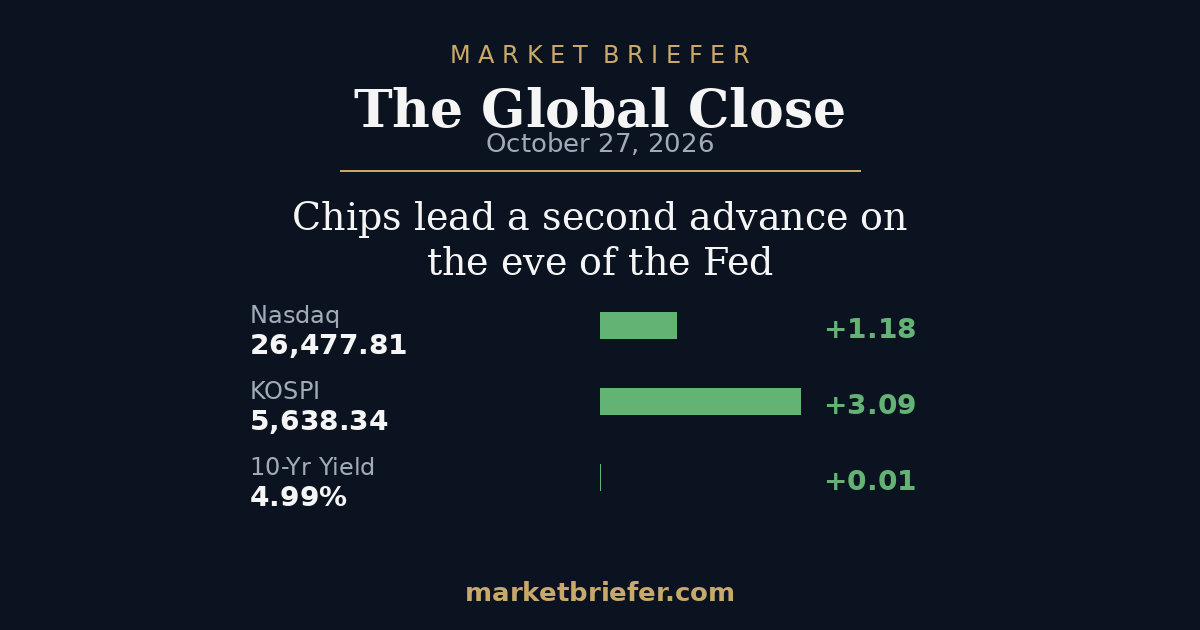
The Global Close: October 27, 2026 — Chips lead a second advance on the eve of the Fed
The S&P 500 rose 0.60% to 7,722.60 and the Nasdaq gained 1.18% as semiconductors climbed 3% on the eve of the Fed decision, Europe advanced outside London, and a $63 billion Anthropic financing package showed how the AI build-out is now funded.
7 min read
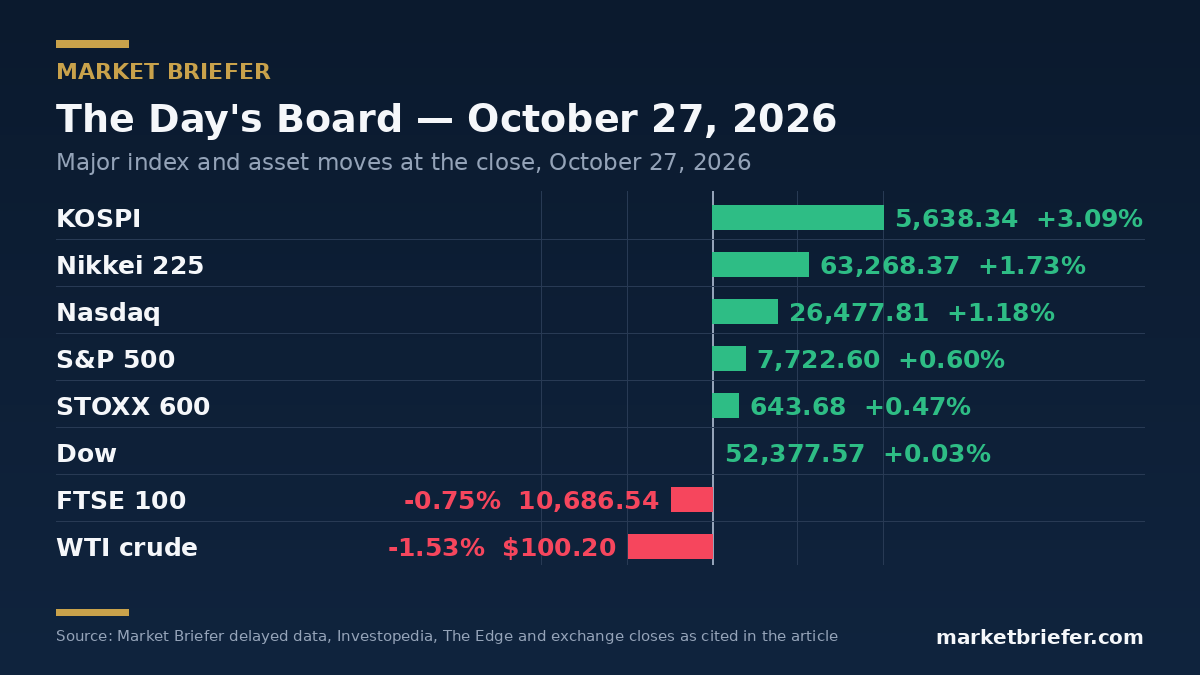
Technology carried markets for a second straight day on Tuesday, and Asia and most of Europe came with it. The S&P 500 rose 45.83 points, or 0.60%, to 7,722.60, the Nasdaq Composite gained 308.43 points, or 1.18%, to 26,477.81, and the Dow Jones Industrial Average added just 15.99 points, or 0.03%, to 52,377.57, held back by a near-11% fall in Boeing after its quarterly loss, Investopedia reported. Semiconductors climbed about 3% as the artificial intelligence trade extended Monday’s Anthropic-led rebound, and consumer confidence jumped to 91.7 in October from a revised 84.2 in September, against forecasts near 81. Europe’s STOXX 600 added 0.47% to 643.68 and Japan’s Nikkei 225 rose 1.73% to 63,268.37, while London sat the rally out ahead of Wednesday’s budget. Oil eased again as diplomacy around Iran kept a lid on the war premium, with WTI crude at $100.20 a barrel in Market Briefer’s delayed data, and the 10-year Treasury yield held at 4.99%, just below the 5% line that has governed this month. Everything now waits on Wednesday: the Federal Reserve’s decision at 2:00 p.m. ET and earnings from Microsoft and Alphabet after the close. Those with most at stake remain borrowers and homebuyers, whose costs track that 10-year yield, and the chip and platform shareholders whose spending plans will be graded company by company over the next two evenings.
The Number That Matters: $63 billion — the financing package announced for Anthropic’s computing capacity. Bank of America, Blackstone, Citi and Morgan Stanley announced a $63 billion transaction for Broadcom computing capacity for Anthropic, with deliveries expected to start in 2027, according to the day’s closing market recap. The figure matters more than the Nasdaq’s 1.18% gain because it shows where the AI build-out’s money is now coming from: a day after Meta Platforms’ planned $95 billion equity raise — into which Nvidia said it will invest $3 billion, Investopedia reported — the expansion is being funded through structured, bank-arranged packages and supplier equity as much as through conventional borrowing at a 10-year yield near 5%. That financing chain is what transmits the AI story into credit markets, chip orders and shareholder dilution at once. Strong Microsoft and Alphabet cash generation on Wednesday would make their internal funding, not these external packages, the more important signal.
United States
The advance was narrow at the top. Technology was the best S&P 500 sector, up 1.70%, and semiconductors rose 3.02%, with the iShares Semiconductor ETF ending almost 4% higher and the Roundhill Memory ETF up roughly 4.5%, Investopedia reported; Advanced Micro Devices and Broadcom were among the chip leaders. Energy was the worst sector, down 2.05% as crude fell, and six of the 11 sectors declined in all. The Russell 2000 rose 1.16% to 2,818.87, yet the equal-weight S&P 500 gained only 0.11%, a reminder that the largest names still did most of the work. The CBOE Volatility Index fell about 5% to around 17.5. The close leaves the S&P 500 about 1.2% below its October 6 record close of 7,819.04 in our own archive — close enough that Wednesday’s Fed language and the evening’s earnings will decide whether the record is tested this week. Our markets desk tracks the full sector board.
Earnings supplied the sharpest single-stock moves. Boeing fell 10.69% after reporting a quarterly loss, single-handedly explaining most of the Dow’s flat finish. Tesla rose about 4%, extending Monday’s 5% gain, while Meta slipped about 1.5% for a second day as investors weighed the dilution in its equity raise, and Nvidia added almost 1% alongside its $3 billion commitment to that offering. Among reporters, JetBlue Airways soared 19%, SoFi Technologies surged 13%, United Parcel Service gained 6% after raising its full-year revenue outlook to about $92.6 billion, and Royal Caribbean jumped 6.5%, while Coca-Cola fell about 1.6% despite a raised full-year guide, and Sherwin-Williams lost 3%. The day’s data argued against a weakening consumer: September durable goods orders rose 1.8%, and the confidence rebound was credited in part to easing gasoline prices. Housing stayed the soft spot, with September new-home sales at a 676,000 annual pace, down 0.6% on the month and 5.3% on the year — the split our explainer on how mortgage rates are actually set traces back to that same near-5% long yield.
No verified investment-grade or high-yield spread print from FRED or a market-close report was available at publication time, so no spread figure is reported here. The day’s credit story was, again, the AI financing machine itself: the $63 billion Anthropic capacity package arranged by four of Wall Street’s largest institutions, structured around future deliveries rather than a conventional bond sale, alongside Nvidia’s equity participation in Meta’s raise. At benchmark yields near 5%, the build-out is being financed by whoever can structure around the rate — banks, asset managers and suppliers — rather than by issuers simply paying it.
Europe and Asia
Europe advanced for a second day, but the leadership rotated. The STOXX 600 rose 0.47% to 643.68 and the Euro Stoxx 50 added 0.79% to 6,164.69, with basic resources up 2.08% and technology up 1.99% leading, while autos and parts fell 1.15% and oil and gas lost 0.85% as crude eased. Germany’s DAX gained 0.71% to 25,590.77, led by Infineon, up 4.8% on the same semiconductor momentum that drove New York and Seoul, and Siemens Energy, up 4.4%, while Mercedes-Benz fell 3.9% after cutting its earnings outlook on weaker Chinese demand. France’s CAC 40 rose 0.51% to 7,887.14 and Italy’s FTSE MIB led with a 0.90% gain to 49,627.95. London was the lone decliner: the FTSE 100 fell 0.75% to 10,686.54 after HSBC closed 5.42% lower on third-quarter revenue of $18.6 billion that missed the $18.93 billion analysts expected, CNBC reported, even as pretax profit rose 32% to $9.63 billion and the bank announced a buyback of up to $1 billion. Reckitt fell 4.85%. The fall landed a day before the chancellor’s first budget, with higher borrowing costs having cut the government’s fiscal headroom and banks among the sectors investors expect the budget to reach.
Asia’s session belonged to the chip trade. South Korea’s KOSPI rose 3.09% to 5,638.34, triggering a program-trading sidecar, after third-quarter GDP grew 1.0% on the quarter against a 0.7% forecast, with SK Hynix up 7% and Samsung Electronics up 4.8%, the Associated Press reported. Japan’s Nikkei 225 climbed 1.73% to 63,268.37 as Advantest jumped more than 10% and SoftBank Group rose about 7%. Australia’s ASX 200 added 0.46% to 8,850.10. China and Hong Kong lagged: the Hang Seng fell 0.73% to 23,041.32, pressured by HSBC’s results, the Shanghai Composite dropped 1.33% to 3,648.30 and the Shenzhen Component lost 2.50%, as investors awaited word from the Communist Party’s plenum in Beijing. India’s Nifty 50 was essentially flat, down 0.02%.
Rates, currencies and commodities
Treasury yields barely moved for a second day, because the argument is no longer about Wednesday’s decision — futures price only about a 7% chance of a hike this week, according to CME data cited by Investopedia — but about what the Fed signals for December after September’s increase. The 10-year yield ended at 4.99% and the 30-year at 5.31% in Market Briefer’s delayed data, with the 2-year around 4.70%, as the Federal Open Market Committee opened its two-day meeting. The dollar firmed, with the Dollar Index at 102.37 in the delayed data, EUR/USD at 1.1131, GBP/USD at 1.3305 and USD/JPY at 157.93, the yen softening ahead of Japan’s central bank decision on Friday.
Oil gave back more of its premium as the Tehran diplomacy continued and traders watched Israel’s parliamentary elections. WTI crude fell to $100.20 a barrel in Market Briefer’s delayed data and Brent eased to $109.74 on the same feed, with front-month futures also lower, down about 1.7% in the reports. Gold rose 0.86% to $4,073.10 an ounce, copper added 2.35% to $6.66 and natural gas was the board’s outlier, up 17.79% to $3.07 in the delayed data. The full board is on the commodities desk. In crypto, Bitcoin rose 1.15% to $80,909 and Ethereum gained 1.74% to $2,350 in Market Briefer’s CoinGecko-sourced data, a session after Bitcoin slipped below $80,000.
What Would Change This Read: This interpretation would weaken if Microsoft and Alphabet report on Wednesday with cloud and AI revenue growth clearly outrunning their capital spending while Meta’s equity tranches price without further share weakness, suggesting the build-out can fund itself from cash flow and the $63 billion package is a one-off rather than the new template. In particular, watch the 10-year yield’s reaction to the Fed’s statement, because a decisive break above 5% alongside strong earnings would distinguish between the current interpretation — that financing structure, not demand, is the AI trade’s constraint — and the alternative that rates alone set the ceiling.
What to watch tomorrow: Wednesday, October 28 is the week’s centre of gravity: the Federal Reserve’s decision at 2:00 p.m. ET, the United Kingdom’s budget, and Microsoft and Alphabet reporting after the close, with Visa’s results, released after Tuesday’s close, also in the mix at the open. Asia opens first, with Seoul and Tokyo taking their cue from the chip trade, and Thursday then brings the first estimate of third-quarter U.S. GDP, the September PCE price index, the European Central Bank’s decision and Amazon’s earnings.
This is not investment advice. The Global Close is AI-assisted market research produced with automated data checks; figures are verified against market-close reports and the site’s delayed data feeds at publication time.