The Global Close: November 9, 2026 — Oil slide and chip rebound power best day since April
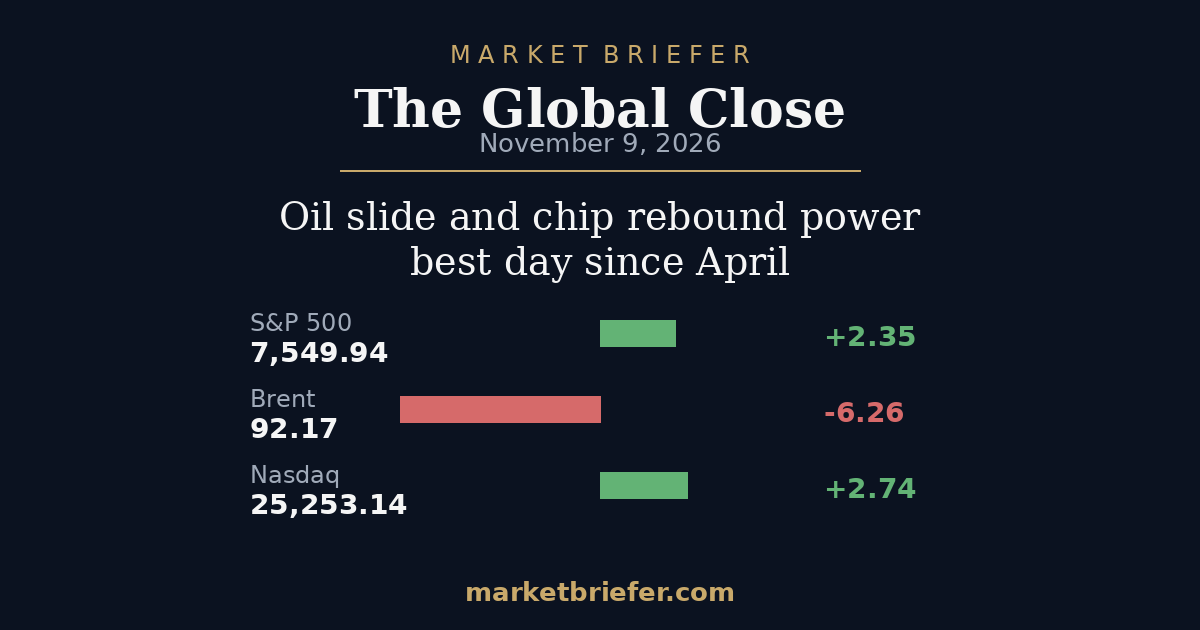
The S&P 500 jumped 2.35% to 7,549.94 for its best day since April as January Brent fell 6.26% to $92.17 on receding Iran strike risks and chipmakers rebounded from last week's rout, even as Nvidia fell 4.27%.
8 min read
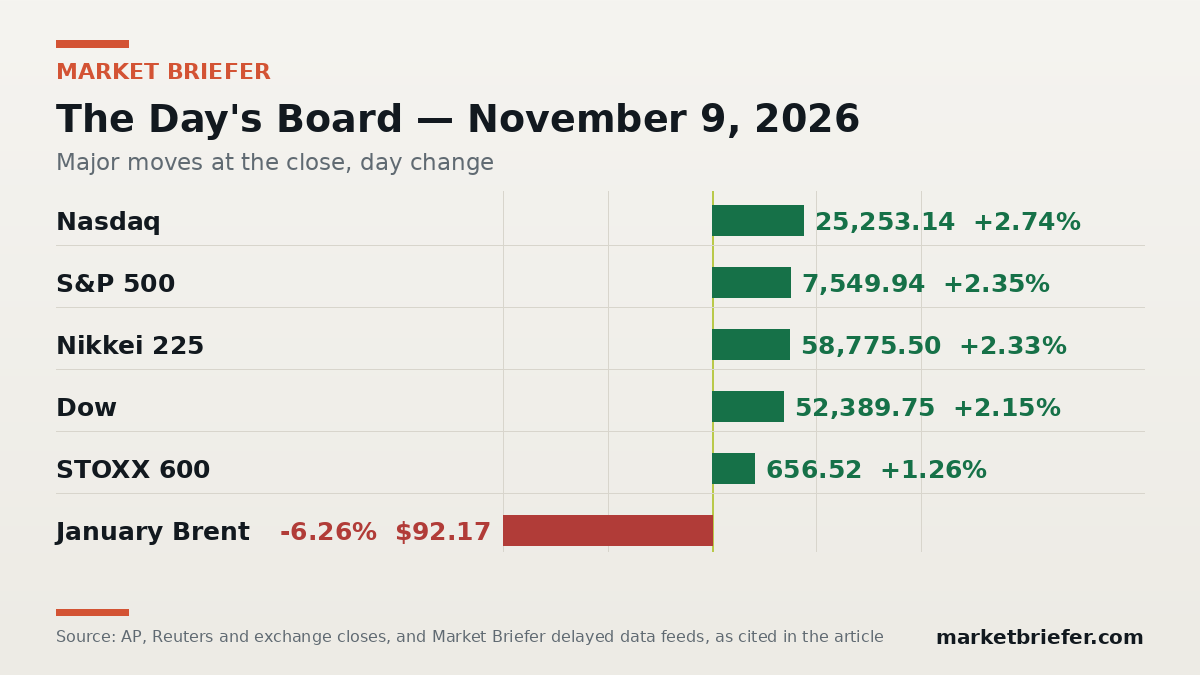
U.S. stocks rallied to their best day since April on Monday, clawing back most of last week's losses as a sharp fall in oil prices eased inflation worries and chipmakers rebounded from their worst week in more than a year. The S&P 500 jumped 173.08 points, or 2.35%, to 7,549.94, the Nasdaq Composite rallied 673.71 points, or 2.74%, to 25,253.14, and the Dow Jones Industrial Average climbed 1,104.02 points, or 2.15%, to 52,389.75. All 11 S&P 500 sectors rose, led by industrials, and advancing stocks beat decliners by 4.46 to 1 on the New York Stock Exchange, according to Reuters. The catalyst was energy: January Brent crude fell 6.26% to $92.17 a barrel in the site's delayed feed, extending a slide from above $112 at the start of the month, after President Donald Trump said in a CNN interview that new strikes on Iran were highly unlikely if negotiations progress, the Associated Press reported. Europe rose with the same tide, Tokyo rebounded 2.33% and India's Nifty 50 edged up 0.23% to 25,044.65. For fuel-sensitive businesses and borrowers alike, a barrel roughly $20 cheaper than at the start of November is the day's real story, because it loosens the inflation constraint that has kept the Federal Reserve on a hiking path into December.
The Number That Matters: $92.17. That is where January Brent crude settled in the site's delayed feed, down 6.26% on the day and roughly $20 below its early-November levels above $112. It is the key number because oil is currently the market's shortcut for inflation: cheaper crude feeds directly into fuel costs, airline and shipping margins, and the headline inflation prints the Fed watches, which is why United Airlines rose about 5.9% and cruise operator Carnival gained about 4% even as energy shares lagged the board. It matters more than the S&P 500's 2.35% jump because the equity move was substantially a reaction to it — a partial retracement of last week's rout, with the index still 3.4% below the all-time high it set in October, according to AP. A decisive break in Tuesday's October consumer price index — a hot core reading that pushes the 2-year Treasury yield sharply higher even with oil falling — would make that yield the more important signal.
The day's single story was relief arriving from the one place the market had not expected it. Last week's sell-off was built on two fears: that Democratic midterm victories could slow the AI data-center build-out, and that expensive oil would keep inflation and the Fed hawkish. Monday unwound both at once. Oil fell as the prospect of renewed U.S. strikes on Iran receded, and chip stocks — the epicenter of Thursday's rout, which had pushed the Nasdaq into correction territory — bought back aggressively, with the Philadelphia semiconductor index jumping more than 6% after a drop of about 12% last week, according to CNBC. The historical anchor is April 8, the session Monday's gain was measured against all day: then, as now, the index's best day in months came from the partial unwinding of a crowded, fear-driven sell-off, and it left the index still below its prior high with the rate question unanswered.
United States: everything rises, Nvidia falls alone
In the United States, breadth was the story. Industrials led the sectors with a gain of more than 3%, consumer discretionary also rose more than 3%, and energy gained the least as its own product fell in price, Reuters reported; it was the first session since May in which all 11 sectors closed higher together. The semiconductor rebound was emphatic: Advanced Micro Devices jumped about 13% after Oppenheimer upgraded the stock to outperform with a $600 price target, Broadcom gained nearly 9%, and the iShares Semiconductor ETF rose more than 7%, CNBC reported. Constellation Energy jumped about 10.5% after reporting profit and revenue above forecasts, while CoreWeave added 5.6%, Tesla rose more than 5% and Cloudflare closed up almost 10%. The glaring exception was Nvidia, which fell 4.27% to $178.67 — the only decliner in the Philadelphia chip index, according to Reuters — after its board opened an independent investigation tied to chief executive Jensen Huang and reports that he had been the target of a foreign intelligence effort; the company said it had no reason to believe national security or company secrets had been compromised. The New York Fed's October survey showed median one-year inflation expectations unchanged at 3.9%. Readers can follow the full board on our markets desk.
Europe built on the same relief. The pan-European STOXX 600 closed 1.26% higher at 656.52, Germany's DAX gained 446.83 points, or 1.73%, to 26,267.19, France's CAC 40 rose 94.30 points, or 1.16%, to 8,233.30, and London's FTSE 100 added 108.93 points, or 1.02%, to 10,782.87, as lower oil eased inflation worries and rising gold lifted miners, Reuters reported. Italy's FTSE MIB led the continent with a 2.69% gain, helped by a 10.7% jump in Banco BPM after Crédit Agricole proposed combining its Italian subsidiary with the lender, while UniCredit climbed about 6.3% after reporting a 24% year-over-year increase in third-quarter earnings. Basic resources was Europe's strongest sector, up 3.14%, with banks adding 2.78%.
Asia, currencies, rates and commodities
Asia's session, which closed before New York opened, was a partial rebound. Japan's Nikkei 225 rose 1,340.73 points, or 2.33%, to 58,775.50, ending five straight declines after Friday's 5.96% plunge, and Taiwan's Taiex jumped 4.94%. South Korea's Kospi fell 0.81% to 5,018.85 for a third straight loss, Hong Kong's Hang Seng eased 32.91 points, or 0.13%, to 24,448.95, and mainland China was mixed: the Shanghai Composite rose 11.61 points, or 0.32%, to 3,660.79, while the blue-chip CSI 300 inched up about 0.1% to 4,056.11, after October data showed consumer prices rising 0.7% year over year and producer prices up 5.7%. Australia's ASX 200 edged up 8.90 points, or 0.10%, to 9,029.70, and India's Nifty 50 rose 58.25 points, or 0.23%, to 25,044.65 against Sunday's special Diwali session close of 24,986.40. Singapore did not trade, on the public holiday after Deepavali.
In currencies and rates, the dollar gave back part of Friday's payrolls-driven surge. The Dollar Index fell 0.60% to 101.68 in the site's delayed feed, the euro stood at 1.1223, sterling at 1.3438 and the dollar at 157.90 yen, even as futures pricing implied roughly four-in-five odds of a December Fed rate hike. Treasury yields barely moved, because the day's forces offset each other: the 10-year yield was essentially flat at 4.86%, the 2-year rose about 5 basis points to 4.57%, and the 30-year held near 5.26%, with the full curve tracked on our U.S. dollar coverage. In credit, no verified closing investment-grade or high-yield spread figures were available from Monday's close reports, so the credit read stays with the rates themselves: front-end borrowing costs inched higher on hike pricing while the long end went nowhere. Commodities beyond oil moved the other way from crude, as our commodities desk board shows: gold rose 1.83% to $4,149.50 an ounce, silver added 3.19% to $53.46 and copper gained 2.65% to $6.38, while natural gas jumped 6.90% to $3.21. December WTI crude fell 4.90% to $86.38 a barrel in the site's feed, tracking January Brent's slide as the war premium continued to unwind; our oil prices explainer sets out how that premium builds and unwinds. In crypto, bitcoin rose 1.15% to $75,214 and ether added 0.45% to $2,133 in the site's delayed snapshot, lagging the equity rebound after a weekend slide that took both tokens to their lowest levels since August amid heavy liquidations.
What Would Change This Read: This interpretation would weaken if Tuesday's October CPI prints hot on the core measure while Brent holds below $95, suggesting today's equity pressure release was not primarily an oil-and-inflation story and that the rate path, not energy, remains the binding constraint. In particular, watch the 2-year yield's reaction to the CPI release, because it would distinguish between the current interpretation — Monday was an oil-driven repricing of inflation risk that equities correctly followed — and the alternative that the rally was simply an oversold bounce after the worst week since April 2025, which cheaper oil happened to coincide with rather than cause.
What to watch tomorrow starts with the week's verdict: October U.S. CPI at 8:30 a.m. Eastern on Tuesday, with economists expecting headline prices to rise 0.3% on the month after September's 0.6% and core prices 0.2% — the last inflation reading the Fed receives before its December meeting. Anthropic is reported to launch its Nasdaq IPO roadshow on Tuesday morning, a live test of appetite for AI listings one week after the sector's rout, and earnings this week from CoreWeave, Cisco and Applied Materials will test whether the chip rebound has results underneath it. The producer price index follows on Friday. In Asia, China releases October trade data on Tuesday, and Tokyo's open will show whether the Nikkei's rebound can hold a second day.
This is not investment advice. The Global Close is AI-assisted market research produced with automated data checks; figures are verified against market-close reports and the site's delayed data feeds at publication time.
See Market Briefer first in Google
Add to Preferred Sources