The Global Close: November 6, 2026 — Chips bounce as hot payrolls lift December hike odds
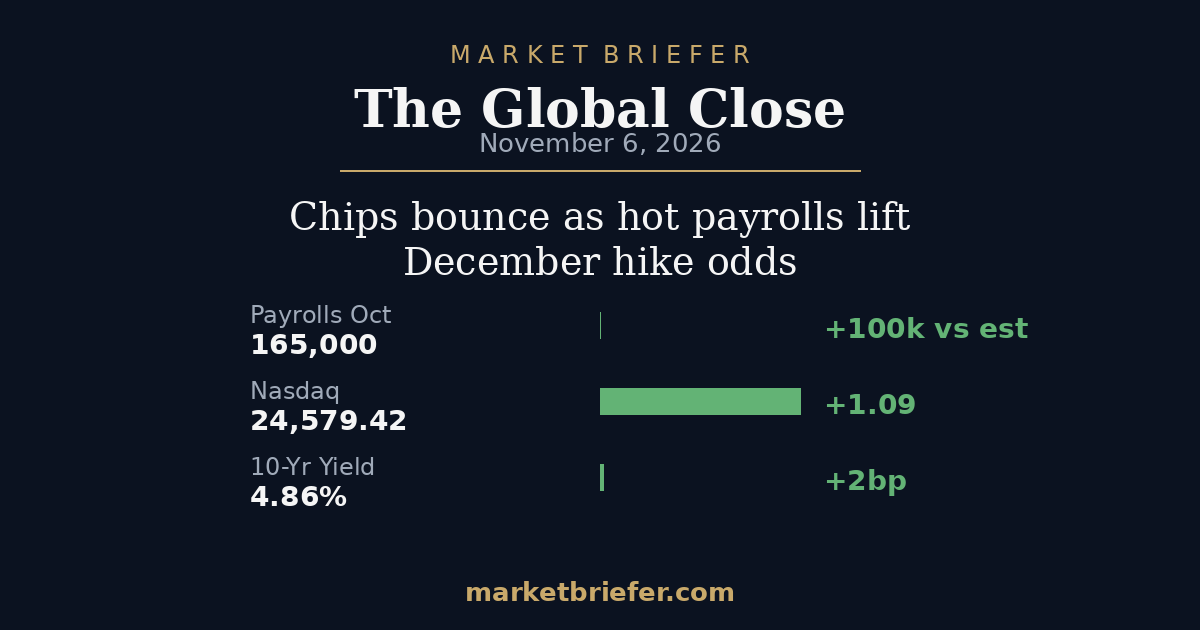
Nasdaq rose 1.09% to 24,579.42 and the S&P 500 added 0.31% to 7,376.86 as chips rebounded, while October payrolls of 165,000 lifted December Fed hike odds to about 78% and the 10-year yield to 4.86%.
7 min read
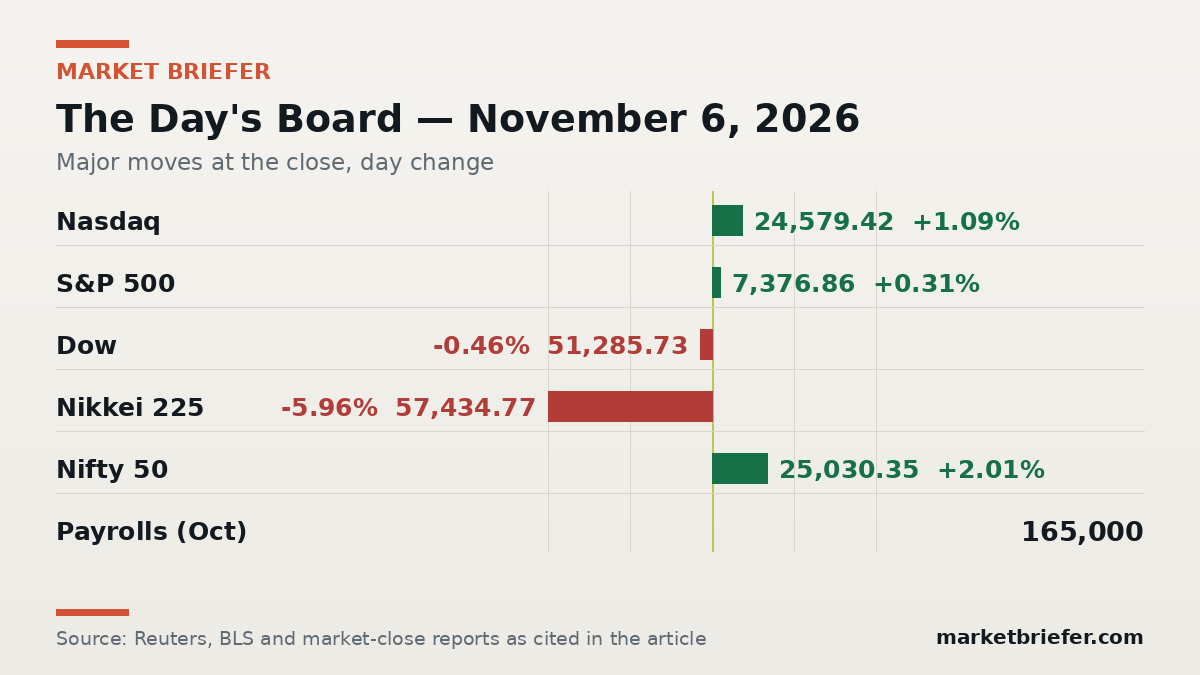
Wall Street ended a bruising week on a split note on Friday, as the Nasdaq Composite rose 264.43 points, or 1.09%, to 24,579.42 and the S&P 500 added 23.13 points, or 0.31%, to 7,376.86, while the Dow Jones Industrial Average fell 237.33 points, or 0.46%, to 51,285.73. Chip stocks recovered part of Thursday’s rout — the session that had pushed the Nasdaq into correction territory — but a far stronger than expected October jobs report lifted Treasury yields and the dollar and pushed market pricing for a December Federal Reserve rate increase to about 78%. The Russell 2000 rose 0.89% to 2,754.11 and the Cboe Volatility Index eased about 9% to 25.58, yet breadth was negative, with 297 S&P 500 stocks falling against 202 advancers, and the equal-weighted index lagged. For the week the S&P 500 fell 2.7%, the Nasdaq 3.4% and the Dow 0.9% — the S&P 500’s worst week since June. Europe and most of Asia closed before the New York rebound and fell, with Tokyo down nearly 6% and Seoul down 6%, while India’s Nifty 50 surged 2.01% to 25,030.35 against the regional tide. For borrowers, the message flipped from Thursday’s relief: a resilient labor market gives the Fed more room to raise, not less.
The Number That Matters: 165,000. That is the number of jobs U.S. employers added in October, against a Reuters consensus of 65,000, with September revised up to 60,000 from the 29,000 first reported in this column and August revised up to 186,000 — a combined upward revision of 84,000. It is the key number because it rewires the rate path every other asset traded on Friday: it pushed the 2-year Treasury yield up toward 4.52% and the 10-year to 4.86%, lifted the dollar index 0.72% to 102.28, and took the priced probability of a December hike to about 78% from about 67% to 70% before the release, according to Reuters. It matters more than the Nasdaq’s 1.09% bounce because that bounce only partly retraced a 12.25% semiconductor collapse, while payrolls — and Tuesday’s October CPI, the last inflation reading before the vote — are the final major data the Fed sees before December 8–9. A decisive fall in the 10-year yield back below 4.80% on a soft CPI print would make that yield the more important signal again.
The day’s single story was two forces pulling opposite ways, and the split close is what that looks like. Buyers returned to the AI supply chain after National Economic Council director Kevin Hassett said the Democratic wins will not stop the data-center build-out, Reuters and CNBC reported, and the semiconductor index rebounded more than 4% intraday. Against that, the jobs report argued the economy does not need relief and the Fed’s inflation fight still has a strong labor market underneath it. The anchor is Thursday itself: the Nasdaq’s 5.52% fall was its steepest in 19 months and the S&P 500’s 4.36% fall its worst since April 2025, so Friday recovered only a fraction of a policy repricing, not a trend.
United States: technology leads, the Dow lags
In the United States, technology was the only decisive winner among the S&P 500 sectors, with the technology fund up 1.45%, while consumer staples fell 1.28%, materials 0.73%, real estate 0.68% and financials 0.59%; communication services added 0.43% and industrials 0.12%, and the semiconductor fund rose 3.62%. Inside chips the rebound was broad: Advanced Micro Devices jumped 11.04%, Lam Research rose 8.23% after its board authorized a $25 billion buyback, Intel gained 7.71%, Micron rose 5.12%, Qualcomm added 5.52% and Nvidia rose 2.78%, while Tesla gained 4.23%. The losers were earnings stories: DraftKings fell 21.30%, Axon Enterprise dropped 18.18% after missing estimates and cutting guidance, Five9 fell 17.63% and Atlassian 16.15%. Space names surged — Firefly Aerospace rose 36.80% on an approximately $1.3 billion engine deal with AST SpaceMobile and Karman Holdings jumped 42.13% — while Airbnb added 11.67%, Cloudflare 9.91% and Vistra 10.55% on strong outlooks. Readers can follow the full board on our markets desk. The rest of the data softened the hike argument only slightly: the University of Michigan’s preliminary November sentiment reading rose to 51.0 from 48.0, with one-year inflation expectations easing to 4.3% from 4.7%.
Europe had no rebound to trade. The STOXX 600 fell about 1%, Reuters reported, wiping out its weekly gains in a decline led by technology shares, though it remains up more than 10% this year — ahead of the S&P 500 — because it carries less AI exposure. Germany’s DAX fell 504.65 points, or 1.92%, to 25,820.36, the steepest fall among the majors, France’s CAC 40 lost 66.37 points, or 0.81%, to 8,139.00, London’s FTSE 100 fell 108.72 points, or 1.01%, to 10,673.94, and the Euro STOXX 50 eased 0.98% to 6,170.49. Spain’s IBEX 35 fell 0.60% to 19,369.49 but finished the week up 3.84%. European yields ended the week lower — France’s 10-year fell 21.6 basis points — as Europe priced Thursday’s rout and the Bank of England’s hike to 4.00%, not Friday’s payrolls surprise.
Asia, currencies, rates and commodities
Asia amplified Thursday’s correction in the chip-heavy markets. Japan’s Nikkei 225 plunged 3,643.13 points, or 5.96%, to 57,434.77 — its worst day since April 2025 and a close more than 20% below its late-June record, in bear-market territory — as SoftBank Group fell more than 10%. South Korea’s Kospi fell 6.02% to 5,059.69 after an intraday drop above 8% triggered a circuit breaker, with Samsung Electronics down 6.35% and SK Hynix down 10.44%. Hong Kong’s Hang Seng fell 315.12 points, or 1.27%, to 24,481.86, and China’s Shanghai Composite eased 1.10% to 3,649.18. Australia’s ASX 200 slipped 44.30 points, or 0.49%, to 9,020.80, holding up far better than Tokyo or Seoul. India was the outlier in the other direction: the Nifty 50 rose 493.75 points, or 2.01%, to 25,030.35, reclaiming 25,000 as foreign inflows continued, even as India VIX jumped 12.13% to 17.47 — a market rising on flows while hedging against the global tape.
In currencies and rates, the payrolls print set the tone. The dollar index rose 0.72% to 102.28, the euro fell 0.63% to 1.1148, sterling fell 0.71% to 1.3354 a day after the Bank of England’s hike, and the dollar rose 0.36% to 158.27 yen. Treasury yields rose at the front end, where Fed expectations live: the 2-year yield climbed about 5 basis points to around 4.52% after the release and the 10-year settled at 4.86%, up about 2 basis points on the day from Thursday’s 4.84%, with the 30-year near 5.26% — the full curve is tracked on our U.S. Treasury yields page. In credit, no new investment-grade or high-yield spread figures were verifiable from Friday’s close reports, so the credit read stays with the rates themselves: benchmark borrowing costs rose on a strong jobs report, led by the front end, which is the channel through which a December hike would reach borrowers first.
Commodities were quiet after a violent week. January Brent eased 0.36% to $97.94 — a like-for-like move in the same January contract that settled at $98.29 on Thursday, not a roll effect — and WTI was flat at $90.54, holding Thursday’s rebound on the reported Hormuz tanker attacks; our oil prices explainer sets out how that war premium builds and unwinds. December gold fell 0.94% to $4,074.90 as higher yields raised the cost of holding it, silver eased to $51.97 and copper dipped 0.16% to $6.26. In crypto, bitcoin was little changed near $75,783, down 0.26%, and ether eased 0.33% to $2,227.78, stabilizing after Thursday’s slide.
What Would Change This Read: This interpretation would weaken if Tuesday’s October CPI comes in soft while the semiconductor index gives back Friday’s rebound, suggesting the market’s problem is the AI re-rating itself rather than the rate path the payrolls print repriced. In particular, watch the 2-year yield alongside CPI, because a 2-year falling back below 4.40% on the inflation data would distinguish between the current read — a strong labor market keeping the Fed hawkish while chips stabilize — and the alternative that Friday’s hike pricing was an overreaction to one payrolls print that inflation data do not confirm.
What to watch next starts with Berkshire Hathaway’s results on Saturday, then Monday brings China’s October CPI, earnings from Rocket Lab and The Trade Desk, and a $58 billion 3-year note auction. The main event is Tuesday, November 10: October U.S. CPI at 8:30 a.m. Eastern — the last inflation report before the Fed’s December 8–9 meeting, since November CPI arrives December 10, after the decision. Thursday brings jobless claims, U.K. GDP and Cisco and Applied Materials results, and Friday brings producer prices. Asia’s Monday open will show whether Tokyo and Seoul stabilize after Friday’s bear-market and circuit-breaker session.
This is not investment advice. The Global Close is AI-assisted market research produced with automated data checks; figures are verified against market-close reports and the site’s delayed data feeds at publication time.
See Market Briefer first in Google
Add to Preferred Sources