The Global Close: November 5, 2026 — Nasdaq falls into correction as chip rout erases the election rally
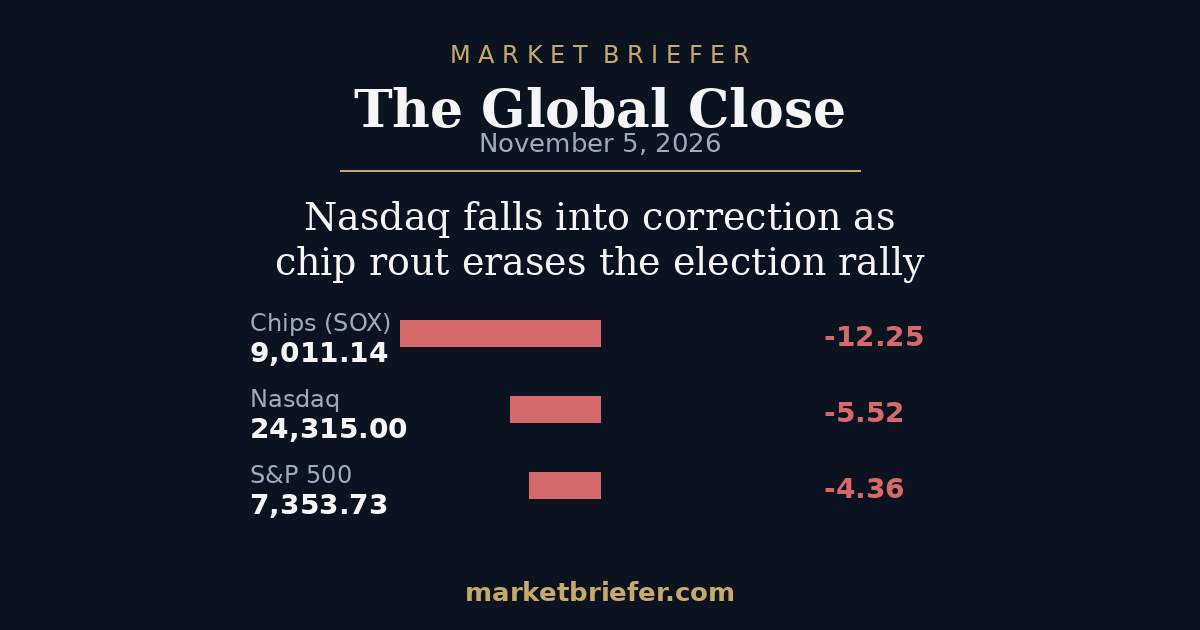
The S&P 500 fell 4.36% to 7,353.73 and the Nasdaq dropped 5.52% into correction territory as the semiconductor index collapsed 12.25% on data-center moratorium fears, more than erasing Wednesday's election rally.
7 min read
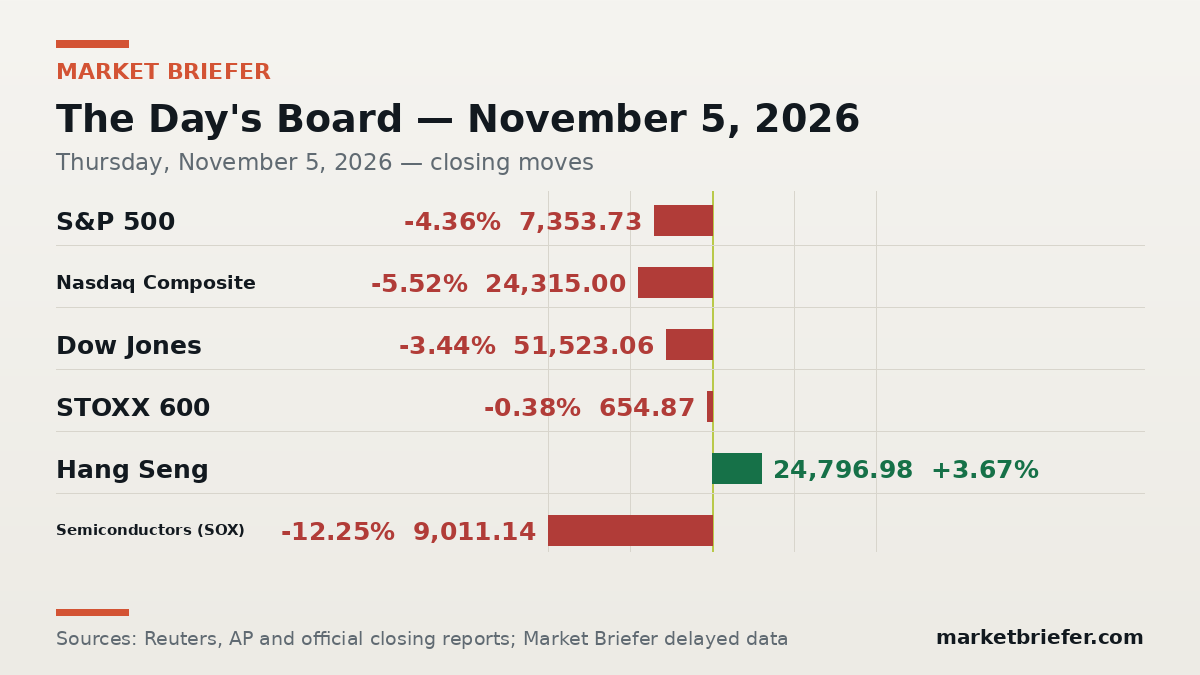
Wall Street gave back Wednesday’s election rally in a single session on Thursday, as the S&P 500 dropped 334.89 points, or 4.36%, to 7,353.73 in its worst day since April 2025, the Nasdaq Composite tumbled 1,421.52 points, or 5.52%, to 24,315.00 and the Dow Jones Industrial Average plunged 1,833.06 points, or 3.44%, to 51,523.06 — more than erasing its 1,569-point gain the day before. The Nasdaq closed in correction territory, 11.9% below its October 6 record close of 27,599.89, after investors’ second look at the election sweep focused on data-center moratoriums that could slow the AI build-out. The Philadelphia Semiconductor Index collapsed 12.25%, oil rebounded as fresh tanker attacks in the Strait of Hormuz put the war premium partly back, and the Cboe Volatility Index jumped about 69% to 28.09. Europe fell only modestly and Asia split between a 3.67% surge in Hong Kong and a 5.28% plunge in Seoul. For borrowers, the one relief was rates: the 10-year Treasury yield fell to 4.84%. Friday’s October jobs report is now the test of whether Thursday was a crowded trade unwinding or something broader.
The Number That Matters: 9,011.14. That is where the Philadelphia Semiconductor Index settled, down 12.25% in its worst day in roughly six and a half years. It is the key number because the chip index is where the repricing actually happened: fears that Democratic victories — including in Texas, where the governor-elect campaigned on a temporary data-center moratorium, alongside dozens of ballot measures limiting construction — could delay the build-out transmit directly into orders for chips, memory and power equipment, and from there into the Nasdaq and the credit of the smaller firms financing the boom. It matters more than the Dow’s 1,833 points because those losses are the consequence and the semiconductor collapse is the mechanism — UBS analysts cited by Reuters estimate roughly 30% of expected U.S. data-center capacity additions in 2028 could be at risk from construction pauses. A stabilization in the chip index back above Wednesday’s levels while the VIX falls below 20 would make the VIX the more important signal again, marking Thursday as positioning rather than re-rating.
The day’s single story was a reversal of interpretation, not of facts. Nothing about Tuesday’s result changed — Democrats still hold both chambers — but the market’s second look focused on what it had celebrated past on Wednesday: candidates who opposed data-center expansion won in Texas and Georgia, incoming senators called for brakes on AI development, and Qualcomm’s weak smartphone-chip forecast gave the reassessment a fundamental trigger, Reuters and the Associated Press reported. The historical anchor is April 2025 itself: the S&P 500’s worst day since then, and the VIX’s largest one-day jump since the days after President Trump unveiled sweeping “Liberation Day” tariffs, is a reminder that the market’s sharpest recent falls have come from policy repricing, not economic data — and Thursday’s data gave sellers no support at all.
United States: a chip-led rout with no sector spared
In the United States, all eleven S&P 500 sectors fell, with technology and consumer discretionary leading and the defensives — staples, utilities and communication services — each down less than 1%. The technology fund XLK fell 8.04%, and inside chips the damage was severe: Micron Technology fell 17.46% to $656.39, Advanced Micro Devices cratered about 17.3%, SanDisk lost more than 20%, Broadcom fell 10.43%, Nvidia dropped 9.26% to $181.60, wiping out its gains for the year according to CNN, and Qualcomm fell about 9.5%. The selling was broad — the Russell 2000 fell 4.45% and the Nasdaq 100 lost 6.36% to 26,629.81, its worst day since March 2020 — yet not indiscriminate: Apple, down about 1.5%, held up far better than its peers, and AppLovin soared 31% to $356.10 on record revenue of $2.18 billion, up 55%. Readers can follow the full board on our markets desk. The data ran against the tape: jobless claims fell to 189,000, below the 196,000 expected and the fewest since mid-July, productivity rose 3.6% against 2.8% expected, and unit labor costs fell 0.7% — a labor market holding up, not cracking.
Europe closed before the U.S. rout deepened and so recorded only its first draft. The STOXX 600 closed 0.38% lower at 654.87, pulling back from close to an all-time high earlier in the session, Reuters reported, with technology stocks down 3.2% to their lowest in nearly two months and defense a second drag as Rheinmetall fell after cutting its 2026 sales forecast for the second time in three months. Germany’s DAX eased 0.43% to 26,325.01 after touching an intraday record, London’s FTSE 100 fell 0.43% to 10,782.66, and France’s CAC 40 rose 0.34% to 8,205.37. The set piece was in London: the Bank of England raised Bank Rate by 25 basis points to 4.00%, its first increase since 2023, by eight votes to one — Catherine Mann dissented in favor of 50 basis points — and Governor Andrew Bailey said inflationary pressure in the pipeline from higher energy prices warranted the move, with a case for another increase if the Middle East conflict does not resolve quickly. The Bank expects U.K. inflation, now 3.5%, to rise toward about 5% by mid-2027 on energy’s second-round effects.
Asia, currencies, rates and commodities
Asia traded the result a full session before New York repriced it, and split along the same fault line. Hong Kong’s Hang Seng jumped 877.48 points, or 3.67%, to 24,796.98 for a fifth straight gain, India’s Nifty 50 rose 576.00 points, or 2.40%, to 24,536.60 — a sixth straight gain and its highest close in nearly three months, as Brent below $100 helped an oil importer — and Australia’s ASX 200 climbed 230.60 points, or 2.61%, to 9,065.10. China’s Shanghai Composite added 0.10% to 3,689.91. The chip-heavy markets went the other way hours before New York did: South Korea’s Kospi plunged 5.28% to 5,383.80 as Samsung Electronics and SK Hynix led an AI selloff, and Japan’s Nikkei 225 fell 1,110.73 points, or 1.79%, to 61,077.90, even as the broader Topix rose 1.16% to 3,940.39 — Thursday’s story was the AI supply chain, not Asia itself.
In currencies and rates, the flight was orderly. The dollar index was little changed near 101.48, the euro eased 0.09% to 1.1217, sterling slipped 0.17% to 1.3448 after the Bank of England’s hike, and the dollar fell 0.49% to 157.64 yen. Treasury yields fell across the curve, led by the front end: the 2-year dropped about 11 basis points to 4.47% and the 10-year fell about 5 basis points to 4.84%, near a two-month low, with the 30-year at 5.26% — bonds rallying on stress, not data. The full curve is tracked on our U.S. Treasury yields page. In credit, no new investment-grade or high-yield spread figures were verifiable from Thursday’s close reports, but the clearest credit signal came from inside the AI trade: CoreWeave’s five-year credit default swaps widened to a record high, according to S&P Global Market Intelligence data cited by Reuters — the financing channel through which an equity repricing could slow real construction.
Commodities reversed Wednesday’s direction. December WTI settled up $2.40, or 2.72%, at $90.52 and January Brent up $3.67, or 3.88%, at $98.29 — a like-for-like rise in the same January contract that settled at $94.63 on Wednesday, not a roll effect — after Reuters reported fresh tanker attacks in the Strait of Hormuz fed supply worries; our oil prices explainer sets out how that war premium builds and unwinds. Gold rose again, December futures settling 0.99% higher at $4,113.50 as lower yields cut the cost of holding it, while silver eased 0.56% to $51.83 and copper fell about 3% to $6.21 on its industrial-demand exposure. In crypto, bitcoin fell about 5.9% to near $75,900 and ether about 8.2% to $2,234, both trading as high-beta risk assets alongside the Nasdaq rather than as havens alongside gold.
What Would Change This Read: This interpretation would weaken if the semiconductor index rebounds on Friday while January Brent holds above $98 and the 10-year yield stays below 4.90%, suggesting Thursday was a one-day unwind of Wednesday’s crowded rally rather than a re-rating of the AI build-out. In particular, watch Friday’s payrolls and the chip index together, because a payrolls figure near expectations alongside a second semiconductor decline would distinguish between the current read — a policy-driven repricing of one crowded trade on a day of solid data — and the alternative that investors are pricing a broader growth and financing problem solid data can no longer offset.
What to watch tomorrow is October nonfarm payrolls at 8:30 a.m. Eastern, expected to rise by about 62,000 to 65,000 after September’s 29,000, with unemployment seen steady at 4.2%. Asia’s open will show whether Seoul and Tokyo extend the chip selloff or follow Hong Kong and Sydney’s steadier lead, and Europe must price the full U.S. rout it only glimpsed at Thursday’s close. January Brent sits just below the $100 line it lost on Wednesday; whether the Hormuz attacks continue will decide if the war premium keeps rebuilding.
This is not investment advice. The Global Close is AI-assisted market research produced with automated data checks; figures are verified against market-close reports and the site’s delayed data feeds at publication time.
See Market Briefer first in Google
Add to Preferred Sources