The Global Close: November 4, 2026 — Dow leaps 1,569 points as Democrats sweep Congress and oil collapses
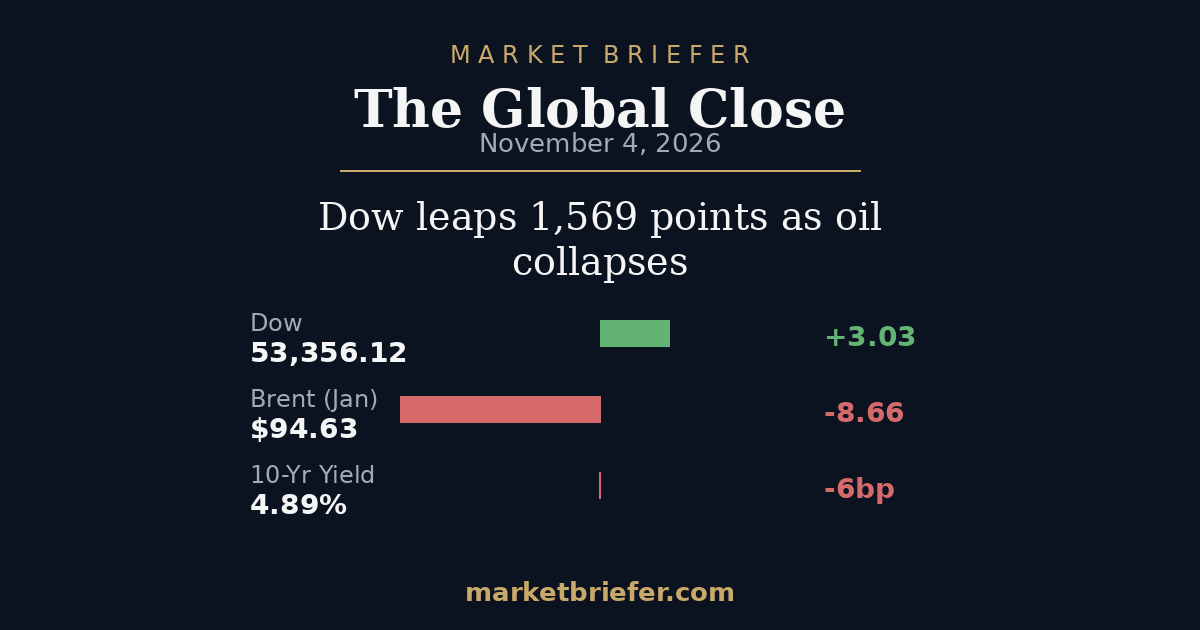
The Dow rose 3.03% to 53,356.12, its best day since April 2025, as Democrats won both chambers of Congress, January Brent fell 8.66% to $94.63 and the 10-year yield eased to 4.89%; Europe rallied to its highest since August and Asia split.
7 min read
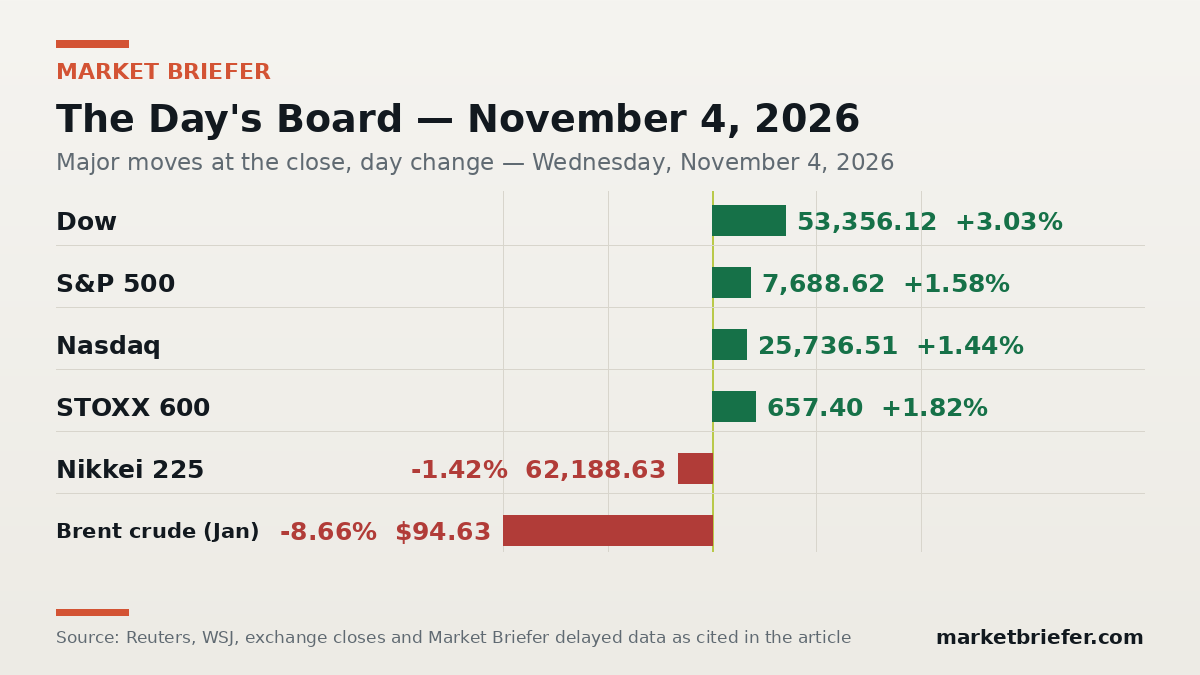
Wall Street staged its biggest rally in nineteen months on Wednesday, the day after Democrats won control of both chambers of Congress in the midterm elections, as the Dow Jones Industrial Average surged 1,569.40 points, or 3.03%, to 53,356.12, the S&P 500 rose 119.70 points, or 1.58%, to 7,688.62 and the Nasdaq Composite added 364.50 points, or 1.44%, to 25,736.51. The proximate fuel was not the vote count itself but what traders decided it meant for the war with Iran: January Brent crude collapsed 8.66% to $94.63 a barrel, December WTI fell 8.38% to $88.04, and the 10-year Treasury yield dropped 6 basis points to 4.89%, its lowest settlement in nearly two months, as investors bet that a Democratic Congress would press the administration toward a negotiated end to the war that has driven this year’s inflation. Europe rallied in full, with the STOXX 600 up 1.82% to its highest close since August, while Asia split between a 2.16% jump in Shanghai and a 1.42% fall in Tokyo. For drivers, truckers and anyone filling a tank, the day’s real news was the oil price: if the fall holds, the fuel costs that helped decide the election get cheaper. For borrowers, the 10-year at 4.89% offers modest relief, and Thursday’s Bank of England decision and Friday’s U.S. jobs report will test whether it lasts.
The Number That Matters: $94.63. That is where January Brent crude settled, down 8.66% against the same contract’s Tuesday settlement of $103.60 — a like-for-like fall in the current front month, not a contract-roll effect — and Reuters put Brent and WTI on course for their biggest weekly decline since April 2020. It is the key number because oil was the transmission mechanism for the whole session: cheaper crude cut inflation expectations, which pulled Treasury yields down across the curve, which lifted the discount-rate pressure that has weighed on equities for weeks, which is why a political result that futures initially sold — Nasdaq futures fell as much as 2.5% overnight — became the Dow’s best day since April 9, 2025. It matters more than the Dow’s 1,569 points because the index move is a consequence; the oil price is the cause that also reaches fuel bills, freight costs and the Federal Reserve’s December decision. A decisive move back above $103.60 in January Brent, reinstating the war premium, would make the 10-year yield the more important signal again.
The day’s single story was a clearing event. The midterms had hung over markets for weeks alongside the war and the cost of the AI build-out; by Wednesday morning the result was unambiguous, President Trump had accepted it, and Vice President JD Vance had publicly blamed the war with Iran for the Republican losses, according to CNBC — a combination traders read as political pressure on the White House to negotiate. The Cboe Volatility Index fell about 20% to 16.69 and nine of the eleven S&P 500 sectors rose. The historical anchor is close at hand: the Dow’s last comparable day was April 9, 2025, when it surged after President Trump paused his reciprocal tariffs — the same pattern of a political constraint on executive action being priced, within hours, as economic relief.
United States, Europe and the political repricing
In the United States, consumer discretionary led the S&P 500 sectors with a gain of about 4.2%, five sectors rose 3% or more, and energy fell about 4.8% as crude collapsed, with industrials the only other decliner as defense shares retreated — Lockheed Martin fell 7% and Northrop Grumman 4.5%, according to Investopedia. Big Tech powered the Dow: Amazon surged 7.4% to a three-month high and Apple jumped nearly 7% to a record, Reuters reported, as investors bet that Democratic opposition to new data-center construction — sharpened by the party’s win in the Texas governor’s race — could protect the incumbents’ scarce computing capacity while easing the cash-flow strain of the AI race; Microsoft, Meta Platforms and Alphabet gained between 2% and 6.3%. The other side of that trade sat in the smaller AI names: Nvidia fell 3%, Broadcom 2%, Micron and Sandisk more than 7% each, and CoreWeave plunged 10%, while 3M rose more than 9% and McDonald’s and Amgen added 6% and 4% after better-than-expected results. The day’s data ran underneath the politics: ADP said private employers added 86,000 jobs in October, above the 69,000 expected and matching September’s revised figure, and the ISM services index eased to 54.5 from 54.9, still firmly in expansion, though its prices-paid component stayed elevated at 73.0 — the detail that keeps the inflation argument alive even as oil falls. The September trade deficit was little changed at about $105 billion. Readers can follow the full board on our markets desk.
Europe took the same trade and ran it further. The STOXX 600 jumped 1.82% to 657.40, its highest close since August 14, Germany’s DAX rose 2.22% to 26,437.67, France’s CAC 40 gained 1.96% to 8,177.89 and London’s FTSE 100 added 1.79% to 10,829.21, with Madrid’s IBEX 35 up 3.00% leading the region. Banks led the European sectors, up 4.32%, while oil and gas fell 2.35% for a fourth straight decline and defense names including BAE Systems and Rheinmetall slumped on the same lower-spending logic that hit their U.S. peers; renewable energy stocks rose on hopes of a friendlier U.S. policy turn, and Novo Nordisk rallied after lifting its full-year guidance. Europe’s rally came despite its own inflation news: Eurostat put eurozone inflation at 4.0% in October, up from 3.8% in September, a three-year high driven by energy inflation of 20.8% — which is precisely why the oil collapse matters more in Europe than the election itself, and why Thursday’s Bank of England decision, with Bank Rate at 3.75% and a rise to 4.00% widely expected, remains live.
Asia, currencies, rates and commodities
Asia traded the early, incomplete version of the story and split accordingly. China’s Shanghai Composite rose 2.16% to 3,686.17 and Hong Kong’s Hang Seng gained 1.67% to 23,919.50, while India’s Nifty 50 added 0.63% to close at 23,960.60, a fifth straight gain, and South Korea’s Kospi rose 0.62% to 5,683.80. Tokyo, reopening after Tuesday’s Culture Day holiday, went the other way: the Nikkei 225 fell 1.42% to 62,188.63 against Monday’s close as chip and AI-linked shares absorbed fears that a Democratic Congress could slow AI spending, and Australia’s ASX 200 eased 0.59% to 8,834.50. In currencies, the dollar index fell 0.35% to 101.51, the euro rose to 1.1237, sterling to 1.3470, and the dollar eased to 158.35 yen from 158.71 on Tuesday. In rates, the 2-year Treasury yield fell about 3 basis points to 4.58% and the 30-year eased 4 basis points to 5.28%, the whole curve moving with oil rather than with the steady ADP jobs print — the full curve is tracked on our U.S. Treasury yields page. No new investment-grade or high-yield spread figures were verifiable from Wednesday’s close reports, so the credit read stays with the transmission itself: benchmark borrowing costs fell on the day, led by the long end.
Commodities were the story in both directions. January Brent’s fall to $94.63 and December WTI’s to $88.04 — WTI’s lowest in nearly two months — took crude below the levels that have fed this year’s inflation, and our oil prices explainer sets out how a war premium of this kind builds and unwinds. Gold rose 3.34% to $4,072.20 an ounce, back above $4,000 with its best day since August 19 by Reuters’ count, and silver jumped 5.52% to $52.33, the precious complex rising alongside equities on the weaker dollar and lower yields rather than as a hedge against them; copper added 0.51% to $6.41. In crypto, bitcoin rose 4.00% to $80,836 and ether gained 6.62% to $2,441 in late trading, both recovering with risk appetite after bitcoin’s overnight low near $76,300.
What Would Change This Read: This interpretation would weaken if January Brent rebounds back above $103.60, its Tuesday settlement, while the 10-year yield stays below 4.95%, suggesting Wednesday’s rally was an election-relief bounce rather than an oil-driven repricing of inflation and rates. In particular, watch Friday’s nonfarm payrolls and the ISM services prices-paid reading’s next print, because a hot payrolls figure alongside prices paid holding near 73 would distinguish between the current read — cheaper oil easing the inflation constraint — and the alternative explanation that domestic price pressure is now self-sustaining and would keep yields high even with oil lower.
What to watch tomorrow starts in London, where the Bank of England announces its rate decision at 7:00 a.m. Eastern with the Monetary Policy Report alongside, a 25-basis-point rise to 4.00% widely expected — its first increase since 2023 — and the vote split carrying the signal for sterling and gilts. The U.S. calendar brings weekly jobless claims, expected near 195,000 against 194,000 previously, and third-quarter productivity and unit labor costs at 8:30 a.m. Eastern, with earnings from ConocoPhillips and Airbnb. Asia’s open will be the first chance for Tokyo and Sydney to trade the completed U.S. session. Friday then brings the week’s main event: October nonfarm payrolls, expected up about 55,000 to 65,000 after September’s 29,000, with unemployment seen steady at 4.2%.
This is not investment advice. The Global Close is AI-assisted market research produced with automated data checks; figures are verified against market-close reports and the site’s delayed data feeds at publication time.
See Market Briefer first in Google
Add to Preferred Sources