The Global Close: November 3, 2026 — Nasdaq snaps its slide on midterm day as the Dow falls alone
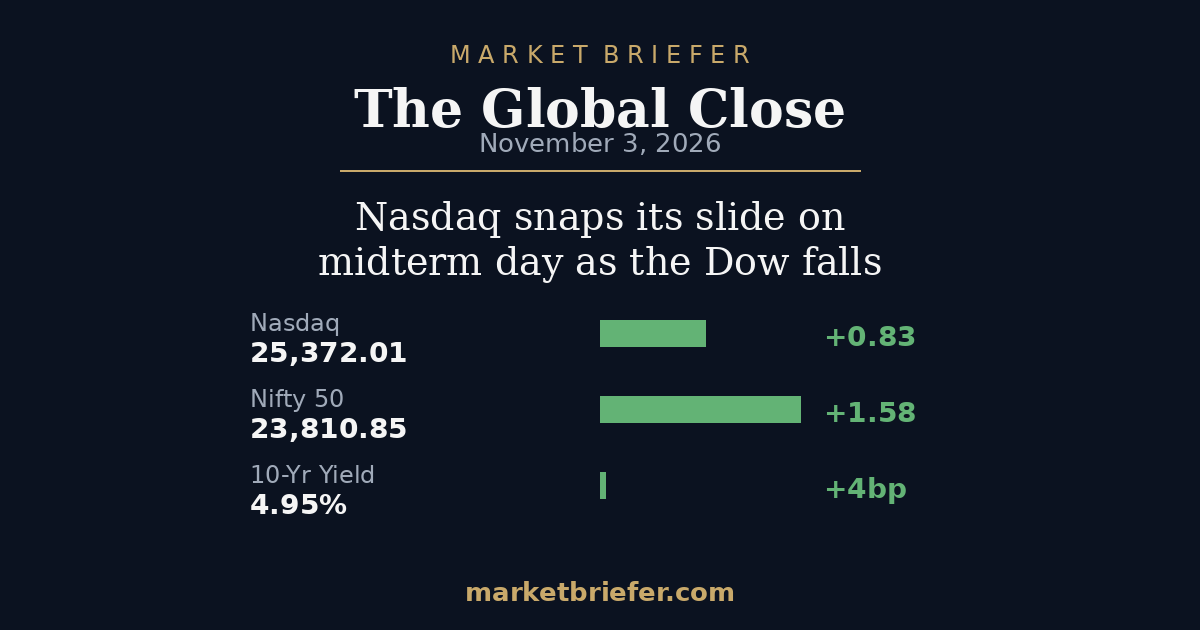
Nasdaq rose 0.83% and the S&P 500 0.36% on midterm day as chips rebounded, while the Dow fell 0.38% on a hot JOLTS report that lifted the 10-year yield to 4.95%; Europe fell across the board, Seoul and Taipei dropped 3.59%, and India's Nifty 50 rose 1.58% to 23,810.85.
7 min read
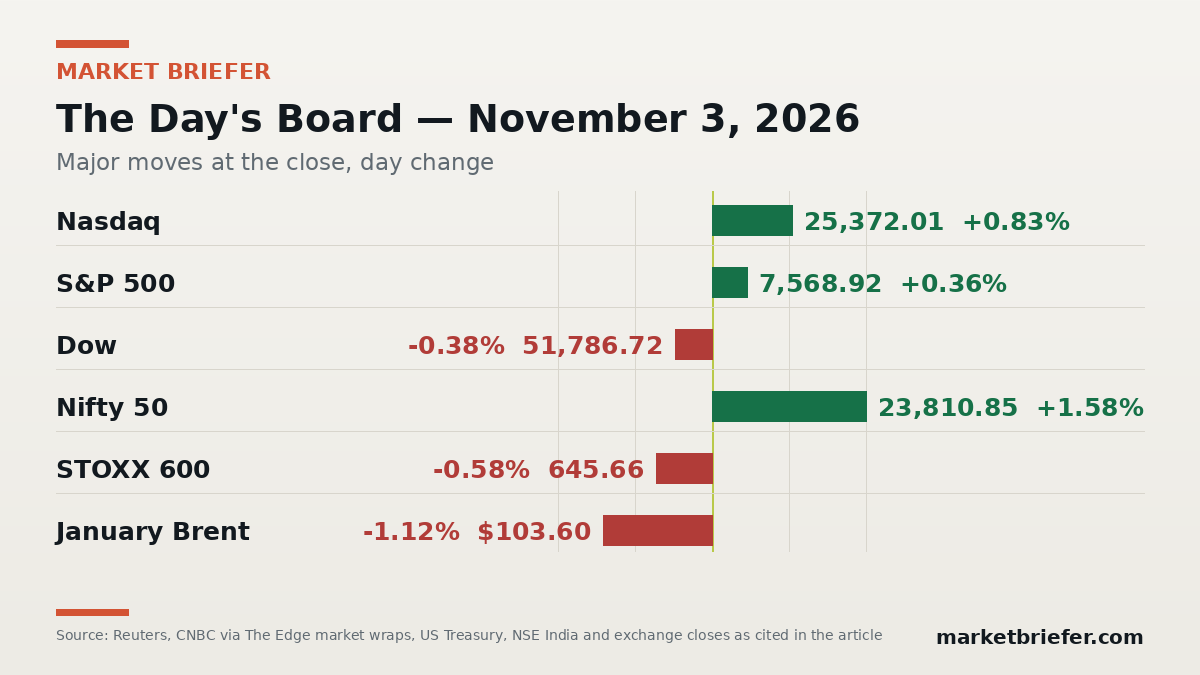
Wall Street split on midterm election day, as a rebound in the technology shares that had led three days of selling lifted the Nasdaq Composite 207.69 points, or 0.83%, to 25,372.01 and the S&P 500 27.52 points, or 0.36%, to 7,568.92, while the Dow Jones Industrial Average fell 197.26 points, or 0.38%, to 51,786.72, the only decliner among the major U.S. indexes. The catalyst mix ran in two directions at once: September job openings rose sharply and layoffs fell, a hotter-than-expected JOLTS report that pushed the 10-year Treasury yield up 4 basis points to 4.95% and pressured the rate-sensitive blue chips that dominate the Dow, even as chip stocks recovered and January Brent crude settled 1.12% lower at $103.60 on hopes of a Qatar-mediated diplomatic settlement between the United States and Iran. Europe closed lower across every major benchmark, Asia was split between a 3.59% technology-led plunge in Seoul and Taipei and a fourth straight gain in India, and voters across the United States were deciding control of Congress, with results that will not be clear until Wednesday at the earliest. For borrowers and homebuyers, the day’s message sat in the bond market rather than the stock market: a firm labor market with the 10-year at 4.95% leaves little room for borrowing costs to ease quickly.
The Number That Matters: 4.95%. That is where the 10-year Treasury yield closed, up 4 basis points, with yields 4 points higher at every maturity from five years out and the 2-year up 2 basis points to 4.61%. It is the key number because it explains the split tape: the JOLTS report said the labor market is firmer than the weak September payroll gain suggested, which steepened the curve, raised the discount rate applied to every future earnings stream, and fell hardest on the Dow’s rate-sensitive names while chip momentum carried the Nasdaq anyway. It matters more than the Nasdaq’s 0.83% rebound because that rebound happened despite the yield, not because conditions eased. A decisive fall in Wednesday’s ADP employment reading that pulled the 10-year back below 4.91%, Monday’s close, would make the labor data — not the yield itself — the more important signal.
The day’s single story was rotation reversing. Monday’s trade had taken money out of technology for a third straight session and into defensives; Tuesday ran it backward, with technology up 1.31%, industrials up 0.96% and communication services up 0.90%, while materials fell 1.93%, consumer staples lost 1.76% and financials eased 0.59% — only four of the eleven S&P 500 sectors rose, in Reuters’ count, even as the index gained. The Philadelphia chip index rose 2.6%, and the Cboe Volatility Index eased 1.51% to 20.83 after three straight rises. The context matters: on Monday the Nasdaq 100 had closed more than 10% below its all-time closing high, confirming a correction, so Tuesday’s 0.68% gain in that index was the first test of whether buyers would defend the level — they did, for one session, led by the same heavyweight names that had driven the decline.
United States, Europe and the rate path
In the United States, Apple was the Dow’s central problem, falling about 1.9% after its warning on holiday-quarter gross margins and softer iPad sales, a drag the price-weighted index could not offset even though Microsoft, Nvidia and Amazon were among its top gainers, according to Reuters. Coinbase rallied 8% after a 15% slide over the three sessions through Monday, and AMD rose sharply after reporting results that showed data-center revenue nearly doubling, with a fourth-quarter revenue forecast above Wall Street estimates. Pfizer, Archer-Daniels-Midland and Marathon Petroleum were among the morning reporters, and factory orders for September rose faster than expected, adding to the picture of an economy that, in Reuters’ phrase, is purring along rather than stalling — even as the Federal Reserve’s senior loan officer survey showed business demand for credit contracting for the first time in over a year, the day’s clearest credit signal and a reminder that tighter lending appetite, not a bond-market event, is where credit conditions are actually moving. Readers tracking how yields, jobs and credit fit together can work through the checklist in our recession signals explainer, and the full curve is updated daily on our U.S. Treasury yields page.
Europe had no such offset. The STOXX 600 fell 0.58% to 645.66, Germany’s DAX lost 0.45% to 25,864.62, France’s CAC 40 eased 0.34% to 8,020.31 and London’s FTSE 100 dropped 1.14% to 10,638.43, the steepest fall in the region, a day after closing at the top of its 52-week range and snapping four straight gains. Europe’s technology sector followed Asia’s lead with a 1.04% fall and basic resources fell hardest, down 2.39%, while in Frankfurt Bayer rose 3.48% to the top of the DAX after raising its 2026 profit forecast and Zalando fell 6.48% to the bottom. With Brent holding above $100 a barrel through the London close, inflation stayed in front of Thursday’s Bank of England decision, where Bank Rate stands at 3.75% with inflation at 3.5% — a combination that keeps pressure on European borrowers even on a day when crude itself was falling.
Asia, currencies and commodities
Asia imported Wall Street’s Monday technology unwind at full force. South Korea’s Kospi and Taiwan’s Taiex each fell 3.59%, to 5,648.79 and 43,307.54 respectively, as chip heavyweights absorbed the selloff, while China’s Shanghai Composite lost 0.82% to 3,608.10 and Singapore’s Straits Times eased 0.65% to 5,269.29. The gainers were elsewhere: India’s Nifty 50 rose 1.58% to 23,810.85, a fourth straight gain, Hong Kong’s Hang Seng added 0.57% to 23,525.97, and Australia’s ASX 200 closed 0.34% higher at 8,886.80 even as the Reserve Bank of Australia raised its cash rate 25 basis points to 4.85%, its fifth increase this year, on a six-to-three vote, warning that inflation would stay above 3% for the coming year. Tokyo’s cash market was closed for the Culture Day holiday, so there is no Nikkei 225 close for Tuesday; trading resumes Wednesday. In currencies, the dollar index rose 0.11% to 101.86, the euro edged to 1.1191, sterling to 1.3413, and the dollar rose 0.49% against the yen to 158.71, the yen weakening as U.S. yields climbed — a level that keeps imported-inflation pressure on Japanese households and export margins in focus when Tokyo reopens. More detail sits on our markets desk.
In commodities, January Brent settled at $103.60 a barrel, down 1.12% against that same contract’s Monday settlement — a second straight decline, not a contract-roll effect — while December WTI settled 0.38% lower at $96.09, as hopes for a negotiated U.S.–Iran settlement, with Qatar mediating, outweighed reports of U.S. strikes on Iran’s Qeshm Island in the Strait of Hormuz the night before. Gold fell 0.91% to $3,933.50 an ounce on the December COMEX contract, still below $4,000, and silver dropped 2.20% to $49.77, the precious complex moving with yields rather than against risk assets. In crypto, bitcoin rose 1.35% to $77,825.40 in late trading, while ether held near $2,250, still weighed by a sixth straight day of outflows from U.S. spot ether funds. Our commodities desk tracks the energy and metals boards in full.
What Would Change This Read: This interpretation would weaken if the 10-year yield falls back below 4.91% while Brent holds above $100, suggesting Tuesday’s Dow pressure was Apple-specific stock weight rather than a rate-driven move. In particular, watch Wednesday’s ADP employment figure and the ISM services prices index, because a soft ADP print alongside sticky services prices would distinguish between the current read — a firm labor market keeping yields high — and the alternative explanation that the economy is slowing while inflation stays embedded, a far worse combination for equities.
What to watch tomorrow is dense. Midterm results will arrive through the night, Tokyo reopens after Culture Day, and the U.S. calendar brings ADP employment for October at 8:15 a.m. Eastern, expected around 65,000 to 69,000 against 90,000 previously, the September trade balance, the Treasury’s quarterly refunding announcement, and the ISM services index at 10 a.m., expected at 54.8 against 54.9, with its prices and employment components carrying the signal. Eurozone flash inflation for October and final PMIs from the U.S., eurozone and Britain are also due, Brazil’s central bank announces its rate decision, and earnings include Qualcomm, Arm Holdings, McDonald’s, Uber and Toyota, ahead of Friday’s nonfarm payrolls.
This is not investment advice. The Global Close is AI-assisted market research produced with automated data checks; figures are verified against market-close reports and the site’s delayed data feeds at publication time.
See Market Briefer first in Google
Add to Preferred Sources