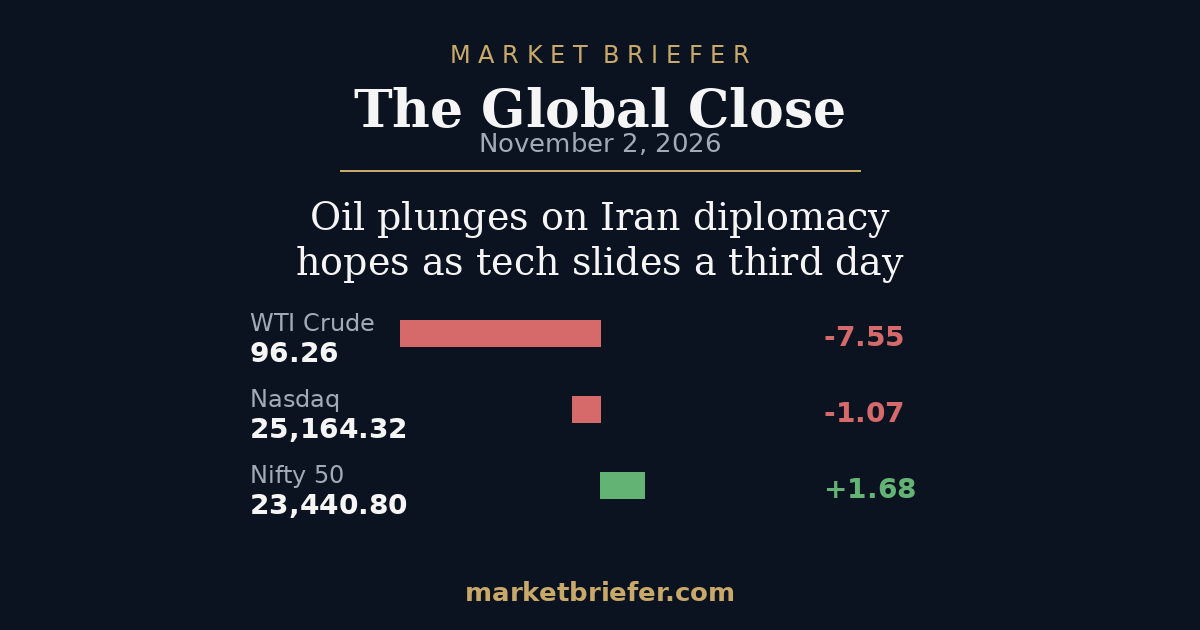
The Global Close: November 2, 2026 — Oil plunges on Iran diplomacy hopes as tech slides a third day
The S&P 500 fell 0.51% to 7,541.40 and the Nasdaq dropped 1.07% as WTI crude plunged 7.55% to $96.26 on U.S.–Iran diplomacy hopes, while the Dow rose 0.41% and India's Nifty 50 surged 1.68% to 23,440.80.
7 min read
November opened with a split decision. Oil plunged as hopes of a U.S.–Iran peace agreement pulled the war premium out of crude, technology shares fell for a third straight session, and the Dow Jones Industrial Average rose alone among the major U.S. indexes. The S&P 500 fell 38.67 points, or 0.51%, to 7,541.40, the Nasdaq Composite dropped 272.68 points, or 1.07%, to 25,164.32, and the Dow added 213.67 points, or 0.41%, to 51,983.98. Europe closed higher as cheaper energy eased inflation concerns, Asia finished mixed with India’s Nifty 50 surging to a one-month high, and gold rebounded 1.48% to $3,956.60 after Friday’s slide to its lowest level in more than a year. What matters next arrives quickly: Apple and Palantir reported after the bell on Monday, and U.S. voters decide control of Congress in Tuesday’s midterm elections.
The Number That Matters: $96.26. That is where WTI crude settled, down 7.55% on the day, after Iran signalled it was open to peace talks and reports from the Qatar-mediated discussions in Doha raised the prospect of the Strait of Hormuz reopening. Oil was the transmission mechanism for the whole session: the drop carried the S&P 500 energy index down 4%, pulled longer-dated Treasury yields lower as inflation pressure eased, and lifted fuel-sensitive shares from Madrid to Mumbai. It mattered more than the Nasdaq’s third straight decline because it repriced the inflation path that every other asset is discounting. A decisive break down in the Doha talks that sent crude back above $104, Friday’s settlement, would make the war premium — not the peace dividend — the number that matters again.
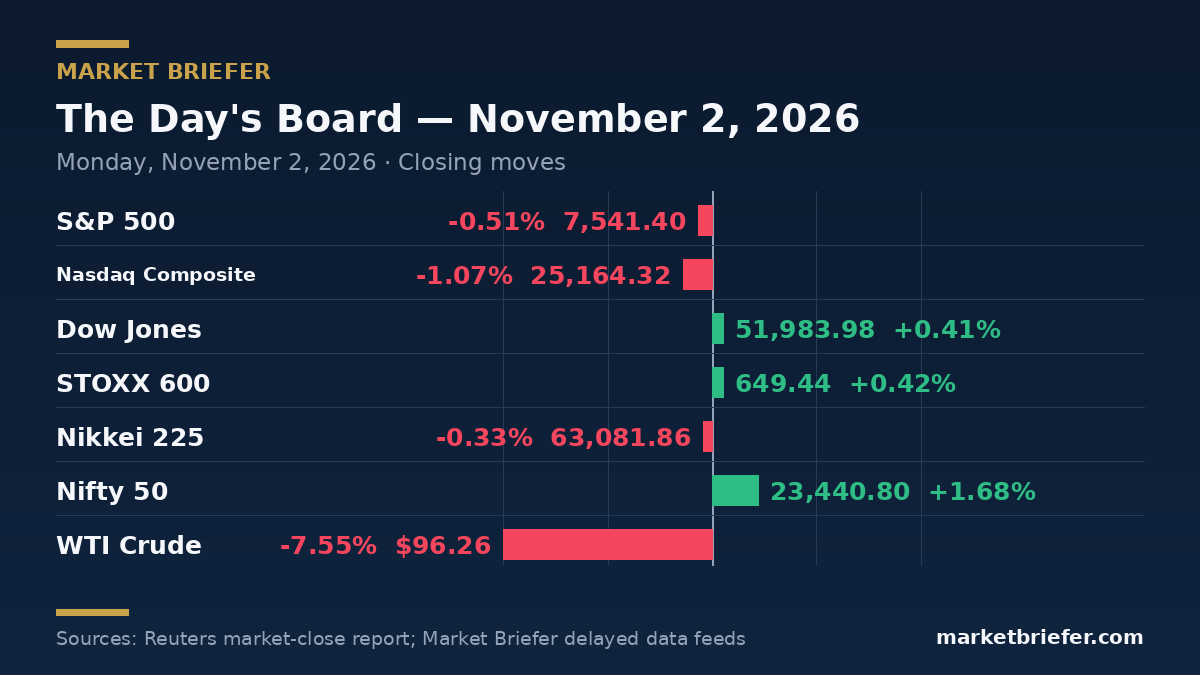
The day’s single story was the collision of those two forces. Early gains faded in the afternoon as AI-related shares came under pressure again, extending a selloff that made October the Nasdaq’s worst month since March 2025, with investors questioning whether massive spending on AI infrastructure is outpacing near-term cash generation, in Reuters’ account of the session. Cheaper oil cushioned the fall everywhere except in the energy and chip complexes themselves, and advancing issues outnumbered decliners inside the S&P 500 by 2.2 to one even as the index closed lower — a breadth pattern that says rotation, not retreat.
United States and Europe
In the United States, seven of the 11 S&P 500 sectors rose. Consumer discretionary led, up 2.25%, followed by materials, up 1.83%, and financials, up 1.76%. Energy fell 4.0% with crude, and technology dropped 2.66%, its third consecutive decline, taking the Nasdaq 100 down 1.39% to 27,989.82. Among individual names, Marvell Technology tumbled about 13% after announcing a $115 billion all-stock deal, including debt, for optical-components maker Lumentum, which itself fell 18.6%. Intel fell 8.8%, adding to Friday’s 29% drop after it forecast quarterly revenue below estimates, while Oracle dropped almost 9% after filings showed plans to raise $20 billion through a debt and share sale — the day’s most notable corporate debt news, and a pointed example of how debt-funded AI spending is being repriced as borrowing costs stay high. AMD fell 7.5% ahead of its Tuesday report and Palantir dipped 3.1% before its own results, while Apple slipped 1.5% ahead of earnings that, after the bell, beat expectations on early iPhone 18 Pro demand, leaving the shares close to flat in extended trading. Amazon rose 2.2% and Tesla gained 1%. U.S. manufacturing activity picked up in October amid solid domestic demand, according to the ISM survey reported Monday, and third-quarter S&P 500 earnings remain on track to climb more than 30% year over year, per LSEG data cited by Reuters.
Europe took the other side of the oil trade. The pan-European STOXX 600 gained 0.42% to 649.44, near a two-month high, as the fall in crude eased inflation concerns. France’s CAC 40 rose 0.98% to 8,047.69, Germany’s DAX added 0.63% to 25,981.09, and London’s FTSE 100 climbed 0.29% to 10,761.33, its fourth consecutive gain. Madrid’s IBEX 35 led the region, up 1.63% to 18,957.80, while the region’s oil and gas sector fell 2.26%, the mirror image of the U.S. energy decline. The full board of European closes is tracked on our markets desk.
Asia, currencies and rates
Asia finished divided between the chip selloff and the oil dividend. Japan’s Nikkei 225 eased 0.33%, down 208.25 points to 63,081.86, as a plunge of more than 15% in memory maker Kioxia after a cautious outlook outweighed a strong gain in Tokyo Electron, in the market’s last session before Tuesday’s Culture Day holiday. Hong Kong’s Hang Seng rose 0.42%, up 98.90 points to 23,393.32, the Shanghai Composite gained 1.08% to 3,638.03, and the CSI 300 added 0.80% to 4,016.92 as Beijing’s support measures for share buybacks lifted mainland sentiment. South Korea’s Kospi rebounded 2.24% to 5,859.08 on institutional bargain hunting after its bruising October. Australia’s S&P/ASX 200 fell 0.58%, down 51.6 points to 8,856.50, with eight of its 11 sectors lower on the eve of the Reserve Bank of Australia’s rate decision. India was the region’s standout: the Nifty 50 rose 1.68%, up 387.70 points to 23,440.80, a third consecutive gain and a one-month high, as Reliance Industries surged 11.6% on strong quarterly earnings, foreign investors returned as net buyers, and cheaper crude lifted a major oil importer.
Currency and rate markets read the oil move as disinflation, not crisis. The dollar index eased 0.10% to 101.78, the euro was little changed at $1.1191, sterling rose to $1.3406, and the dollar held at 157.85 yen. The 10-year Treasury yield fell four basis points to 4.89% and the 30-year eased to 5.27%, while the 2-year was roughly flat near 4.58% — the long end responding to cheaper energy while the front end stayed anchored to expectations that the Federal Reserve, which held rates at 3.75% to 4.00% last week, could still tighten in December. How that split between long and short yields transmits to borrowing costs is set out in our explainer on how bond yields work. Credit spreads produced no verified move we can source by publication time; the day’s credit story was supply and scrutiny, in the form of Oracle’s planned $20 billion raise.
Commodities, crypto and what comes next
Energy dominated the commodity board, and one figure needs care. January Brent, now the front-month contract after the December contract expired on October 30, closed at $104.23 on the site’s delayed feed, down about 7.6% against the January contract’s own prior close, according to market-close reports — a contract change, not a price plunge. The larger percentage shown against Brent in some data tables spans the December-to-January contract roll and is not a like-for-like move, so it is not printed here as one. WTI’s December contract settled at $96.26, down 7.55% from Friday’s $104.12. Gold rose 1.48% to $3,956.60 as buyers returned after Friday’s drop below $3,900, silver gained 3.29% to $50.71, and copper added 1.30% to $6.54, while natural gas eased 1.17% to $2.86. The energy moves and their drivers are covered in depth on our commodities desk. Crypto stayed under pressure after last week’s Binance hack: Bitcoin fell 1.31% to $76,720 and Ethereum eased 0.40% to $2,248. The pattern has a precedent worth naming: in the autumn of 2023, a sharp oil spike on Middle East escalation pushed the 10-year yield toward 5% and knocked the S&P 500 roughly 10% below its July peak before diplomacy and supply assurances unwound both moves within weeks — a reminder that war-premium trades, in either direction, have historically reversed faster than the positioning built on them.
What Would Change This Read: This interpretation would weaken if January Brent reclaims $110 while the 10-year yield rises back above 4.95%, suggesting Monday’s moves were a one-day positioning flush rather than a genuine repricing of the inflation path. In particular, watch Tuesday’s midterm results and the week’s remaining earnings, because they would distinguish between the current read — diplomacy easing an energy shock while AI valuations reset — and the alternative that political and earnings risk, not oil, is about to take over the tape.
What to watch tomorrow is unusually concrete. U.S. midterm elections on Tuesday will decide whether Democrats wrest control of the House, and possibly the Senate, from Republicans. AMD reports earnings, the Reserve Bank of Australia announces its rate decision, and Tokyo’s markets are closed for Culture Day, thinning Asia’s session. Later in the week, Friday’s U.S. jobs report is the next test of the December rate-hike pricing embedded in the 2-year yield. For energy importers from India to Europe, and for borrowers watching the long end of the Treasury curve, one more day of falling crude would do more than any single earnings print — and one failed headline from Doha could undo all of it.
This is not investment advice. The Global Close is AI-assisted market research produced with automated data checks; figures are verified against market-close reports and the site’s delayed data feeds at publication time.