The Global Close: November 18, 2026 — Nvidia beats and still falls
U.S. stocks ended mixed as Nvidia fell despite its earnings beat and hawkish Fed minutes weighed on the Dow, Europe fell on a 4.0% inflation print, and gold settled at a 14-month low.
7 min read
Nvidia delivered the earnings beat the market had spent four sessions demanding, and its shares still closed lower — the argument has moved from whether AI spending is real to what investors will pay for it while the Federal Reserve leans toward raising rates. That doubt travelled unevenly around the world: Asia’s chip markets took the print at face value and rose, Europe ignored it in the face of a 4.0% inflation reading and fell for a second day, and New York split down the middle, the Nasdaq higher and the Dow sharply lower.
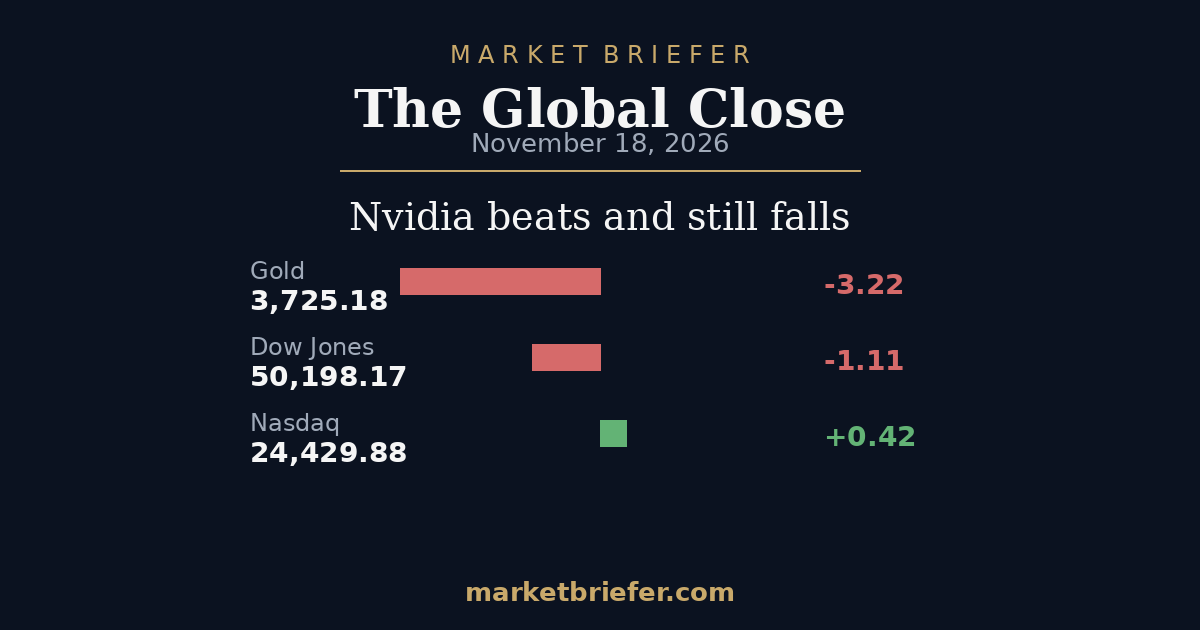
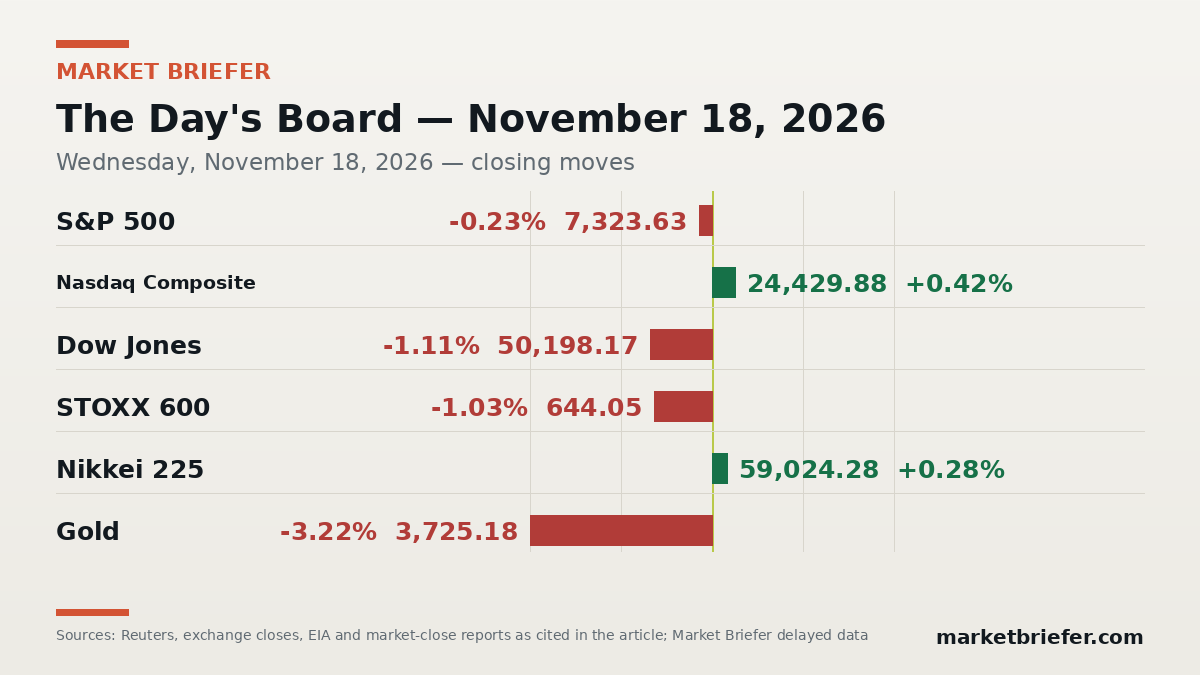
U.S. stocks ended mixed on Wednesday. The S&P 500 fell 16.90 points, or 0.23%, to 7,323.63, a fifth straight decline, while the Nasdaq Composite rose 101.50 points, or 0.42%, to 24,429.88, ending a four-day fall, and the Dow Jones Industrial Average dropped 561.25 points, or 1.11%, to 50,198.17, Reuters and exchange closing data showed. Nvidia, which had risen as much as 2.7% in early trading on third-quarter revenue of $115.84 billion and a fourth-quarter guide near $130 billion, faded through the session and closed down 2.89% at $150.96. Minutes from the Federal Reserve’s October meeting showed almost all officials backing a rate increase in December, and the S&P 500 gave back its modest gains after they appeared. Gold fell to a 14-month low and oil fell on a larger-than-expected build in U.S. inventories.
The Number That Matters: $3,725.18. That is where gold settled on Wednesday, down $123.77, or 3.22%, from Tuesday’s $3,848.95 — its lowest close since September 19, 2025, and its biggest one-day fall since October 30. It is the key number because it fell hardest on a day when the usual explanations moved the other way: the 10-year Treasury yield eased to 5.07% and the dollar rose only modestly, so this was not a rates move but a liquidation, and it transmitted directly into equities, driving Europe’s basic-resources sector down 4.69% and sending Freeport-McMoRan and Newmont each more than 6% lower in New York. It matters more than the headline index moves because it says crowded positions, not just cautious ones, are being unwound. A decisive rise in the 10-year yield back above last week’s highs near 5.14% while gold stabilises would make the yield the more important signal instead.
The day’s single story was a beat that could not hold. The chip complex split rather than rallied: Advanced Micro Devices rose about 5% and Broadcom about 4%, while Marvell fell 2% and Intel and Micron each lost about 1%, and cybersecurity shares — Palo Alto Networks up 10%, CrowdStrike 8% and Fortinet 6% — did more for the Nasdaq than the chipmaker at the centre of the trade.
United States: the beat fades, the minutes land, retail holds up
In the United States, the split between the indexes was a split between stories. The Dow took the day’s two hardest hits: UnitedHealth fell 10% on concern about regulatory scrutiny of health insurers, and Humana, the S&P 500’s weakest stock, fell 13%. The Nasdaq was held up by everything except Nvidia — the cybersecurity group, the rival chipmakers and the retailers. TJX jumped 8.05% to $140.30 after forecasting upbeat annual sales, Target rose 4.01% to $165.93 on an upbeat holiday outlook, and Lowe’s added about 1%, all three beating expectations a day before Walmart reports. The Russell 2000 rose 0.46% to 2,714.31, a reminder that the selling remains concentrated in the largest names. Readers can follow the full board on our markets desk.
The afternoon’s policy news pointed one way. The minutes showed the committee still focused on inflation, with a few policymakers arguing for a 50-basis-point increase if incoming data were unfavourable, and Governor Christopher Waller said the central bank may need to be more aggressive; futures price a December 25-basis-point increase as near certain. Wednesday’s housing data showed the cost reaching households directly: mortgage rates climbed, building permits faltered and pending home sales fell to a record low. In credit, the latest ICE BofA spreads available through FRED, for November 13, stood at 89 basis points for investment-grade debt and 323 basis points for high-yield, still showing no sign that lenders are pricing the equity slide as a threat to borrowers’ ability to pay.
Europe falls on its own inflation print, Asia splits on the chip print
Europe opened firmer on the Nvidia numbers and then sold off on its own data. The pan-European STOXX 600 closed down 1.03% at 644.05, Germany’s DAX fell 309.13 points, or 1.19%, to 25,736.24, France’s CAC 40 lost 69.95 points, or 0.85%, to 8,146.83, and London’s FTSE 100 fell 138.70 points, or 1.30%, to 10,551.17, with all nine major European indexes lower. Eurostat reported euro-area inflation accelerating to 4.0% in October, its highest since September 2023 and twice the European Central Bank’s target, with core inflation revised up to 2.6%; in Britain, consumer prices rose 3.6% year on year, matching expectations, with core inflation steady at 2.8%. Basic resources fell 4.69% as the gold and silver declines hit the miners — Antofagasta, Anglo American, Glencore and Rio Tinto lost between 4.7% and 8% in London — oil and gas fell 2.10%, and autos and parts, up 0.18%, was the only sector to rise.
Asia, trading on the Nvidia print before Europe’s inflation data existed, split along supply-chain lines. South Korea’s Kospi rose 1.99% to 5,067.44 and Japan’s Nikkei 225 added 163.85 points, or 0.28%, to 59,024.28. Hong Kong’s Hang Seng fell 213.42 points, or 0.91%, to 23,294.75, on weakness in Chinese technology shares, while China’s Shanghai Composite edged up 3.25 points, or 0.09%, to 3,587.83. Australia’s S&P/ASX 200 fell 61.40 points, or 0.69%, to 8,821.80, a fifth straight decline, with Lendlease down 16.91%. India gave back its two-day gain: the Nifty 50 fell 159.45 points, or 0.63%, to 25,227.95, as investors booked profits after the November advance, even as foreign investors bought a net ₹5,867 crore of shares.
Rates, currencies, commodities and crypto
Treasuries steadied even as the minutes argued for higher rates: the 10-year yield eased about 3 basis points to 5.07% and the 2-year held near 4.80%, while the Treasury sold $16 billion of 20-year bonds at 5.459%. The Dollar Index rose 0.22% to 103.79, holding near its 19-month high; the euro traded near $1.0972, sterling near $1.3147, and the dollar near 159.22 yen in late pricing. For exporters, a dollar above 103 for a second week keeps Tuesday’s margin pressure in place.
Oil fell on supply, not demand fears alone. The Energy Information Administration reported U.S. commercial crude inventories rising 3.38 million barrels in the week to November 13, against expectations of a build near 0.4 million, with gasoline stocks also higher; December WTI settled at $83.26 a barrel, down $2.75, or 3.2%, from Tuesday’s $86.01 settlement, and January Brent settled at $91.95, down 1.28% from Tuesday’s $93.14 settlement for the same January contract — no contract roll distorts either figure, and shipping attacks near the Strait of Hormuz limited the decline. Our oil prices explainer sets out how the surplus the International Energy Agency has flagged is being priced. Gold’s fall to $3,725.18 was the commodity story of the day, and silver followed it, down 4.89% to $45.06. In crypto, bitcoin fell about 3.9% to near $62,252 and ether fell about 3.8% to near $1,753 in late trading, extending November’s slide alongside the same liquidation that hit precious metals.
After the close, Anthropic priced its offering at $83 a share, above the $70 to $78 range, in an upsized deal valuing the Claude developer at about $1.5 trillion fully diluted, alongside a separate $26 billion private placement; trading begins Thursday on the Nasdaq under the ticker ANT. Private-market demand for AI exposure cleared above range on the same afternoon public-market investors sold the sector’s bellwether on a beat.
What Would Change This Read: This interpretation would weaken if Anthropic closes its first day below its $83 issue price while Nvidia and the broader chip group fall together, suggesting the constraint is AI valuations themselves rather than positioning in one crowded name. In particular, watch Anthropic’s first-day close against Nvidia’s share price on Thursday, because it would distinguish between the current interpretation — that investors are discriminating between AI exposures at a 5.07% 10-year yield — and the alternative that the de-rating is becoming indiscriminate.
What to watch on Thursday starts in Asia, where Tokyo and Seoul will trade on both the Nvidia guide and the Anthropic pricing, then turns to Walmart’s results before the U.S. open, weekly jobless claims and the Philadelphia Fed index at 8:30 a.m. Eastern, leading indicators at 10 a.m., and Fed Vice Chair Philip Jefferson speaking on economic shocks. Anthropic’s first day of trading, and whether gold holds above $3,700, are the two market tests that matter most.
This is not investment advice. The Global Close is AI-assisted market research produced with automated data checks; figures are verified against market-close reports and the site’s delayed data feeds at publication time.
See Market Briefer first in Google
Add to Preferred Sources