The Global Close: November 17, 2026 — S&P 500 at a four-month low as Nvidia beats after the bell
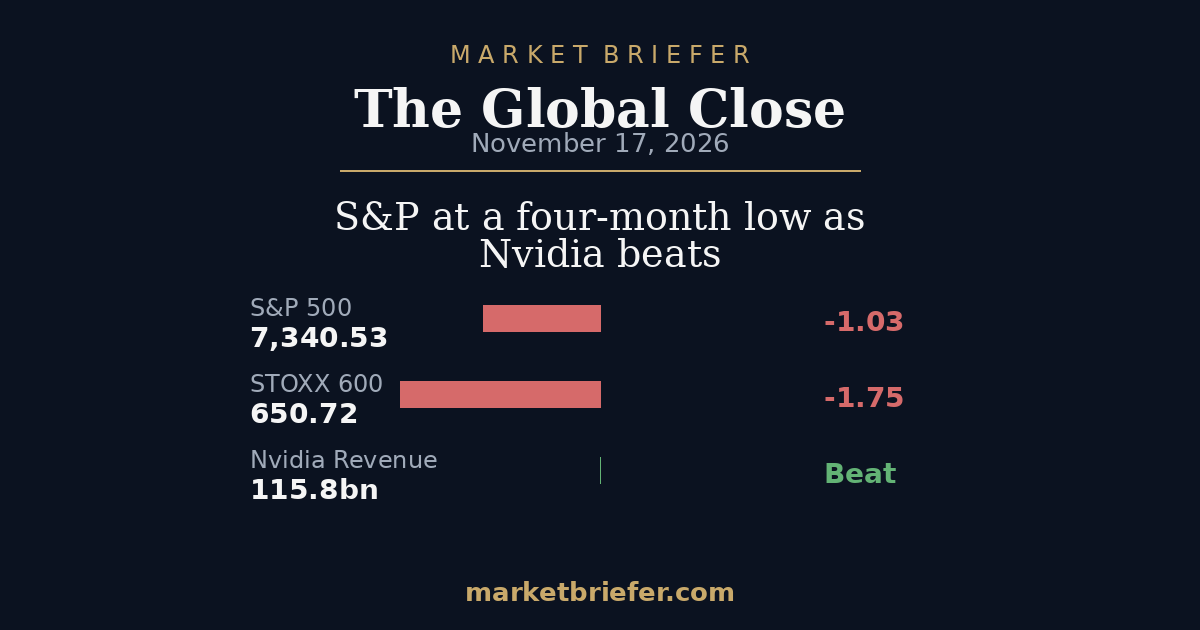
U.S. stocks fell a fourth straight session and the S&P 500 closed at its lowest since late July, Europe had its worst day in eight months, and Nvidia beat and guided to $130 billion after the bell.
7 min read
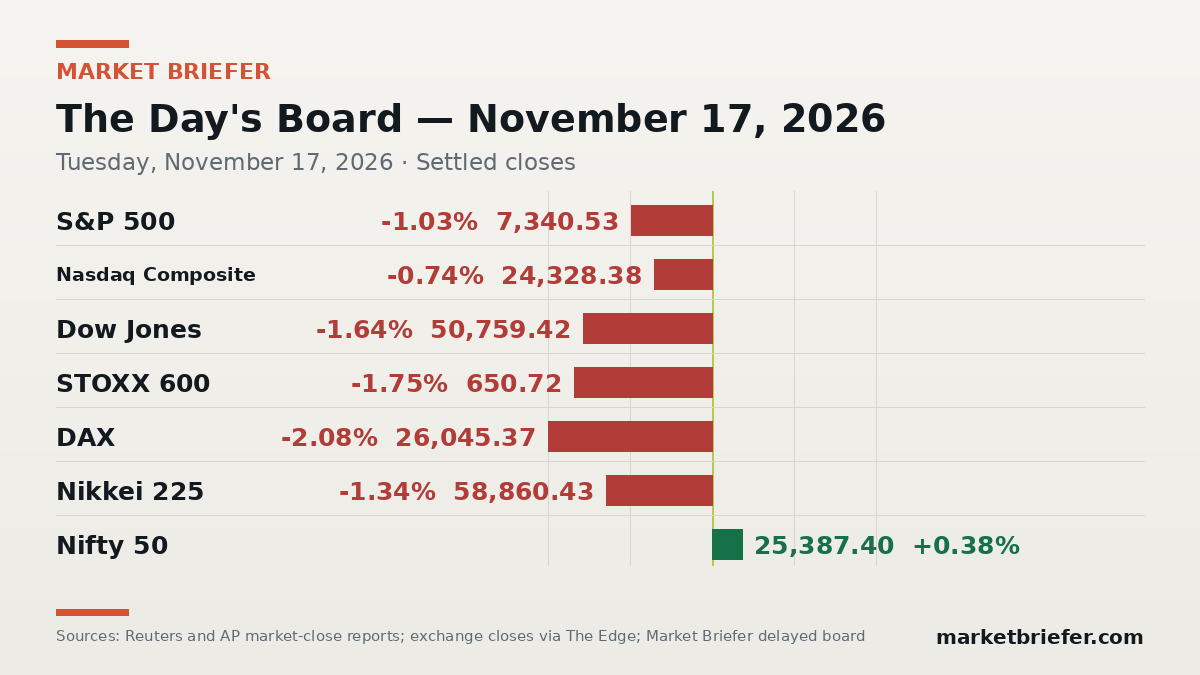
U.S. stocks fell for a fourth straight session on Tuesday, and the S&P 500 closed at its lowest level since late July, as investors cut technology and software shares ahead of Nvidia’s earnings and priced a Federal Reserve rate increase in December as close to certain. The S&P 500 fell 76.06 points, or 1.03%, to 7,340.53, the Nasdaq Composite dropped 181.38 points, or 0.74%, to 24,328.38, and the Dow Jones Industrial Average fell 848.75 points, or 1.64%, to 50,759.42, after dropping more than 1,000 points at its worst level of the day, the Associated Press reported. Europe had its worst day in eight months, Asia fell almost everywhere except India, and the dollar touched a fresh 19-month high. Then, after the close, Nvidia reported revenue well above expectations and guided higher — the first piece of news in four sessions that argues against the selloff’s own logic.
The Number That Matters: $130 billion. That is the fourth-quarter revenue Nvidia guided to after Tuesday’s close, plus or minus 3%, against a consensus near $125.1 billion, on third-quarter revenue of $115.84 billion that beat the $109.1 billion expected. It is the key number because the past four sessions were, at bottom, an argument about whether AI spending can still outrun tighter chip-export rules, a leadership shock at Nvidia itself, and a 5%-plus 10-year yield — and $130 billion, guided with no China data-centre compute revenue assumed, is the strongest single answer yet that the spending has not slowed. It matters more than the headline index falls because those falls were the market pricing the question before the answer arrived. A decisive move in the Philadelphia Semiconductor Index on Wednesday, if chips fail to follow the guide higher, would make the software selloff the more important signal instead.
The day’s single story was de-risking ahead of an answer. Investors sold first and waited for Nvidia second: all eleven S&P 500 sectors finished lower, nearly nine in ten stocks in the index fell, and the CBOE Volatility Index rose 11.14% to 25.46 after touching 27.73 intraday. Yet the selling had rotated — the Philadelphia Semiconductor Index, down 5.28% on Monday, rose 0.34% on Tuesday, while software took the hit chips had taken the day before.
United States: software falls, chips steady, the consumer holds
In the United States, financials were the weakest sector, down 1.89%, and energy eased 0.52%, while no sector rose. Salesforce fell 9.45%, its steepest one-day drop since May 2024, Intuit dropped 7.17%, ServiceNow lost 6.51% and Fair Isaac fell 5.68%, as the de-rating moved from hardware into the software names that sell to the same AI budgets. Nvidia itself slipped only 0.44% to $155.46 in the regular session, and networking and optical names led the gainers — Broadcom rose 2.46%, Ciena 2.82%, Coherent 3.65% and Lumentum 2.56% — a sign the chip complex was stabilising even as the broad index fell. The Russell 2000 lost 1.50% to about 2,702. Home Depot beat on earnings, with comparable sales up 2.2% against 1.8% expected, but its narrowed outlook implied a soft fourth quarter and the shares fell about 2.5% to $339.01; Disney also beat on both lines and fell anyway. Readers can follow the full board on our markets desk.
The day’s data gave the sellers no help and the Fed hawks some. October retail sales rose 0.2%, a tenth above forecast after September’s 0.8% gain, and the control group that feeds GDP rose 0.6% against 0.3% expected, while import prices jumped 1.1%. St. Louis Fed President Alberto Musalem said several rate hikes are likely needed before spring, and futures implied about a 95.4% probability of a 25-basis-point increase at the December 8–9 meeting, with the December hike close to fully priced. For borrowers, that pricing is the day’s concrete transmission: resilient spending is being read not as relief but as another reason the cost of money stays higher for longer. In credit, the latest ICE BofA spreads available through FRED, for November 13, stood at 89 basis points for investment-grade debt and 323 basis points for high-yield — still no sign that lenders are pricing the equity selloff as a threat to borrowers’ ability to pay.
Europe’s worst day in eight months, Asia’s fourth straight fall
Europe, which had cushioned Monday’s fall with a rotation into banks, healthcare and defence, gave way on Tuesday. The pan-European STOXX 600 closed down 1.75% at 650.72, its biggest one-day fall since March 20 and now 2.5% below last week’s record high, Reuters reported. Germany’s DAX fell 553.27 points, or 2.08%, to 26,045.37, France’s CAC 40 lost 135.22 points, or 1.62%, to 8,216.78, and London’s FTSE 100 fell 1.76% to 10,689.87 in the site’s delayed board, its steepest fall in eight months. European technology dropped 3.9%, its steepest daily fall since February 3, Deutsche Bank slid, and online broker XTB slumped 17.5% as the STOXX 600’s worst performer. The one bright domestic print — Germany’s ZEW sentiment index climbing to 35.6 in November from 28.1, well above the 29.0 expected — was ignored, which is itself information: on Tuesday, positioning ahead of Nvidia mattered more than European data.
Asia had already set the tone, falling for a fourth straight session in most markets as the U.S. chip-export rule continued to work through the supply chain. Japan’s Nikkei 225 fell 801.59 points, or 1.34%, to 58,860.43, South Korea’s Kospi dropped 2.59% to 4,968.48, and Hong Kong’s Hang Seng lost 245.67 points, or 1.03%, to 23,508.17, giving back Monday’s gain on losses in Baidu and Alibaba. China’s Shanghai Composite eased 0.50% to 3,584.58. Australia’s S&P/ASX 200 fell 161.50 points, or 1.79%, to 8,883.20, a fourth straight decline to a one-week low, dragged by miners and banks. India was the region’s only gainer for a second day: the Nifty 50 rose 96.30 points, or 0.38%, to 25,387.40, closing at its highest since February on record foreign inflows and lower oil, with the Sensex up 0.52% to 82,532.19, the Hindu BusinessLine reported. The pattern rhymes with October 2024, when a single ASML order-book miss knocked chip shares from Taipei to Amsterdam in a day and the broad indexes recovered within weeks once earnings confirmed demand — the comparison cuts both ways, and Wednesday’s chip open will say which half of it applies.
Rates, currencies, commodities and crypto
In rates, Treasuries steadied rather than rallied: the 10-year yield eased about 2 basis points to 5.10% late in the session and the 2-year held near 4.83%, leaving both near one-month highs and the curve still pricing a December hike. The Dollar Index rose to 103.66 intraday, its highest since April 2, 2025, extending its run to a sixth straight session, Reuters reported, before easing late. The euro slipped to a fresh 19-month low, trading near $1.0993 after an intraday low of $1.0968, sterling firmed to about $1.32, and the dollar traded near 159.49 yen, close enough to 160 for intervention risk to remain live in Tokyo. For exporters, a dollar at 19-month highs is a margin story as much as a markets story — U.S. goods get dearer abroad with every session the index holds above 103.
Oil was little changed after Monday’s supply-driven drop, with December WTI near $85.43, down 0.34% in late indicative pricing, and January Brent near $92.65, up 0.23% against the same January contract’s $92.44 Monday settle — no contract roll distorts either figure. Our oil prices explainer sets out how the surplus the International Energy Agency has flagged is priced. Gold steadied near $3,849.85 an ounce, down 0.18%, after Monday’s fresh one-year low, and copper rose to about $6.08. In crypto, bitcoin traded near $64,748, down about 1.0% on the day and still deep in a November slide, while ether held near $1,828, up about 1.1% — stabilisation at low levels rather than a recovery.
What Would Change This Read: This interpretation would weaken if the Philadelphia Semiconductor Index falls on Wednesday despite Nvidia’s $130 billion guide, while software stabilises, suggesting the selloff is a broad AI de-rating that earnings cannot arrest rather than a positioning squeeze ahead of one report. In particular, watch the semiconductor index against the Nasdaq Composite on Wednesday, because it would distinguish between the current interpretation — that investors de-risked into a known event and the event delivered — and the alternative that valuations themselves, at a 5.10% 10-year yield, are now the binding constraint.
What to watch on Wednesday starts with Asia’s reaction to Nvidia’s report and whether Tokyo and Seoul’s chip names follow the guide or the week’s momentum, then turns to U.S. building permits and housing starts, pending home sales, and the minutes of the Federal Reserve’s last meeting, with Fed speakers Daly, Williams and Kashkari also scheduled. Anthropic’s expected market debut later in the week remains the second test of what investors will pay for AI exposure.
This is not investment advice. The Global Close is AI-assisted market research produced with automated data checks; figures are verified against market-close reports and the site’s delayed data feeds at publication time.
See Market Briefer first in Google
Add to Preferred Sources