The Global Close: November 16, 2026 — Nasdaq in correction as a new chip rule slams the AI trade
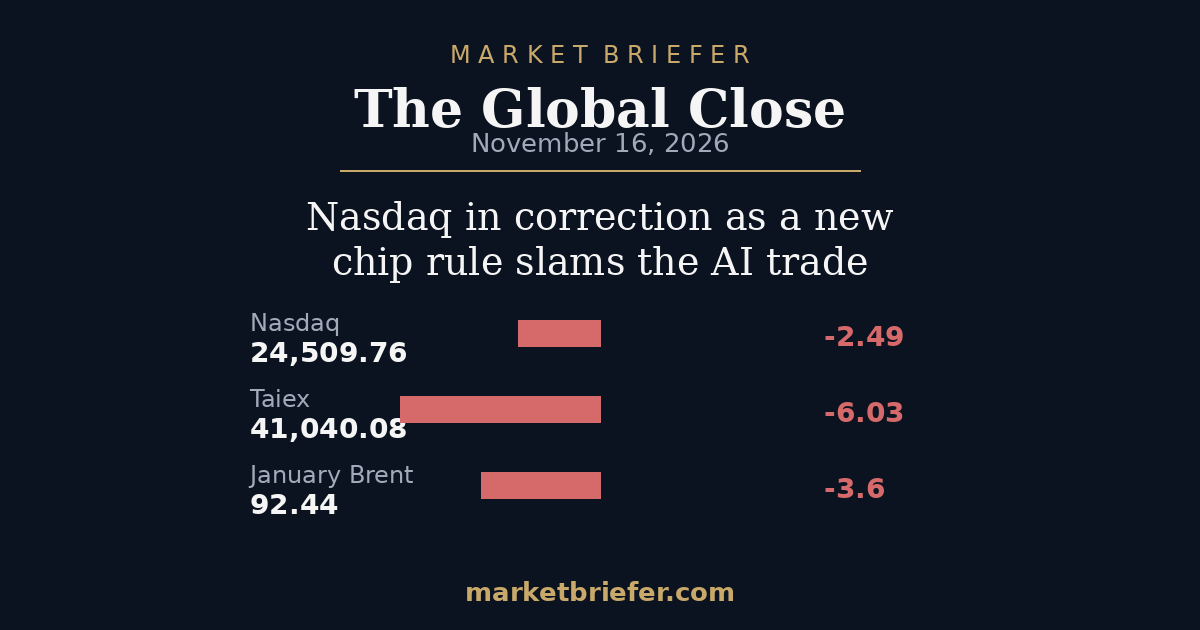
Nasdaq fell 2.49% into correction as a new U.S. chip licensing rule slammed semiconductors 5.28%; S&P 500 lost 1.92%, Taiex plunged 6.03%, January Brent settled at $92.44.
7 min read
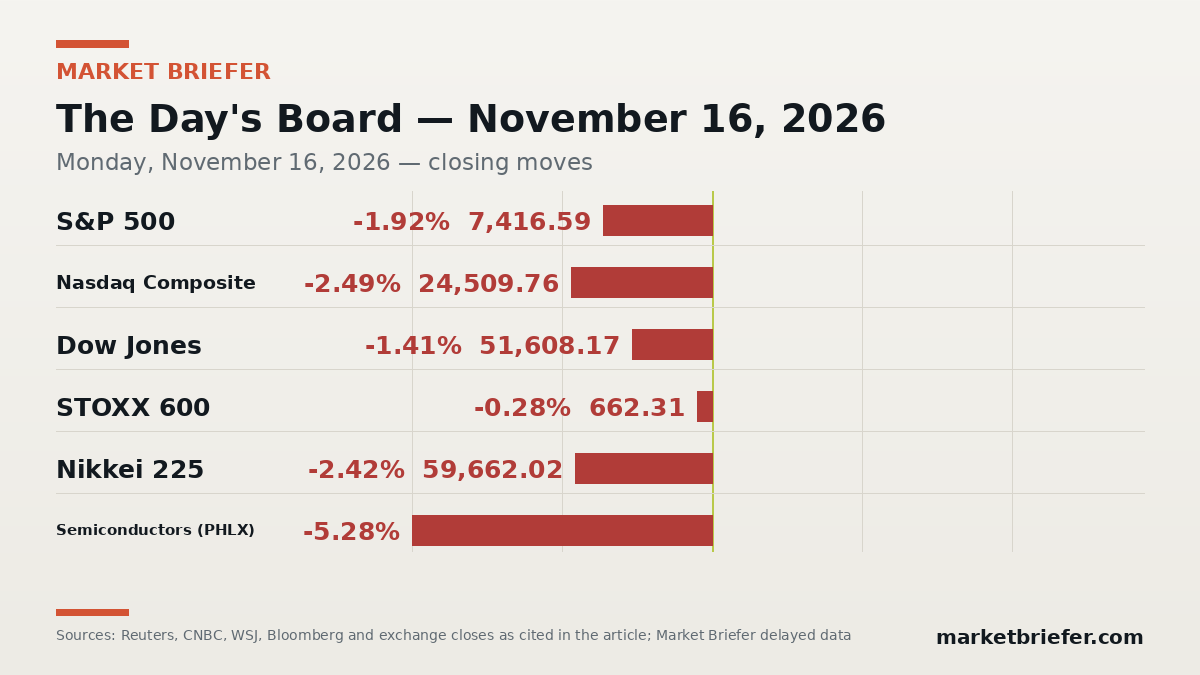
U.S. stocks fell sharply on Monday for a third straight session, and the Nasdaq Composite entered a correction, as a new U.S. rule restricting China’s access to advanced AI chips hit semiconductor shares already reeling from Jensen Huang’s resignation at Nvidia, a day before the chipmaker reports earnings under an interim chief executive. The S&P 500 fell 145.08 points, or 1.92%, to 7,416.59, the Nasdaq Composite dropped 626.52 points, or 2.49%, to 24,509.76 — more than 10% below its October 6 high, which puts it in a correction, Reuters reported — and the Dow Jones Industrial Average fell 739.38 points, or 1.41%, to 51,608.17. Falling bond yields and a 3% drop in oil failed to support Wall Street, Reuters reported, while the dollar rose to a fresh 19-month high, Taiwan’s Taiex plunged 6.03%, and Europe pulled back from record territory.
The Number That Matters: -5.28%. That is Monday’s fall in the Philadelphia Semiconductor Index, after the Commerce Department’s Bureau of Industry and Security issued a rule requiring licences for advanced AI chips sent to data centers in five countries, and for remote access to those chips by China-headquartered companies. It is the key number because it names the transmission channel for everything else here: a policy rule, not a data print, repriced chip earnings across three continents in a single day, from Taipei’s 6.03% plunge to the Nasdaq’s correction. It matters more than the headline index falls because those falls were its arithmetic — chips and the largest technology names accounted for most of the S&P 500’s decline. A decisive move in Nvidia’s earnings after Tuesday’s close, if the numbers and the new leadership’s guidance calm the policy and governance fears at once, would make that report the more important signal.
The day’s single story was that the AI trade’s two supports gave way together. For a week the market has been pricing a leadership shock at Nvidia; on Monday it was asked to price a smaller addressable market as well, as Washington moved to curb China’s access to AI chips while President Trump travelled to Asia for meetings where trade and technology top the agenda, Reuters reported. Nvidia fell 4.12% to $156.14 and Alphabet fell about 4%, and neither lower yields nor cheaper oil — the cushions that usually catch a growth selloff — caught this one.
United States: a rule, not a rate, did the damage
In the United States, nine of the S&P 500’s eleven sectors fell and two rose, Reuters reported. Technology and communication services each fell about 3%; the sector funds told the same story, with technology down 3.24% and consumer staples the best performer, up 0.27%. Energy fell 1.96% alongside crude and financials eased 0.85%. SanDisk fell 8.58%, Micron dropped 7.62% and Dell Technologies lost 6.96%, while Nvidia’s 4.12% fall cost the index about a fifth of a percentage point on its own. The selling was not confined to the largest names — the Russell 2000 fell 1.70% to 2,742.94 — but it was led by them, and the CBOE Volatility Index jumped 18.73% to 22.91. Tyson Foods rose 8.72% and Procter & Gamble gained 1.90%, the defensive end of the board doing what it is held for. Readers can follow the full board on our markets desk.
The day’s domestic data argued against panic about the wider economy. The New York Fed’s Empire State manufacturing index fell to 7.8 in November from 25.5 in October, below the 16.7 forecast, but stayed in expansion, and its employment index rose to 18.1, its highest since June 2022. Fed Chair Kevin Warsh set out three scenarios for superintelligence in a speech that moved no rate expectations, and futures still implied about a 93% probability of a 25-basis-point increase at the December 8–9 meeting. In credit, the latest ICE BofA spreads through FRED, for November 13, showed investment-grade debt unchanged at 89 basis points over Treasuries and high-yield at 323 basis points, 3 basis points wider — a barely visible response to a 1.92% equity fall, and evidence lenders are not yet pricing this as a threat to borrowers.
Asia bears the first blow, Europe the second
Asia, where the chip supply chain is physically made, took the selloff first and hardest. Taiwan’s Taiex plunged 2,635.04 points, or 6.03%, to 41,040.08, its second-largest point decline on record, with 82 stocks falling by the daily limit, according to exchange reports. Japan’s Nikkei 225 fell 1,480.33 points, or 2.42%, to 59,662.02, back below 60,000, and South Korea’s Kospi dropped 3.59% to 5,100.50 in a third straight decline. China’s Shanghai Composite fell 0.87% to 3,602.57 and the CSI 300 lost 0.91% to 3,979.80, on a day when Beijing’s October data showed continued weakness in industrial production, consumption, house prices, lending and investment, Reuters reported. Two markets bucked the slide: Hong Kong’s Hang Seng rose 116.24 points, or 0.49%, to 23,753.84, ending three straight losses, and India’s Nifty 50 gained 146.80 points, or 0.58%, to 25,291.10. Australia’s S&P/ASX 200 fell 37.50 points, or 0.41%, to 9,044.70, a third straight decline confirmed in the site’s delayed board. Japan also reported its economy contracted at an annualised 0.1% in the third quarter, against expectations for 0.3% growth.
Europe’s session was a smaller echo, cushioned by the rotation that has made the region the year’s haven from AI volatility. The pan-European STOXX 600 closed 0.28% lower at 662.31, snapping a five-session winning run that had carried it to record territory, Reuters reported. Germany’s DAX fell 151.31 points, or 0.57%, to 26,598.64, France’s CAC 40 eased 16.91 points, or 0.20%, to 8,352.00, and London’s FTSE 100 slipped 21.01 points, or 0.19%, to 10,881.55. ASML fell 2.4%, while healthcare rose 0.8% as the top sectoral gainer and Novo Nordisk gained 2.4% after its CagriSema drug showed 25.4% weight loss among early responders. Morgan Stanley upgraded European equities to overweight from equal weight — the region’s banks, drugmakers and defence shares are being bought precisely because they are not the trade that is unwinding.
Rates, currencies, commodities and crypto
In rates, Treasuries rallied only modestly into the equity fall: the 10-year yield eased 3 basis points to 5.12% and the 2-year fell about 4 basis points to 4.84%, Reuters reported, after the 2-year’s largest weekly increase in more than two years last week. The Dollar Index rose 0.16% to 103.58 in the site’s delayed board, at a fresh 19-month high, the euro fell 0.44% to 1.1001, on the edge of the $1.10 line ING has flagged as the break that could extend the dollar’s run, sterling eased 0.36% to 1.3184, and the dollar ended at 159.46 yen, close enough to 160 for intervention risk to remain part of the conversation in Tokyo. For borrowers the picture barely softened — a 5.12% 10-year still prices mortgages and corporate debt off the week’s repricing, not Monday’s dip.
Oil fell on supply, not demand. December WTI settled down $2.84, or 3.2%, at $85.72 a barrel, its lowest close since August 28, and January Brent settled down $3.40, or 3.6%, at $92.44 — a like-for-like move in the same January contract that settled at $95.84 on Friday — as Persian Gulf exports rebounded faster than expected and the International Energy Agency pointed to a fourth-quarter surplus of 1.7 million barrels a day, the Wall Street Journal and Bloomberg reported. Our oil prices explainer sets out how that balance is priced. Gold fell about 1% to a fresh one-year low, with December futures at $3,854.60, down 0.82%, and silver fell 4.29% to $46.93 in the site’s delayed board, with copper down 1.43% to $5.99. In crypto, bitcoin held near $64,909 in the site’s board, down 0.19% over 24 hours, after a weekend plunge below $62,000 — its lowest since July — extended its November decline to 17% and its weekly losing streak to six, CoinDesk reported, and ether eased 0.66% to $1,816 after recovering from a weekend low near $1,710.
What Would Change This Read: This interpretation would weaken if Nvidia’s Tuesday earnings lift the semiconductor index while the broader Nasdaq keeps falling, suggesting Monday’s pressure was a broad de-rating rather than a chip-specific policy repricing. In particular, watch the Philadelphia Semiconductor Index against the Nasdaq Composite on Wednesday, because it would distinguish between the current interpretation — that a licensing rule aimed at one complex drove a correction led by that complex — and the alternative that investors are cutting AI exposure of every kind regardless of policy.
What to watch on Tuesday starts in Asia, where markets will trade the U.S. close and China’s response to the chip rule, then builds to the week’s centre of gravity: October retail sales, expected up 0.2% after September’s 0.8% rise, Germany’s ZEW survey and UK labour data, and Fed speakers Waller, Hammack, Musalem and Williams, before Nvidia reports after the close — its first results under interim chief executive Colette Kress, with consensus near $109 billion of revenue. Anthropic’s expected debut later in the week and Wednesday’s Fed minutes follow.
This is not investment advice. The Global Close is AI-assisted market research produced with automated data checks; figures are verified against market-close reports and the site’s delayed data feeds at publication time.
See Market Briefer first in Google
Add to Preferred Sources