The Global Close: November 13, 2026 — Chips give back the rally as yields end the week at 5.15%
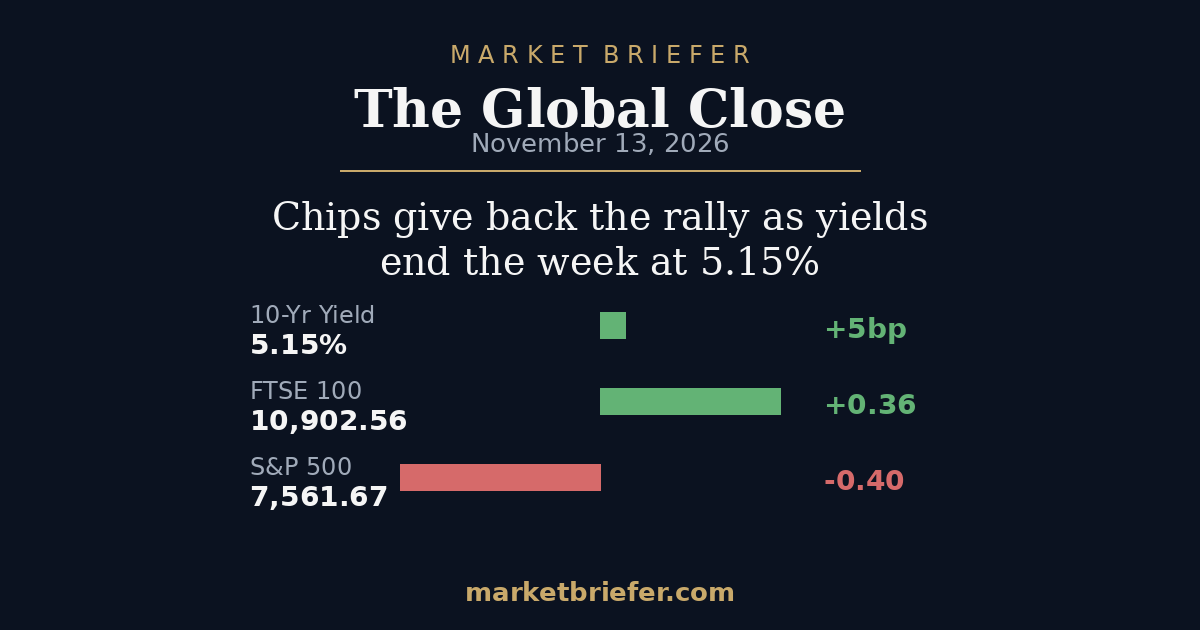
U.S. stocks ended mixed on Friday as chip shares surrendered Thursday's gains and Treasury yields closed the week at 5.15%, while Europe banked its best week since June and Asia split between Tokyo and Hong Kong.
7 min read
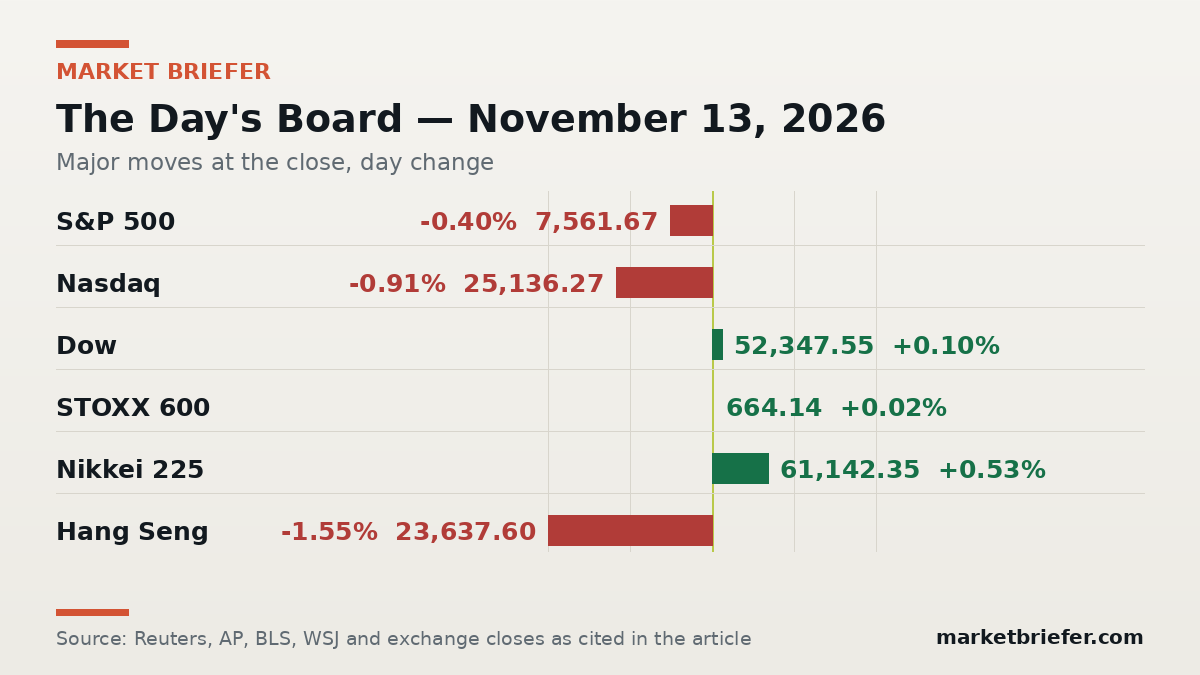
U.S. stocks ended mixed on Friday as the chip shares that rallied on Nvidia’s leadership shock gave the gains back, and a producer-price report that was softer than expected for the month but the hottest in almost four years over the year left the case for a December rate increase intact. The S&P 500 fell 30.73 points, or 0.40%, to 7,561.67, the Nasdaq Composite dropped 229.82 points, or 0.91%, to 25,136.27, and the Dow Jones Industrial Average rose 50.46 points, or 0.10%, to 52,347.55, according to the Associated Press. The 10-year Treasury yield closed the week at 5.15%, its biggest weekly rise in 19 months, the dollar extended its run to a new high for the year, Europe held near records to bank its best week since June, and bitcoin fell through its 200-week average to near $68,400. All three indexes still gained for the week, snapping a four-week losing streak for the S&P 500 and Nasdaq, Reuters reported.
The Number That Matters: 5.15%. That is where the 10-year Treasury yield closed on Friday, up 5 basis points on the day and 29 basis points on the week, the largest weekly gain in 19 months, the Wall Street Journal reported, with the 2-year ending at 4.87% after a 35-basis-point weekly rise. It is the key number because it is the price against which everything else here is discounted: it kept a December increase fully priced even after a producer-price print below forecast, carried the dollar to its strongest since April 2025, and is the rate borrowers, from homebuyers to the companies financing the AI buildout, actually face. It matters more than the chip selloff because that was a rotation inside one trade, while the yield repriced every asset at once. A decisive move in Tuesday’s retail sales report, if it printed weak enough to pull the 10-year back below 5%, would make that release the more important signal.
The day’s single story was reversal inside the AI complex. On Thursday, Advanced Micro Devices and Broadcom had each climbed nearly 6% as investors treated Jensen Huang’s resignation at Nvidia as a redistribution of the AI trade toward its rivals. On Friday the logic ran backwards: AMD fell 8.75% to $534.06, Broadcom lost 4.76%, Cisco fell 6.24% and Dell Technologies dropped 7.18%, and the Philadelphia Semiconductor Index fell 3.43%. Nvidia itself fell 2.0% to $162.85 and recorded its sixth straight weekly decline, its longest such streak since October 2012, Reuters reported — a marker that frames this not as a one-day governance shock but as the trade’s first sustained loss of momentum in thirteen years. The CBOE Volatility Index rose 3.16% to 19.29, while the equal-weighted S&P 500 rose, a sign the selling stayed concentrated in the largest technology names.
United States: technology worst, staples best, inflation unmoved
In the United States, technology was the worst-performing of the 11 major S&P 500 sectors, Reuters reported, and the sector funds told the same story: consumer staples led, rising 1.42%, while technology fell 2.01%, with seven of the eleven funds higher. Communication services added 1.05%, energy 0.98% and financials 0.81%, as money leaving chips found defensive homes rather than leaving equities altogether. Microsoft ended higher after a global outage affecting Outlook and Teams began to ease, and the Financial Times reported Nvidia’s board has approached Arm Holdings chief executive Rene Haas in its search for a successor to Huang. The neocloud firms tied most closely to Nvidia’s financing web, CoreWeave and Nebius, fell for a second day. Readers can follow the full board on our markets desk.
The inflation data gave neither side a clean win. The Producer Price Index rose 0.3% in October, below the 0.4% a Reuters poll expected and well below September’s upwardly revised 1.4%, the Bureau of Labor Statistics reported, but the 12-month increase accelerated to 6.5%, the largest since November 2022. The report kept expectations for an increase of at least 25 basis points at the Fed’s December 8–9 meeting locked in, with roughly a 10% chance of a half-point move priced, according to CME FedWatch data cited by Reuters, and officials leaned the same way on Friday: San Francisco’s Mary Daly said her bias is that the Fed will need to raise its rate, and Boston’s Susan Collins said tighter policy is coming, Reuters reported. Our bond yields explainer sets out how a 5.15% 10-year reaches stock prices, mortgages and borrowing costs.
Europe holds its records while Asia splits
Europe had the calm session the United States did not, and finished the week as the rotation’s destination. The pan-European STOXX 600 ended flat, up 0.02% at 664.14, a day after closing at a record, and gained more than 2% for the week, its best since late June, as the euro zone banks index rose more than 4% and led the advance, Reuters reported. Germany’s DAX slipped 21.93 points, or 0.08%, to 26,749.95, just below Thursday’s record close, France’s CAC 40 added 7.55 points, or 0.09%, to 8,368.91, and London’s FTSE 100 rose 39.47 points, or 0.36%, to 10,902.56. Wise Group gained 7.7% to top the index after reporting a 23% rise in first-half net revenue, while Richemont fell 3.8% on weaker-than-expected jewellery sales at the Cartier owner, and European technology fell 1.3% as the chip selloff crossed the Atlantic, Reuters reported. In November so far the STOXX 600 is up about 2.7% while the Nasdaq 100 is down by a similar amount.
Asia split along the same fault line. Japan’s Nikkei 225 rose 322.99 points, or 0.53%, to 61,142.35 and Taiwan’s Taiex gained 1.35% to 43,675.12, while Hong Kong’s Hang Seng fell 370.95 points, or 1.55%, to 23,637.60 in its third straight decline. China’s Shanghai Composite lost 21.48 points, or 0.59%, to 3,634.35 and the CSI 300 eased 0.68% to 4,016.29. Australia’s S&P/ASX 200 fell 64.60 points, or 0.71%, to 9,082.20, South Korea’s Kospi dropped 0.98% to 5,290.53, and India’s Nifty 50 fell 155.05 points, or 0.61%, to 25,144.30, snapping its winning streak as auto and realty shares weighed, according to exchange closes.
Rates, currencies, commodities and crypto
In currencies, the dollar closed at its strongest since April 2025: the Dollar Index rose 0.24% to 103.41, the euro fell 0.31% to 1.1027, sterling eased 0.19% to 1.3215, and the dollar ended near 159.79 yen after touching the 160 line this week, where Japanese intervention has historically been a risk. Credit did not confirm the equity stress: the latest ICE BofA spreads through FRED, for November 12, showed investment-grade debt at 89 basis points over Treasuries and high-yield at 320 basis points, both tighter on the day — the signature of a positioning move in one crowded trade rather than broadening fear about borrowers.
December WTI crude settled down 0.2% at $88.56 a barrel and January Brent settled essentially unchanged at $95.84, a like-for-like move in the same January contract that settled at $95.82 on Thursday, the Wall Street Journal reported, as both benchmarks recorded a second straight weekly decline. The International Energy Agency pointed to an improved supply outlook and a global surplus in the fourth quarter, the first since the Iran war began, even as the market stayed edgy about the Middle East conflict, and U.S. crude production hit a record 14.013 million barrels a day in the latest EIA week. Our oil prices explainer explains how that balance is priced. Gold futures eased 0.24% to $3,875.90 an ounce, holding near Thursday’s one-year low, and copper fell 1.56% to $6.09 in the site’s delayed board, heading for a fifth straight weekly drop. In crypto, bitcoin fell 4.22% to $68,433, slipping below its 200-week moving average near $68,000, CoinDesk reported, and ether fell 4.13% to $1,931, below $2,000 for the first time since August.
What Would Change This Read: This interpretation would weaken if the 10-year yield falls back below 5% next week while chip shares keep falling, suggesting Friday’s pressure was primarily an AI-leadership repricing rather than a rate-driven move. In particular, watch Tuesday’s retail sales report and Nvidia’s earnings the same day, because they would distinguish between the current interpretation — that yields are the binding constraint and the chip move is a rotation inside a crowded trade — and the alternative that the AI complex is entering a broader de-rating that lower yields would not arrest.
What to watch next starts Monday with the Empire State manufacturing index, China’s October activity data, Canadian inflation and euro zone industrial production. The week then builds quickly: October retail sales and Nvidia’s earnings on Tuesday, the Fed’s October minutes on Wednesday, and Anthropic’s debut — the events most likely to test both halves of Friday’s story, the yield and the trade it is repricing.
This is not investment advice. The Global Close is AI-assisted market research produced with automated data checks; figures are verified against market-close reports and the site’s delayed data feeds at publication time.
See Market Briefer first in Google
Add to Preferred Sources