The Global Close: November 12, 2026 — Wall Street absorbs the Nvidia shock as yields break 5%
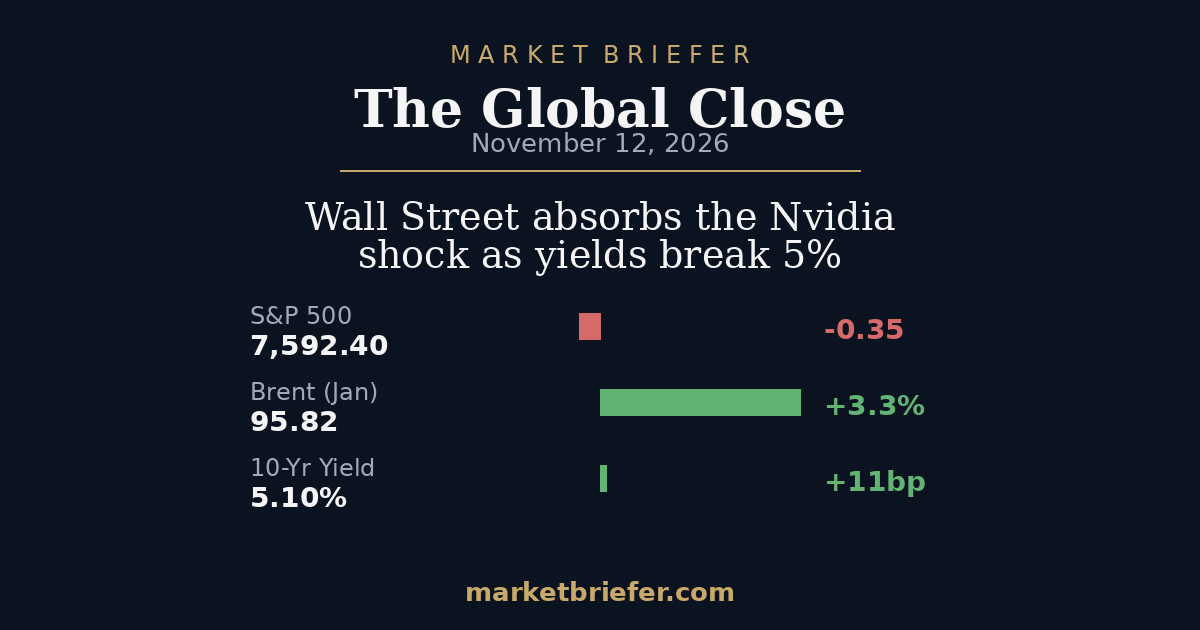
U.S. stocks slipped about 0.4% as Nvidia absorbed its CEO's resignation and the 10-year Treasury closed at 5.10%, while Europe set records, Asia fell, January Brent jumped 3.3% to $95.82 and gold hit a one-year low.
7 min read
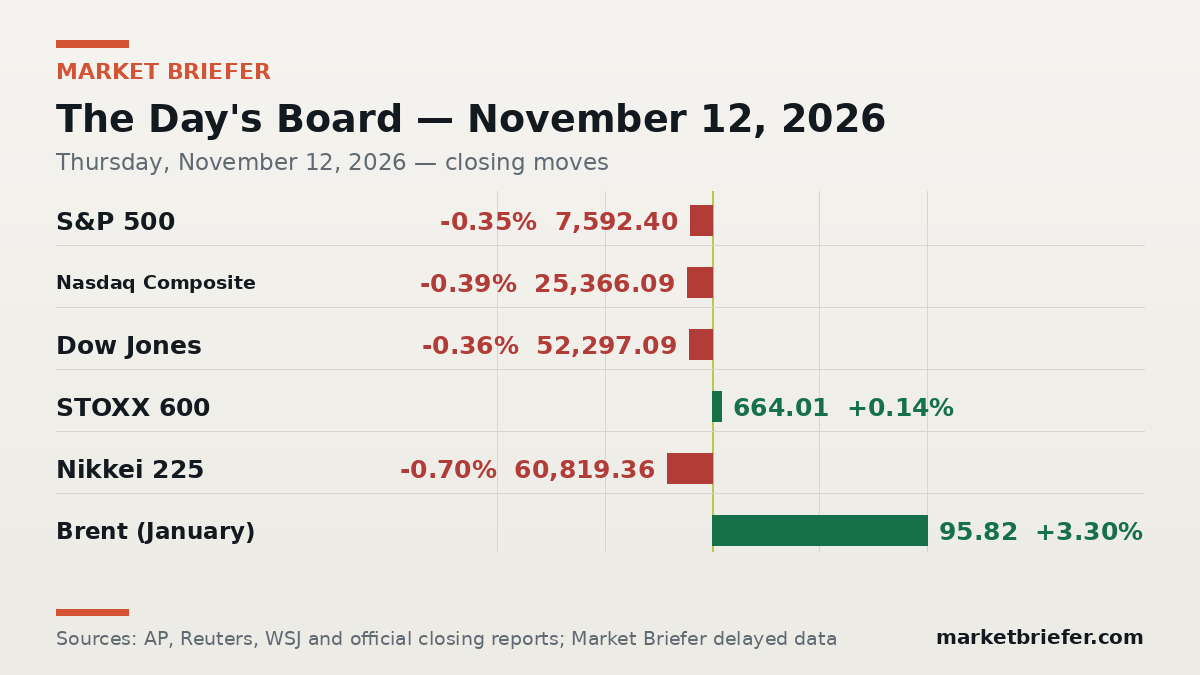
U.S. stocks finished with modest losses on Thursday after absorbing two shocks that would each, on a quieter day, have dominated the session: the resignation of Nvidia’s chief executive and a jump in Treasury yields back above 5% as the bond market reopened from the Veterans Day closure. The S&P 500 fell 26.98 points, or 0.35%, to 7,592.40, the Nasdaq Composite sank 100.10 points, or 0.39%, to 25,366.09, and the Dow Jones Industrial Average dipped 189.40 points, or 0.36%, to 52,297.09, the Associated Press reported. Nvidia plunged 14% in the opening minutes after its board announced that Jensen Huang, its co-founder and chief executive, had resigned amid the board’s investigation, with chief financial officer Colette Kress named interim chief executive; the stock recovered to close down 4.3% as rivals Advanced Micro Devices and Broadcom each climbed nearly 6%, according to Reuters and the AP. Europe closed at records and Asia gave back part of its recent run, while oil rallied after President Donald Trump said the United States does not need a deal with Iran, gold fell to a one-year low, and the dollar set its highest level since April 2025.
The Number That Matters: 5.10%. That is where the 10-year Treasury yield closed, at 5.102%, after the largest two-day rise since April 2025, the Wall Street Journal reported. It is the key number because it is the transmission line for everything else in this edition: the yield sets the discount rate for the AI buildout’s borrowing and the reference for mortgage rates — on the same day that sales of previously occupied homes fell to their slowest pace in more than 16 years, the AP reported — and it stands behind a dollar at its strongest since April 2025 and a 3% fall in gold. It matters more than Nvidia’s swing because the stock’s loss was halved by the close while the yield’s gain was not. A decisive move in Friday’s producer price index, if it printed soft enough to pull the 10-year back below 5%, would make that release the more important signal.
The day’s single story was how narrow the damage stayed relative to the headlines. Nvidia has now fallen more than 30% from its October 6 peak, a loss of about $1.8 trillion of market value in five weeks, Reuters calculated, yet the broader market treated its chief executive’s exit as a redistribution inside the AI trade rather than a verdict on it: chip buyers rotated to AMD and Broadcom, money rotated into energy, and the CBOE Volatility Index rose 6.92% to 18.70 — a flinch, not a panic, against Wednesday’s 17.49. The small-cap Russell 2000, with no such rotation to catch it, fell 1.66% to 2,799.06, the clearest measure of how much of the resilience was composition rather than calm.
United States: the shock contained, the rate problem widened
In the United States, energy was the strongest S&P 500 sector, rising 1.5%, and materials the weakest, falling 1.5%, with nine sectors lower and two higher, Reuters reported. Marathon Petroleum climbed 2.5% and Exxon Mobil added 1.8% on the oil rally, while the fuel bill landed on airlines: the sector fell about 5%, with United Airlines down more than 6%. Inside the AI complex the split was sharp — Super Micro Computer tumbled 11% after reports of a Justice Department probe, Nebius fell about 16% on a capital-spending forecast far above consensus, and CoreWeave gave back 6.9% of Wednesday’s surge. Corteva plunged 24% on weak Brazilian conditions and Global Payments fell 12% after Reuters reported two private-equity firms had dropped plans to acquire it. Readers can follow the full board on our markets desk. The day’s data pointed the same way as the yields: initial jobless claims rose 9,000 to 200,000, above the 194,000 forecast, and October existing home sales fell 5.5% to a 3.75 million annual pace, a 16-year low — evidence that high mortgage rates are still tightening on households even as the labor market holds.
Europe had the session the United States did not. The pan-European STOXX 600 rose 0.96 points, or 0.14%, to a record close of 664.01, its fourth consecutive gain, and Germany’s DAX climbed 109.11 points, or 0.41%, to a record 26,771.88, while France’s CAC 40 added 28.49 points, or 0.34%, to 8,361.36 and London’s FTSE 100 rose 27.62 points, or 0.25%, to 10,863.09. The support was earnings and rotation: STOXX 600 companies are tracking toward quarterly profit growth of about 25%, the strongest in four years on LSEG data cited by Reuters, Siemens rose after raising its medium-term growth outlook on record orders of €34.77 billion, Burberry surged 8.0%, and Reuters reported flows shifting out of AI-linked names in Asia and the United States into Europe. Britain’s economy added a tailwind, growing 0.7% in the third quarter — the fastest pace since early 2024, helped by AI-related strength, the Office for National Statistics said.
Asia, rates, currencies and commodities
Asia closed mostly lower as the Nvidia news hit the region’s chip supply chain first. Japan’s Nikkei 225 fell 429.23 points, or 0.70%, to 60,819.36, its first decline in four sessions, though the broader Topix rose 0.20% to 3,937.33; Advantest fell 4.6% and SoftBank Group 3.0%. Hong Kong’s Hang Seng dropped 307.37 points, or 1.26%, to 24,008.55, the Shanghai Composite lost 0.67% to 3,655.83, Taiwan’s Taiex fell 2.63% to 43,091.87 and South Korea’s Kospi eased 0.61% to 5,342.73. Australia’s S&P/ASX 200 slipped 6.40 points, or 0.07%, to 9,146.80, while India’s Nifty 50 was the region’s exception, rising 44.30 points, or 0.18%, to 25,299.35 as banking shares offset the chip drag.
In rates, the reopened Treasury market repriced the whole curve: the 2-year yield closed at 4.862%, its largest two-day gain since March 2023, and the curve flattened for a fourth straight session, Reuters reported, as Cleveland Fed President Beth Hammack said policy needs to move to a restrictive stance and Chicago’s Austan Goolsbee and San Francisco’s Mary Daly each backed further tightening. Futures fully price a quarter-point hike at the December 8–9 meeting, with LSEG data putting a 15% probability on a half point. The long end found no relief from supply: the $25 billion 30-year auction drew a bid-to-cover ratio of 2.36, below the 2.45 ten-auction average — lackluster demand on the same day the Treasury reported a record $404 billion October budget deficit, according to Reuters. The dollar carried the move abroad: the Dollar Index rose to 103.17, its highest since April 2025, the euro fell 0.28% to 1.1061, sterling eased 0.26% to 1.3240, and the dollar touched 160.04 yen before closing near 159.88, inside the zone where Japanese intervention has historically been a risk.
Commodities took the geopolitical leg of the story, as our commodities desk board shows. December WTI crude settled up 2.6%, or $2.21, at $88.74 a barrel and January Brent settled up 3.3%, or $3.06, at $95.82 — a like-for-like move in the same January contract that settled at $92.76 on Wednesday, not a contract roll — after President Trump posted that the United States does not need a deal with Iran; a 4.657 million-barrel build in U.S. crude inventories did not hold prices down. Our oil prices explainer sets out how that war premium is built and unwound. Gold, which pays no yield, took the rate move directly: futures fell 2.8% to $3,879.50 an ounce and spot gold touched $3,853, a one-year low, Reuters reported, while copper eased to $6.24 in the site’s delayed board. In crypto, bitcoin fell about 4% to near $71,400 and ether about 3% to near $2,018, tracking the tech selloff as U.S. spot bitcoin ETFs recorded a fifth straight day of outflows, CoinDesk reported.
What Would Change This Read: This interpretation would weaken if Friday’s producer price index prints soft while the 10-year yield falls back below 5% and January Brent holds above $90, suggesting Thursday’s pressure was an auction-and-reopening effect in a bond market catching up from a holiday, rather than a broadening inflation repricing. In particular, watch the PPI’s core reading and Nvidia’s follow-through, because they would distinguish between the current interpretation — that yields, not one company’s governance crisis, are the binding constraint — and the alternative that Thursday was primarily an AI-specific shock on a heavy supply day.
What to watch tomorrow starts with the second inflation print of the week: October’s producer price index, due Friday. Euro zone third-quarter GDP gets its flash estimate and Germany publishes wholesale inflation, while Fed officials Susan Collins, Lorie Logan, Michelle Bowman and Mary Daly speak — the first chance for officials to validate the market’s December pricing since yields moved. The Nvidia succession remains the single-stock file, and Asia’s open will show whether Tokyo’s chip names stabilize or extend the selloff.
This is not investment advice. The Global Close is AI-assisted market research produced with automated data checks; figures are verified against market-close reports and the site’s delayed data feeds at publication time.
See Market Briefer first in Google
Add to Preferred Sources