The Global Close: November 11, 2026 — AI rebound pulls Wall Street back toward its record
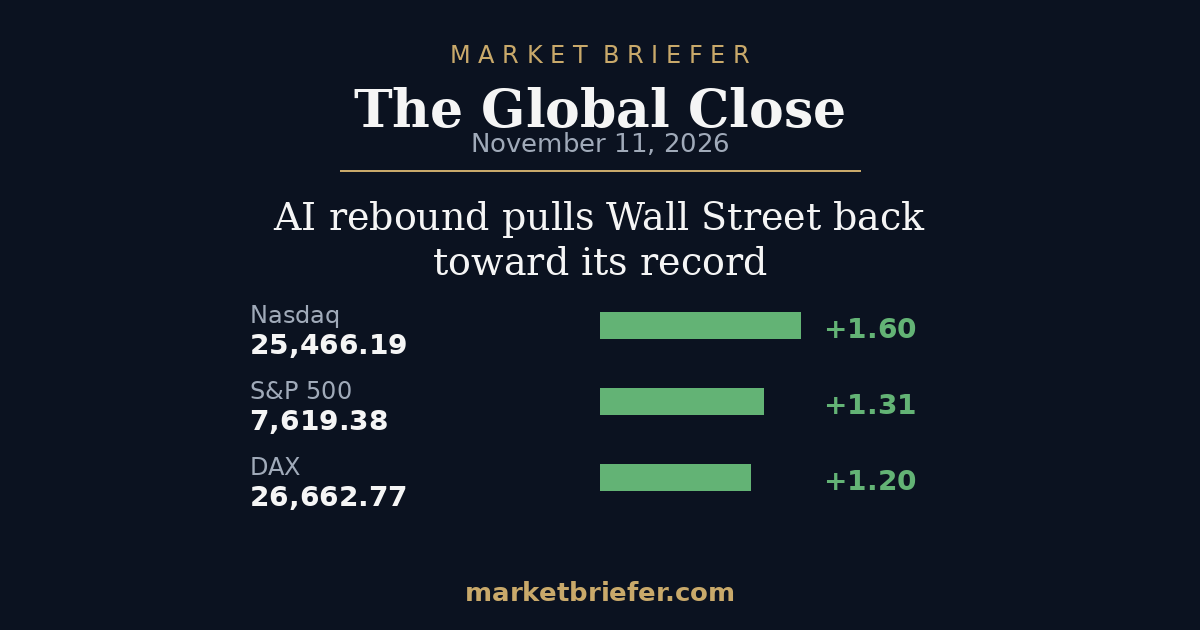
CoreWeave's earnings sparked an AI rebound that lifted the S&P 500 1.31% to 7,619.38, within 2.6% of its record, as Europe closed at a record and Tokyo rose a third day, with the bond market shut for Veterans Day.
7 min read
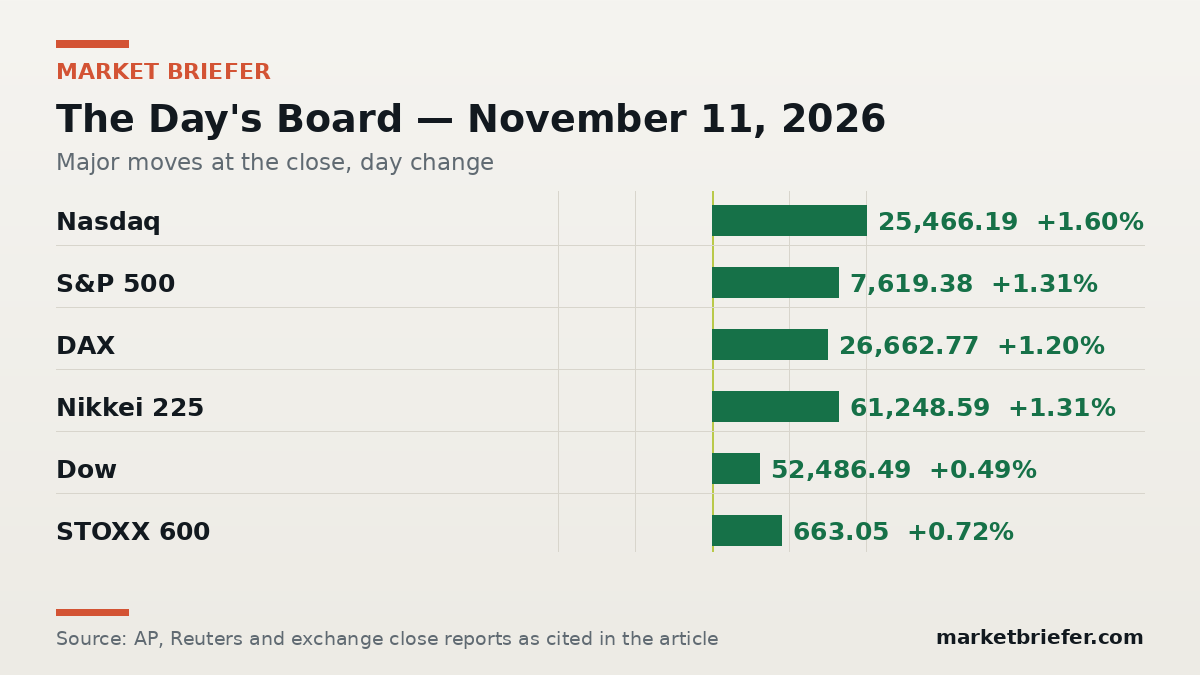
U.S. stocks rebounded sharply on Wednesday as one earnings report from the heart of the artificial intelligence buildout reversed the mood Tuesday’s hot inflation print had set, and the rally ran through every major region except Hong Kong. The S&P 500 rose 98.45 points, or 1.31%, to 7,619.38, the Nasdaq Composite rallied 400.31 points, or 1.60%, to 25,466.19, and the Dow Jones Industrial Average added 254.60 points, or 0.49%, to 52,486.49, the Associated Press reported. CoreWeave, which rents access to AI chips over the cloud, leaped 24.7% after reporting a smaller loss than analysts expected and raising its full-year revenue forecast, pulling chipmakers and data-center suppliers with it. Europe closed at a record, Tokyo rose for a third straight session, and India’s market reopened from its Diwali holiday with a gain of nearly 1%, even as traders priced a Federal Reserve rate hike in December as a certainty after October consumer prices rose 0.4% and core prices 0.3%. The U.S. bond market was closed for Veterans Day, so the rally ran without a fresh Treasury verdict on that pricing — the reason the rate question, not the stock rebound, remains the market’s open file.
The Number That Matters: 7,619.38. That is where the S&P 500 closed, within 2.6% of its all-time closing high of 7,819.04 set on October 6, according to the AP, despite an inflation report strong enough to put a half-point December hike on the table. It is the key number because it measures the distance the market has decided the rate shock does not reach at index level: yields transmit through discount rates into equity valuations, yet the index retraced almost the entire drawdown while futures still fully price at least a quarter-point hike on December 8–9, with a small but real chance of a half point, CME FedWatch data cited by Reuters showed. It matters more than the Nasdaq’s larger gain because the recovery was not confined to speculative names — nine of the S&P 500’s eleven sectors rose. A decisive move in the 10-year Treasury yield back above 5% when cash trading resumes on Thursday would make that yield, not this index level, the more important signal.
The day’s single story was how completely one company’s report card reset a market-wide argument. CoreWeave reported quarterly revenue of about $3.66 billion, ahead of the roughly $3.56 billion consensus, raised its 2026 revenue outlook to between $13.0 billion and $13.3 billion, and said it expected adjusted profitability in the first half of 2028, Reuters reported. Chief executive Michael Intrator said the company has roughly $9 billion in customer prepayments and deposits expected over the next three months, aimed squarely at the concern that has dogged the stock — how a debt-funded expansion is paid for if demand cools. The market’s answer was that demand is not cooling yet. The CBOE Volatility Index fell about 10% to 17.49, its fourth straight decline, after touching a more-than-seven-month high of 28.36 during last week’s sell-off, Reuters reported — the comparison that frames the session: a fear gauge that spiked when investors questioned the AI buildout has now retraced most of that spike in four sessions, because one heavily indebted tenant of the buildout showed its order book still growing.
United States: technology leads, breadth follows
In the United States, technology was the strongest of the S&P 500’s eleven sectors, rising 3.23%, with energy and industrials also ahead and consumer discretionary essentially flat, down 0.06%, as the only clear laggard. Micron Technology rallied 11.9% and Broadcom rose 4%, the AP reported, while Nvidia climbed 2.9% to $173.73 after two straight days of sharp losses that had nothing to do with demand — its board is investigating chief executive Jensen Huang, a governance matter separate from the industry’s fundamentals. Outside technology, Fossil Group soared 26.7% on a stronger-than-expected profit and a raised revenue forecast, while the rate-sensitive corners kept Tuesday’s bruises: homebuilders D.R. Horton fell 1.5% and PulteGroup 0.8%, and United Airlines lost 1.8% as oil recovered part of its earlier losses. Readers can follow the full board on our markets desk.
Europe turned the same AI rebound into a record. The pan-European STOXX 600 closed up 4.73 points, or 0.72%, at 663.05, a record close, and the EURO STOXX 50 rose 1.04% to 6,393.39. Germany’s DAX led the region, rallying 315.32 points, or 1.20%, to 26,662.77, as Siemens Energy jumped 10.8% after raising its 2027 profit-margin expectations — Europe’s own version of the data-center power trade. London’s FTSE 100 advanced 83.88 points, or 0.78%, to 10,835.47, and France’s CAC 40 added 54.28 points, or 0.66%, to 8,332.87. Oil and gas was the strongest sector group, ending eight straight declines as crude recovered from two-month lows.
Asia, currencies, rates and commodities
Asia set the tone before Europe opened, closing mostly higher for a third straight session as the semiconductor rebound spread through the region’s supply chain. Japan’s Nikkei 225 climbed 789.01 points, or 1.31%, to 61,248.59, with chip-testing equipment maker Advantest contributing roughly 378 points of the gain. South Korea’s Kospi jumped 2.6% to 5,375.36 and Taiwan’s Taiex rose 3.62% to 44,257.15. Hong Kong’s Hang Seng was the sole decliner, falling 241.12 points, or 0.98%, to 24,315.92, while the Shanghai Composite rose 16.92 points, or 0.46%, to 3,680.64 as China’s Singles Day shopping festival opened. Australia’s S&P/ASX 200 rose 24.20 points, or 0.27%, to 9,153.20. India’s Nifty 50 reopened after Tuesday’s Diwali-Balipratipada closure and gained 210.40 points, or 0.84%, to 25,255.05, led by banking and auto shares, after touching 25,424.35 intraday — its highest level in nearly nine months — before the U.S. inflation overhang trimmed the gain, exchange data showed.
In currencies and rates, the dollar extended Tuesday’s advance while the cash Treasury market sat out the session. The Dollar Index rose about 0.7% to near 102.9, the euro fell to 1.1093, sterling eased to 1.3279, and the dollar climbed 0.70% to 159.84 yen, breaking above its 100-day moving average near 159.00 a day after clearing the 200-day average at 158.70, according to the day’s FX wraps; the full board is on our U.S. dollar coverage. With no cash trading, Tuesday’s closing yields remain the reference: the 2-year at 4.74% and the 10-year at 4.99%, after the 10-year briefly touched 5.03% intraday on Tuesday — levels that mean borrowers face mortgage and corporate funding costs set by the year’s most hawkish repricing, even on a day stocks chose to ignore it. In credit, the Veterans Day closure meant no new cash-market spread prints for investment-grade or high-yield debt; the credit story stayed in investors’ reassessment of whether AI builders’ customer prepayments can carry their borrowing, rather than in any verified move in bond spreads.
Commodities split between geopolitics and the dollar, as our commodities desk board tracks. December WTI crude settled up 0.51% at $86.48 a barrel and January Brent added 1.4% to $92.76, the AP reported, recovering from two-month lows as attacks on shipping in the Strait of Hormuz — 37 vessels attacked in October, the highest monthly total since the war began in February, according to Washington Institute data cited by Reuters — revived supply concerns, and as industry data showed a 9.8 million-barrel draw in U.S. crude inventories for the week ended November 6. Our oil prices explainer sets out how that war premium is built and unwound. Gold, squeezed by the stronger dollar, fell about 1% to $3,991.80 an ounce, slipping back below $4,000, while silver rose and copper edged 0.55% higher to $6.27. In crypto, bitcoin rose 1.06% to $74,482 and ether held near $2,083, a steadier session than the equity rebound around them, with bitcoin ETF outflows extending to a fourth day, CoinDesk reported.
What Would Change This Read: This interpretation would weaken if the 10-year Treasury yield pushes decisively above 5% when cash trading resumes on Thursday while the S&P 500 gives back most of Wednesday’s gain, suggesting the rebound was a one-day positioning squeeze in a closed bond market rather than a genuine repricing of AI earnings power. In particular, watch Thursday’s initial jobless claims and the 30-year Treasury auction, because they would distinguish between the current interpretation — that AI cash flows, not rate relief, carried the session — and the alternative that equities simply traded unopposed while the market that prices their discount rate was shut.
What to watch tomorrow begins in London, where U.K. third-quarter GDP is due before the European open, followed in the United States by initial jobless claims, forecast at 194,000 against 189,000 the prior week, existing home sales, the Energy Information Administration’s crude inventory report, and a 30-year Treasury auction — the first live read on demand for long-dated debt since Tuesday’s repricing. Fed speakers Hammack, Barr, Goolsbee, Daly and Schmid will test whether officials validate the market’s December pricing, and Friday’s producer price index remains the second inflation print before the December 8–9 meeting. In Asia, Tokyo’s open will show whether the Nikkei can extend its run above 60,000 on Wall Street’s close.
This is not investment advice. The Global Close is AI-assisted market research produced with automated data checks; figures are verified against market-close reports and the site’s delayed data feeds at publication time.
See Market Briefer first in Google
Add to Preferred Sources