The Global Close: November 10, 2026 — Hot CPI puts a half-point hike on the table
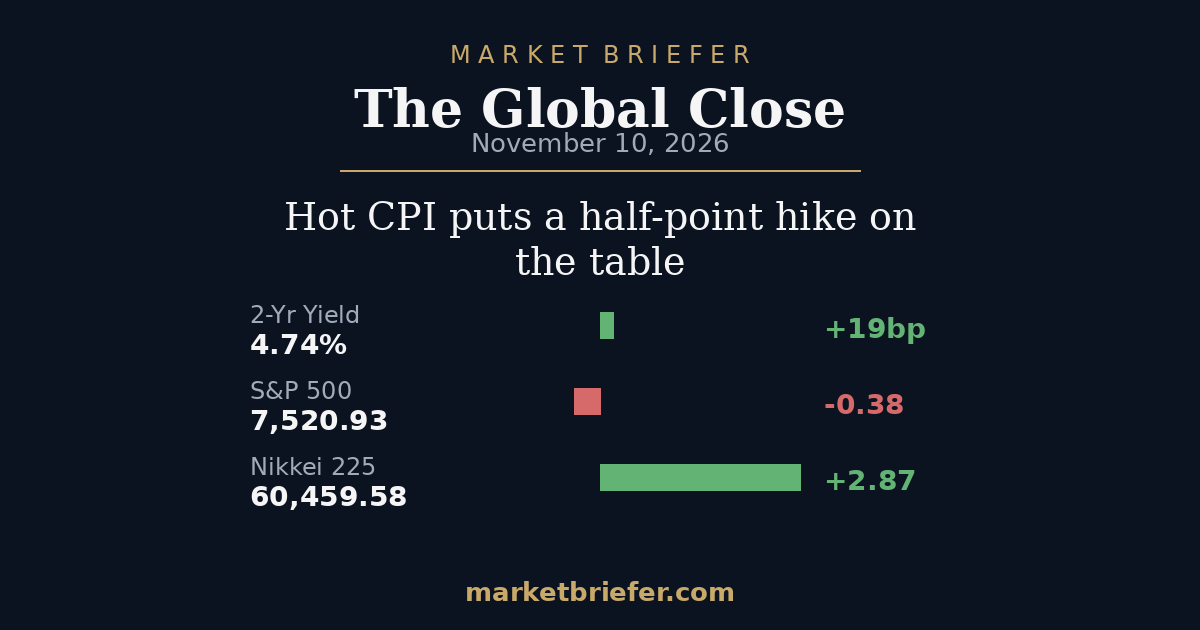
U.S. stocks slipped as October core CPI rose 0.3% for a third straight month, the 2-year Treasury yield jumped about 19 basis points to 4.74%, Tokyo surged through 60,000 and January Brent settled at $91.49.
7 min read
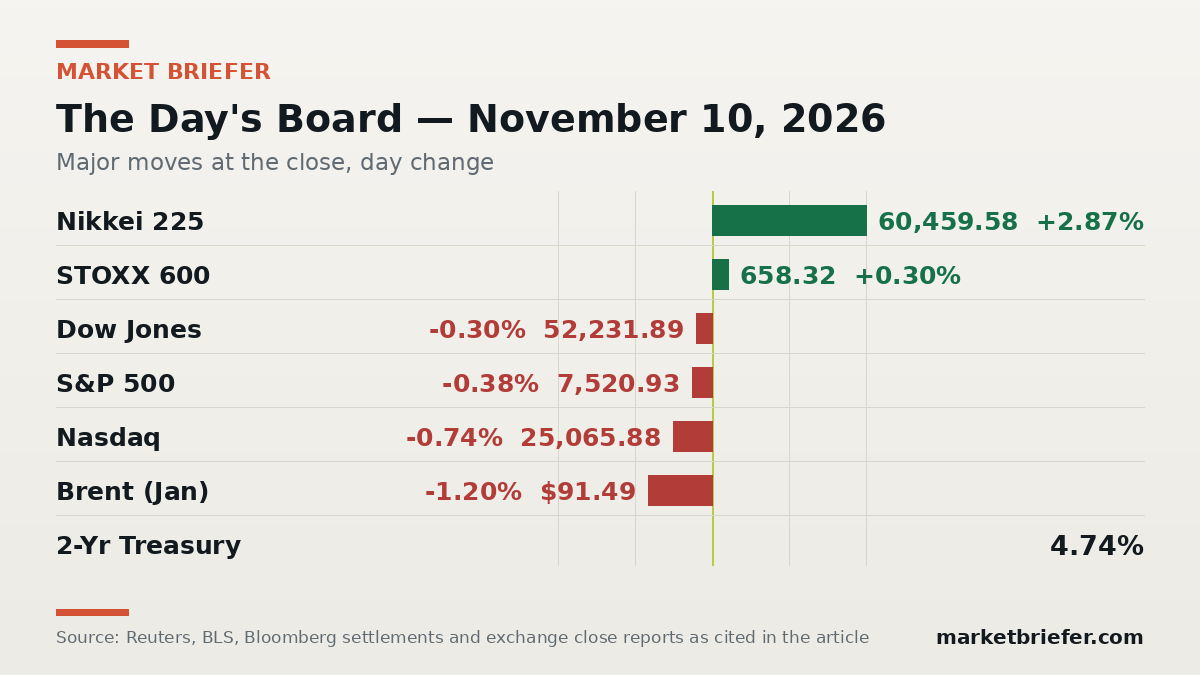
U.S. stocks gave back a slice of Monday’s surge on Tuesday after October inflation came in hotter than expected for a third straight month, reviving the question the market thought it had settled: not whether the Federal Reserve hikes in December, but by how much. The S&P 500 fell 29.01 points, or 0.38%, to 7,520.93, the Nasdaq Composite dropped 187.26 points, or 0.74%, to 25,065.88, and the Dow Jones Industrial Average eased 157.86 points, or 0.30%, to 52,231.89, with all three indexes closing well above their session lows. Consumer prices rose 0.4% in October and core prices 0.3% — the third straight 0.3% core reading, against forecasts of 0.3% and 0.2%, the Bureau of Labor Statistics reported. Yields jumped, the dollar strengthened and gold fell about 2%, while the rest of the world mostly kept Monday’s rebound alive: Tokyo surged 2.87% through 60,000, Seoul jumped 4.39%, and Europe added 0.3% even as London slipped. For borrowers the message was concrete: the market now treats a December hike as certain and has begun pricing a half-point move.
The Number That Matters: 4.74%. That is where the 2-year Treasury yield closed, up about 19 basis points in its largest single-day rise since the April 2025 tariff shock, according to Reuters. It is the key number because the 2-year is the market’s direct line to the Fed: hours before the data, Governor Christopher Waller had said a core reading of 0.3% or more would prompt him to consider a 50-basis-point hike at the December 8–9 meeting, and the print landed exactly on his line, which is why the front end, not the stock market, set the day’s tone. It matters more than the S&P 500’s modest decline because equities recovered most of their losses by the close while the 2-year did not — the rate repricing, unlike the index dip, was still intact at the bell. A decisive move in Friday’s producer price index, if it showed pipeline prices cooling sharply, would make that release the more important signal.
The day’s single story was a number small in itself and large in what it unlocked. A 0.3% core reading was the third in a row, it followed a blowout October jobs report, and Fed officials had publicly attached consequences to it in advance. Dallas Fed President Lorie Logan echoed Waller, saying it may be possible to move more rapidly than a quarter point, while Kansas City’s Jeffrey Schmid called policy “fairly accommodative,” Reuters reported. Futures fully priced a December hike of at least 25 basis points, up from roughly 84% odds on Monday, with a half-point move near one in ten by late afternoon. The historical anchor is April 2025, the last time the 2-year moved this much in a day: then, as now, a policy shock forced a violent one-session repricing of the rate path, and it stuck because officials validated it.
United States: technology lags, Nvidia falls again
In the United States, the selling was concentrated where higher yields bite hardest. Technology was the worst performer among the S&P 500’s 11 sectors, falling more than 1%, Reuters reported, while financials, energy and consumer staples held modest gains for much of the session. Nvidia fell for a second straight day, dropping 5.47% to $168.89 — a two-day loss of nearly 10% — after The Information reported that chief executive Jensen Huang’s relationship with a Chinese businesswoman had facilitated the shipment of at least $7.5 billion of the company’s chips through Chinese firms, according to Reuters; the company’s board investigation, disclosed Monday, remains open. The rest of the chip complex held up far better: Broadcom rose about 4%, Advanced Micro Devices added about 1%, and the iShares Semiconductor ETF ended near unchanged, keeping the damage company-specific. Microsoft fell about 2%, Take-Two Interactive jumped about 8% as huge preorders for Grand Theft Auto VI outweighed a results miss, and Paramount Skydance tumbled nearly 8% to lead the S&P 500’s decliners after its first earnings report since the merger. Readers can follow the full board on our markets desk.
Europe kept the rebound but not the momentum. The pan-European STOXX 600 closed 0.3% higher at 658.32, Germany’s DAX rose 80.26 points, or 0.3%, to 26,347.45, and France’s CAC 40 added 45.29 points, or 0.6%, to 8,278.59, while London’s FTSE 100 gave up its morning gains to close down 31.28 points, or 0.29%, at 10,751.59, Sharecast reported. The continent traded on de-escalation hopes after President Donald Trump said the Iran war was “effectively over,” and on a strong Infineon report — fourth-quarter revenue up 19% with an outlook for further data-center-driven growth. Henkel rose after raising its outlook, Vodafone dipped despite lifting guidance, and BP, Shell and Repsol fell with oil; the hot U.S. print trimmed gains mid-afternoon, and hawkish comments from Bank of England Deputy Governor Clare Lombardelli weighed on London.
Asia, currencies, rates and commodities
Asia had the day’s strongest session, closing before the U.S. data landed. Japan’s Nikkei 225 climbed 1,684.08 points, or 2.87%, to 60,459.58, reclaiming the 60,000 level for a second straight gain, with the broader Topix up 1.98% at 3,893.71. South Korea’s Kospi jumped 220.28 points, or 4.39%, to 5,239.13, snapping a three-day slide as technology shares rallied. Hong Kong’s Hang Seng rose 108.09 points, or 0.44%, to 24,557.04, the Shanghai Composite inched up 2.93 points, or 0.08%, to 3,663.72, and the CSI 300 added about 0.1% to 4,059.11, as China’s October trade data showed a $105.28 billion surplus with exports up 35.2% year over year and imports up 41.6%, the fastest import growth since May 2021. Australia’s ASX 200 rose 99.30 points, or 1.10%, to 9,129.00, led by industrials. India’s market did not trade: the NSE and BSE were closed for the Diwali-Balipratipada holiday and reopen Wednesday, so Mumbai’s last close remains Monday’s, when the Nifty 50 rose 0.23% to 25,044.65.
In currencies and rates, the dollar was the mirror image of Monday’s slide. The Dollar Index rose 0.6% to 102.29, the euro fell 0.56% to 1.1156, and in the site’s delayed feed sterling stood at 1.3345 and the dollar at 158.80 yen, with the full currency board on our U.S. dollar coverage. The 10-year Treasury yield rose about 13 basis points to 4.99%, after touching 5.03% intraday, as investors weighed a December hike the Fed has been telegraphing since it raised rates in September for the first time in three years. In credit, no verified closing investment-grade or high-yield spread figures were available from Tuesday’s close reports, so the credit story stays in the front end of the Treasury curve, where borrowing costs reset most directly off the policy path.
Commodities split along the day’s two forces, as our commodities desk board shows. December WTI settled down 0.9% at $86.04 a barrel and January Brent down 1.2% at $91.49, after Brent briefly dipped below $90 for the first time since August, Bloomberg reported. A correction to Monday’s edition: that article printed the site feed’s $92.17 for January Brent and $86.38 for December WTI; the exchange settlements were $92.57 and $86.85 respectively, and today’s percentage moves are measured against those settlements. Gold, which pays no yield, took the rate shock directly: futures fell 1.82% to $4,039.70 an ounce, silver eased 1.93% to $51.55 in the site’s feed, copper slipped to $6.27, and natural gas rose 3.11% to $3.32. Our oil prices explainer sets out how the war premium now unwinding was built. In crypto, bitcoin fell to $73,641 and ether to $2,052 in the site’s delayed snapshot, both near their lowest levels in almost three months, as the jump in yields tightened financial conditions across risk assets.
What Would Change This Read: This interpretation would weaken if Friday’s October producer price index prints soft while the 2-year yield falls back below 4.60%, suggesting Tuesday’s repricing was driven by Waller’s pre-set trigger and positioning rather than by a broadening inflation trend. In particular, watch the PPI’s core goods and services detail, because it would distinguish between the current interpretation — underlying inflation is sticky enough to force a faster hiking path — and the alternative that October’s CPI strength was concentrated in a few volatile categories the Fed can look through.
What to watch tomorrow is shaped by the calendar. Wednesday is Veterans Day: U.S. stocks trade a full session but the bond market is closed, so equities move without a fresh Treasury signal, and follow-through on Tuesday’s repricing waits for Thursday’s jobless claims and Friday’s producer price index, the second inflation print the Fed sees before December 9. CoreWeave reports after Tuesday’s close, a live test of the debt-funded AI buildout. India’s markets reopen, and Tokyo’s open will show whether the Nikkei holds above 60,000 after pricing in the hot U.S. print.
This is not investment advice. The Global Close is AI-assisted market research produced with automated data checks; figures are verified against market-close reports and the site’s delayed data feeds at publication time.
See Market Briefer first in Google
Add to Preferred Sources