IRS Sets 2027 Tax Brackets, Raises Standard Deduction to $33,200 for Married Couples
The IRS released its tax year 2027 inflation adjustments in Revenue Procedure 2026-35: the standard deduction rises to $33,200 for married couples filing jointly and $16,600 for single filers, bracket thresholds climb about 3.2 percent, and the child tax credit reaches $2,300, for returns filed in 2028.
2 min read
The Internal Revenue Service on Thursday released the annual inflation adjustments for tax year 2027, setting the income-tax brackets, the standard deduction and dozens of other figures for the returns taxpayers file in 2028. The adjustments, set out in Revenue Procedure 2026-35, raise the bracket thresholds by about 3.2 percent while leaving the seven tax rates unchanged at 10 percent through 37 percent. The figures apply to 2027 income; this spring’s return still uses the 2026 amounts.
The standard deduction rises to $33,200 for married couples filing jointly, up $1,000 from this year, the IRS said. For single taxpayers and married individuals filing separately, the deduction rises to $16,600, up from $16,100, and for heads of household it will be $24,925. Readers can compare the two years through the 2026 tax brackets and the standard deduction, explained in our library, which sets out the amounts that still apply to the return due next spring.
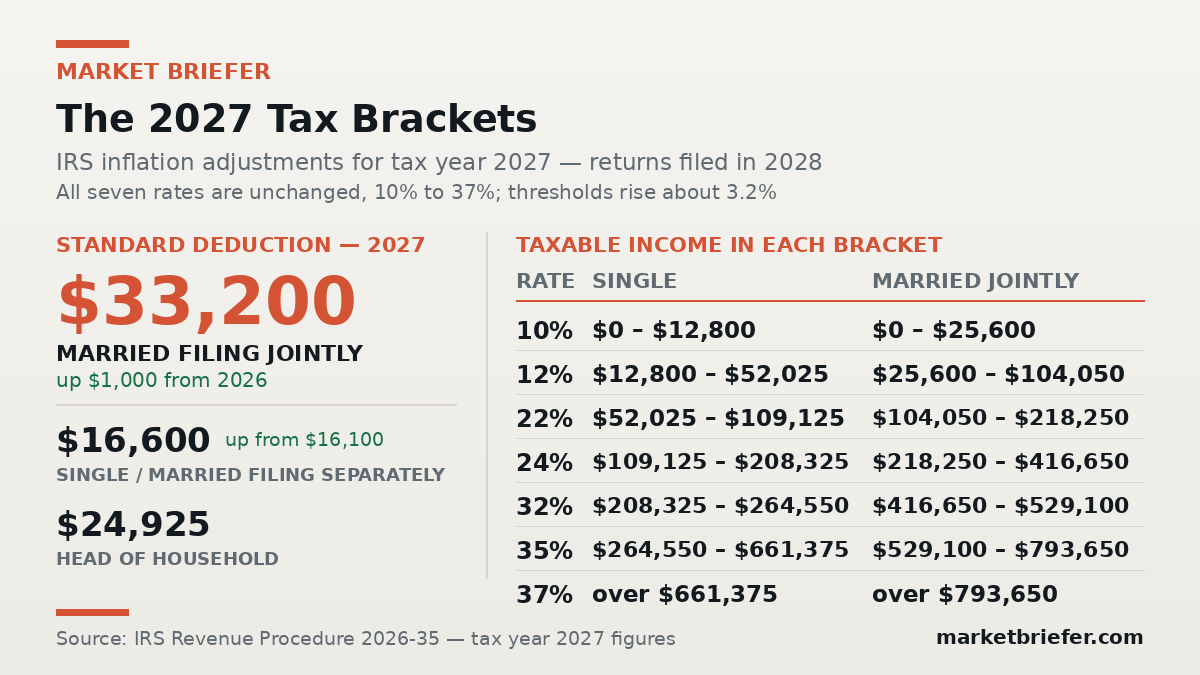
For single filers, the 12 percent rate will apply to taxable income above $12,800 in 2027, the 22 percent rate above $52,025, the 24 percent rate above $109,125, the 32 percent rate above $208,325, the 35 percent rate above $264,550 and the top 37 percent rate above $661,375. For married couples filing jointly, the thresholds are $25,600 for the 12 percent bracket, $104,050 for 22 percent, $218,250 for 24 percent, $416,650 for 32 percent, $529,100 for 35 percent and $793,650 for the top rate, Barron’s reported. Because thresholds rise with inflation, households whose pay only keeps pace with prices keep more income in the lower brackets.
The maximum child tax credit rises to $2,300 for 2027, up $100, with the refundable portion also up $100 to $1,800, and the maximum earned income tax credit reaches $8,496 for taxpayers with three or more qualifying children. Businesses can expense up to $2.64 million of Section 179 property, up from $2.56 million, the estate-tax exclusion rises to $15.48 million, the gift exclusion climbs to $20,000 and the health flexible spending account limit rises to $3,500. The temporary $6,000 deduction for seniors is not indexed and stays fixed, the Wall Street Journal reported, and the cap on the state and local tax deduction gets its own separate 1 percent adjustment, to $40,804.
“Hardworking American taxpayers will continue to benefit from the Working Families Tax Cuts and will see WFTC credits and deductions increase with this adjustment,” IRS Chief Executive Officer Frank J. Bisignano said in a statement, Accounting Today reported. Revenue Procedure 2026-35 carries the full tables for nearly 70 provisions, and further developments are tracked on the Tax & Policy desk.
Educational coverage — not tax or investment advice.
See Market Briefer first in Google
Add to Preferred Sources