Corporate America: October 30, 2026 — Intel’s Worst Day in 52 Years Meets Big Oil’s Refining Windfall
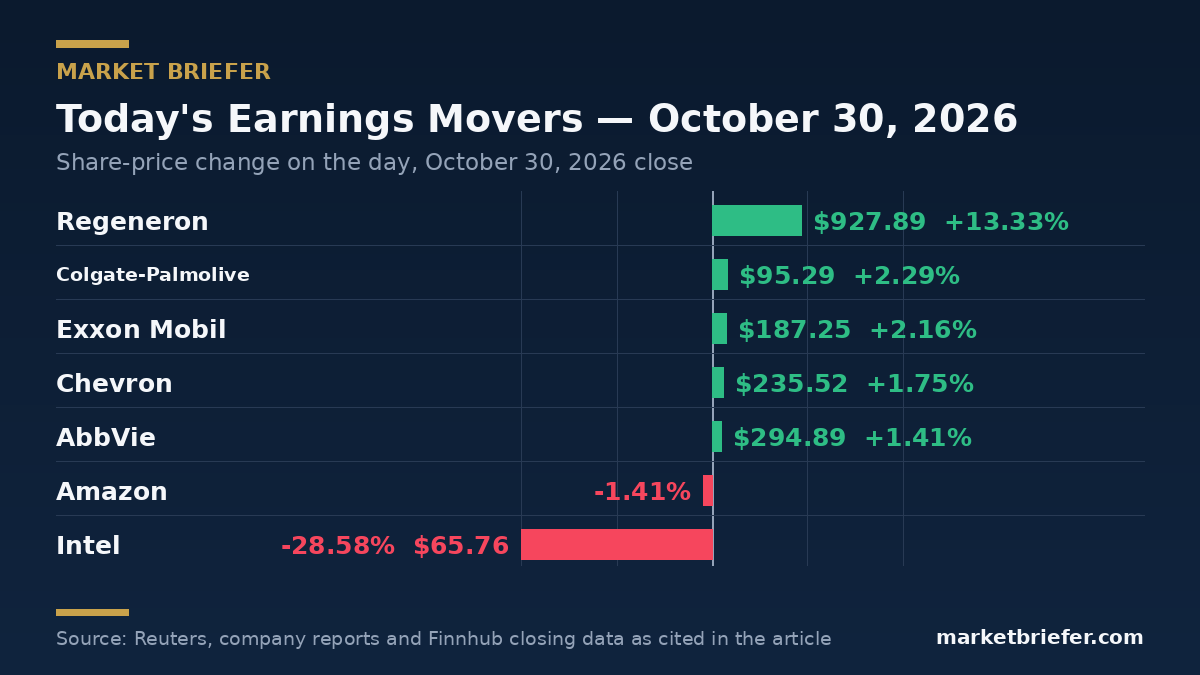
Intel plunged 28.58% in its worst day since the 1970s as the Nasdaq fell 2.86%, while Exxon and Chevron beat on a refining windfall, Regeneron surged 13.33% and AbbVie and Colgate raised outlooks on October 30, 2026.
5 min read
Intel closed down 28.58% at $65.76 on Friday, its worst day since the 1970s according to CNBC reporting cited in the day’s market wraps, after the chipmaker’s weak fourth-quarter outlook set off a semiconductor selloff that pulled the Nasdaq Composite down 2.86% to 25,437.00 and the Nasdaq 100 down 3.46%. The S&P 500 fell 1.82% to 7,580.07 and the Dow Jones Industrial Average fell 1.09% to 51,770.31, even as six of the eleven S&P 500 sectors rose. Energy led the gainers, up 1.91%, as Exxon Mobil and Chevron both beat expectations on a refining windfall, while health care and consumer staples also advanced on the day tracked on our Corporate America desk.
The split was the week’s story in one session. Technology lost 4.24% as investors punished guidance and cash burn, while companies that raised outlooks and returned cash were rewarded. Regeneron surged 13.33% to $927.89, Colgate-Palmolive rose 2.29% to $95.29, and the oil majors rose with their sector. Amazon ended 1.41% lower despite 39% cloud growth, because its spending bill is now the number investors watch first. That is the test our Earnings Season Playbook has flagged all season: a beat opens the door, but guidance and free cash flow decide whether the stock keeps it.
Earnings: Refining Paid, Guidance Ruled
Exxon Mobil earned $15.4 billion, or $3.72 a share, with adjusted earnings of $4.23 a share topping the $4.08 average estimate compiled by LSEG, Reuters reported. Revenue rose 33% to $113.16 billion, according to the Associated Press. For the first time in at least six years, Exxon earned more from refining than from producing oil and gas: Energy Products earned $7.17 billion against $7.09 billion from upstream, as war-driven fuel margins lifted refining across the industry. Its Gulf Coast refineries ran at 100% of capacity. Exxon shares closed up 2.16% at $187.25.
Chevron earned $9.9 billion, or $5.06 a share, with adjusted earnings of $5.28 a share beating the $4.89 analysts expected, and revenue up 36% to $67.8 billion. Downstream earnings reached $4.93 billion, up from $1.14 billion a year earlier and the highest in at least six years, as its U.S. refineries processed a record 1.09 million barrels of crude a day at nearly 98% of capacity, Reuters reported. “Margins will stay a bit elevated, maybe into next year,” Chevron Vice Chairman Mark Nelson said on the analyst call. Chevron shares closed up 1.75% at $235.52.
Health care supplied the day’s biggest gainer. Regeneron reported revenue up 36% to $5.12 billion, above the $4.56 billion analysts expected, with adjusted earnings up 70% to $20.07 a share against about $16.24 expected on LSEG data, Reuters reported. Global sales of Dupixent, booked by partner Sanofi, rose 35% to $6.5 billion, Sanofi collaboration revenue rose 68% to $2.72 billion, and U.S. sales of Eylea HD rose 62% to $699 million. AbbVie was steadier but just as clean: revenue rose 10.3% to $17.40 billion, ahead of the $17.31 billion expected, and adjusted earnings of $3.82 a share beat the $3.75 expected, Reuters reported. Skyrizi sales rose 22.7% to $5.78 billion, beating the $5.75 billion expected, Rinvoq rose nearly 24% to $2.71 billion, and neuroscience revenue climbed 19% to $3.39 billion, more than offsetting Humira’s fall to $683 million. AbbVie shares closed up 1.41% at $294.89, a record.
Colgate-Palmolive led staples. Net sales rose 4.6% to $5.37 billion, organic sales rose 3.6%, and Base Business earnings rose 7% to $0.97 a share, beating the $0.93 expected on Reuters data, the company reported. Gross margin expanded 90 basis points to 60.3% on a Base Business basis, even as resin and logistics costs stayed elevated. Church & Dwight also beat, with earnings of $0.92 a share on revenue of $1.60 billion, while Kenvue reported sales up 3.2% to $3.886 billion and adjusted earnings of $0.29 a share, and gave no guidance because of its pending combination with Kimberly-Clark. Intel’s fall followed its forecast of fourth-quarter revenue of $15 billion to $16 billion, below the $17.07 billion expected, while Amazon’s decline came as investors weighed AWS growth of 39% to $46 billion against trailing-twelve-month free cash flow of negative $42.4 billion and a held capital spending forecast of about $220 billion.
Deals, Capital and Footprint
The oil majors chose balance sheets over bigger payouts. Exxon cut debt by $8 billion in the quarter, raised its fourth-quarter dividend by 4 cents to $1.07 a share, payable December 10, and said it would repurchase $20 billion of shares in 2027, the same level as the previous two years, Reuters reported. Chevron has cut net debt by nearly $14 billion compared with the end of 2025. “We think in decades, not quarters,” Chevron Chief Financial Officer Eimear Bonner told Reuters. AbbVie made the day’s other shareholder move, raising its full-year adjusted profit forecast to $13.95 to $13.99 a share, from $13.76 to $13.96, including a 69-cent hit from acquired research and milestone costs, and lifting its quarterly dividend 5.2% to $1.82 a share from $1.73, starting with the February 2027 payment. It also completed its acquisition of Apogee Therapeutics, the $10.9 billion deal that adds eczema and asthma treatments to its pipeline. Colgate narrowed its 2026 sales growth outlook to 4% to 5%, from 2% to 6%, and raised its Base Business earnings growth outlook to 5% to 7%.
Footprint moves were about adding fuel capacity rather than cutting jobs. Exxon said refinery investments, including at its Baytown complex in Texas, will add another 100,000 barrels a day of distillate production, and Chief Financial Officer Neil Hansen said the company’s most meaningful response to high fuel prices is to increase supply. Chevron said it could grow capacity by 7% at its Pascagoula refinery in Mississippi by the end of the decade. No major U.S. layoff announcement led the day’s news.
The one to watch is Monday, November 2, when Apple reports fiscal fourth-quarter results after the close, according to Apple’s investor calendar and the week’s earnings calendars, in the first earnings call led by new Chief Executive John Ternus alongside Chief Financial Officer Kevan Parekh. Analysts expect earnings of about $1.99 a share on revenue of about $113.19 billion, after Apple guided to revenue growth of 9% to 11%. Palantir and Vertex Pharmaceuticals also report Monday. After a week in which Alphabet, Amazon and Intel were punished for what growth costs to fund, Apple will be judged on the same question: not whether demand is real, but what it costs to serve it.
This is not investment advice. Corporate America is AI-assisted research produced with automated data checks; figures are verified against the cited sources at publication time.