Corporate America: October 28, 2026 — Microsoft’s Cloud Beat Meets Alphabet’s Cash Burn
Microsoft beat on Azure and free cash flow while Alphabet's $51.4 billion capex pushed cash flow negative, Oracle forecast $225 billion by 2030, and a Peltz-led group bid $1.4 billion for Wendy's on October 28.
5 min read
Microsoft and Alphabet told opposite versions of the same artificial intelligence story on Wednesday. Microsoft showed cloud revenue growing fast enough, and spending controlled enough, to leave $18.6 billion in free cash flow. Alphabet showed cloud revenue more than doubling, yet spending so heavy that free cash flow fell to negative $9.07 billion and its shares dropped about 10% in extended trading. The split, on a day the Federal Reserve left rates unchanged, ran through a busy session tracked on our Corporate America desk: Oracle surged on a forecast meant to calm the same fears, a Peltz-led group bid $1.4 billion to take Wendy’s private, and suppliers were rewarded while a solar miss was punished.
Microsoft reported revenue of $92.3 billion for the quarter ended September 30, up 19% from a year earlier, according to Reuters. Revenue at Azure, its cloud business, grew 48% to $33.17 billion, topping the $32.84 billion estimate compiled by Visible Alpha and up from $29.4 billion in the prior quarter. Capital expenditure was $45.2 billion, up from $34.9 billion a year earlier but below Microsoft’s own $50 billion projection, and free cash flow of $18.6 billion was well above the $8.54 billion analysts expected. Its shares rose in extended trading.
Alphabet’s numbers were larger and harder to fund. Total revenue rose 25% to $127.6 billion, short of the $128.2 billion analysts expected according to LSEG data cited by Reuters, because its core advertising business reported $82.01 billion, about $1.41 billion short of expectations. Google Cloud revenue more than doubled, rising 103% to $30.71 billion and beating estimates, but capital expenditure reached $51.4 billion and free cash flow was negative $9.07 billion, compared with expectations that it would come close to breaking even and a $5.9 billion burn in the prior quarter. Net income fell 25% to $26.17 billion and adjusted earnings of $2.67 a share missed the $3.02 target, Reuters reported. Chief Financial Officer Anat Ashkenazi said capital expenditure will increase significantly in 2027. That is the pattern our Earnings Season Playbook sets out to watch: growth alone is no longer enough when its cash cost rises faster.
Earnings Beyond the Hyperscalers
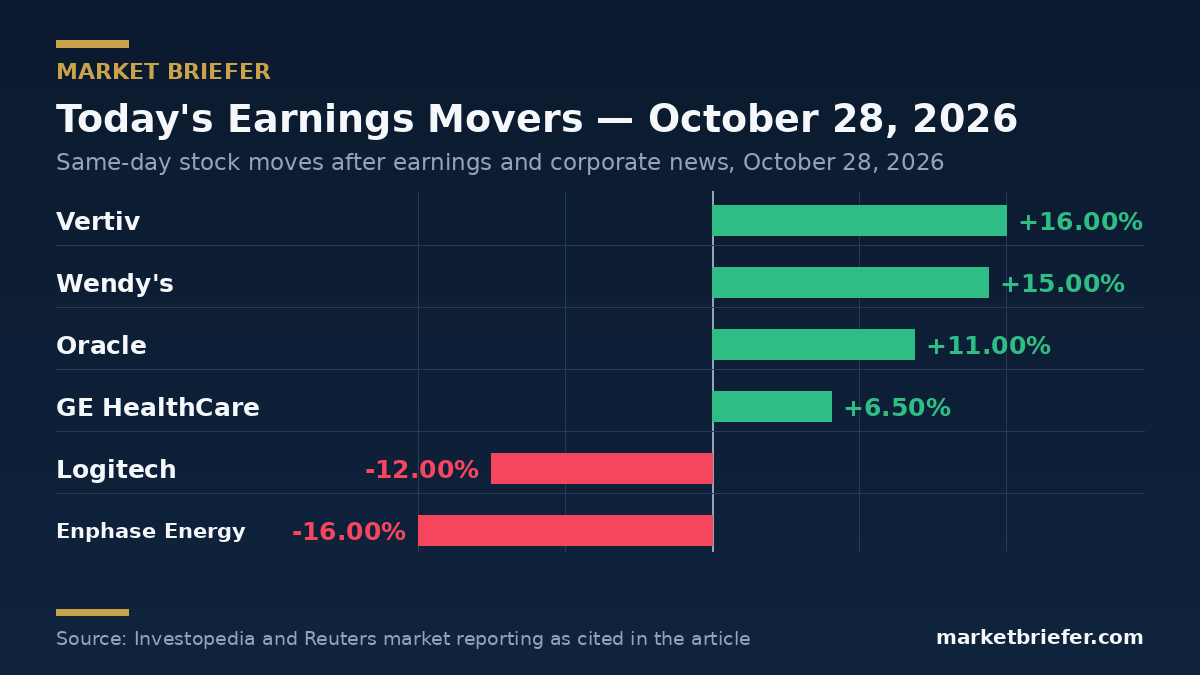
The data-center suppliers had the cleanest day. Vertiv soared 16% after net sales growth of 61%, organic orders growth of more than 100% and diluted earnings growth of 91%, and it raised full-year guidance in its company release. GE HealthCare jumped 6.5% after revenue rose 7.2%, adjusted earnings rose 25.1% to $1.34 a share, above consensus, and it raised its full-year adjusted outlook to $4.95 to $5.05 a share, from $4.80 to $5.00, on a $23.7 billion backlog.
The misses were treated harshly. Enphase Energy plunged 16% after missing on revenue and guiding well below expectations for the fourth quarter as U.S. home solar demand stayed weak, and Logitech sank 12% after its results, Investopedia reported. FedEx offered a more mixed read on the wider economy. The Memphis-based shipper reported third-quarter adjusted profit of $3.74 a share, up from $2.93 a year earlier, a 28% rise in earnings driven by improved pricing, higher volumes and cost savings, Reuters reported. It forecast 2026 adjusted profit of $18 to $18.60 a share, above the $17.73 analysts expected according to LSEG. Yet its shares dropped nearly 4% in extended trading after operating margin at its core U.S. express delivery segment fell to 6.6%, from 6.8% a year earlier. Chief Executive Raj Subramaniam cited disciplined execution to reduce cost-to-serve.
Deals, Capital and Strategy
Wendy’s supplied the day’s deal. Billionaire Nelson Peltz’s Trian Fund Management, which with related parties holds a 16.3% stake, led a group offering $7.35 a share in cash, about $1.4 billion in total and roughly a 20% premium to Tuesday’s closing price, according to a regulatory filing reported by Reuters. The group includes Flynn Group, one of Wendy’s largest U.S. franchisees, and BlueFive Capital and Sixth Street Partners. It told the board private ownership provided the patient capital needed to restore the business, describing Wendy’s as at a critical juncture amid consumer pressure, commodity inflation and intensifying competition. Wendy’s, which withdrew its annual forecasts in August, saw its shares surge 15% on the bid.
Oracle made the day’s biggest capital promise. At its investor day in Las Vegas, the company forecast revenue of more than $225 billion for fiscal 2030, an adjusted operating margin above 40% and adjusted earnings of more than $21 a share, implying average annual growth of about 35%, Reuters reported. Chief Financial Officer Hilary Maxson said free cash flow would turn positive in the second half of fiscal 2028 and exceed $30 billion in fiscal 2029, and Oracle committed to limiting additional capital raises through fiscal 2030 to $20 billion, split between equity and debt. It reaffirmed fiscal 2027 revenue of more than $90 billion and adjusted earnings of $8.10 a share. The shares soared 11%, after falling by around a third this year on concern about debt taken on to fund AI infrastructure. Diebold Nixdorf followed with a smaller return: it lowered its full-year revenue outlook to $3.86 billion to $3.9 billion and its earnings outlook to $4.50 to $4.85 a share, citing elevated component costs, while its board authorized a new $250 million share buyback program.
Jobs moves were concentrated in technology and entertainment. Microsoft this week offered voluntary buyouts to about 60,000 employees, more than a quarter of its workforce and its second such program this year, with eligible workers to decide by early December, according to Business Insider and The Seattle Times reporting cited in national coverage. Walt Disney laid off 100 to 200 employees in Disney Experiences, mostly in Walt Disney Imagineering in Glendale, California, the Los Angeles Times reported, as it shifted project priorities.
The one to watch is Thursday, October 29. Before the open, Eli Lilly, Mastercard, Merck and Caterpillar report, according to the earnings calendars published for the week, and after the close Amazon, Intel, Starbucks and Coinbase report, with Amazon the next hyperscaler test of whether cloud growth can outrun AI spending. After Wednesday, the question is no longer whether AI demand is real — Microsoft, Alphabet, Vertiv and Oracle all showed that it is — but which companies can fund it from their own cash flow.
This is not investment advice. Corporate America is AI-assisted research produced with automated data checks; figures are verified against the cited sources at publication time.