Corporate America: November 6, 2026 — Chips Bounce Back as DraftKings Plunges 21%
Chips rebounded Friday after Thursday's rout as October payrolls tripled forecasts at 165,000, Moderna and Vistra beat and raised their outlooks, and DraftKings plunged 21% on the cost of its prediction-markets bet.
5 min read
Corporate America spent Friday deciding how much of Thursday’s rout to take back. The chip stocks that led the market’s worst session since April 2025 led the recovery, as the Nasdaq Composite rose 264.43 points, or 1.09%, to 24,579.42 and the S&P 500 rose 23.13 points, or 0.31%, to 7,376.86, while the Dow Jones Industrial Average fell 237.33 points, or 0.46%, to 51,285.73, according to the Associated Press close. The bounce recovered only a fraction of Thursday’s losses: the S&P 500 still fell 2.7% for the week, the Nasdaq fell 3.4% and the Dow fell 0.9%, and it ran into a jobs report strong enough to push traders toward expecting another Federal Reserve rate increase in December.
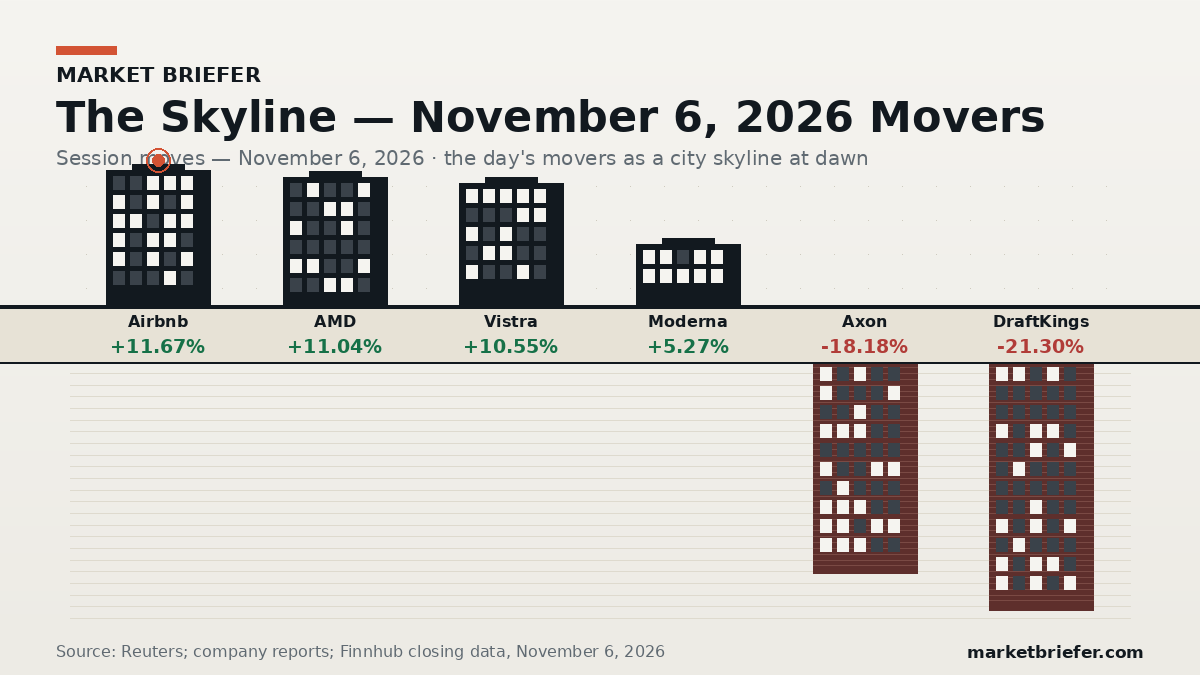
The buying, tracked throughout on our Corporate America desk, was narrow and specific. Advanced Micro Devices closed up 11.04% at $449.04, Intel rose 7.71%, Micron Technology rose 5.12% and Nvidia rose 2.78%, while SanDisk, Thursday’s worst performer, recovered 3.55%. Airbnb was the day’s biggest large-cap winner, closing up 11.67% at $189.99 as Thursday evening’s raised outlook and new $12 billion buyback authorization got a full session’s verdict. Against that, the earnings calendar produced two heavy losers: Axon Enterprise fell 18.18% to $313.00 and DraftKings fell 21.30% to $18.51. It was, as our Earnings Season Playbook puts it, a session that rewarded raised guidance and punished any company asking investors to fund a bigger future out of a smaller present.
Earnings: Guidance Raised in Health and Power, Cut in Betting and Drones
Moderna delivered the morning’s cleanest beat. Third-quarter revenue rose 29% to $1.31 billion, well ahead of the roughly $889 million analysts expected, as higher international COVID vaccine sales drove net product sales up 30.8% to $1.27 billion. The company swung to net income of $162 million, or $0.38 a diluted share, from a loss of $200 million, or $0.51 a share, a year earlier, against expectations for a loss of about $1.10 a share, and cut research and development spending 27% to $583 million. Moderna raised its 2026 revenue growth target to 15% to 25%, from up to 10% previously, trimmed planned research spending to about $2.7 billion and lifted its year-end cash and investments outlook to $8.1 billion to $8.3 billion. The shares closed up 5.27% at $254.19.
Humana’s beat came with a harder story underneath. Revenue rose about 26% to $41.16 billion, ahead of the $40.87 billion expected, and the adjusted loss of $0.70 a share was narrower than the roughly $1.03 loss analysts had penciled in, though it compared with adjusted earnings of $3.24 a share a year earlier as Medicare Advantage Star Ratings pressure and higher benefit costs for new members bit. The consolidated benefit ratio deteriorated to 93.9%, while the insurance segment’s 93.7% came in better than the slightly above 94% management had guided. Humana raised its full-year adjusted earnings guidance to at least $9.50 a share, from at least $9.00, and its GAAP guidance to at least $15.09, and the shares closed up 5.33% at $433.74.
Vistra turned power demand into the day’s strongest utility print. Revenue rose 28% to $6.35 billion, but ongoing operations adjusted EBITDA jumped more than 50% to $2.378 billion, from $1.581 billion, on higher realized prices, the acquired Lotus plants and the return of Martin Lake Unit 1, and net income rose to $1.14 billion. Chief Executive Jim Burke told analysts demand from hyperscalers and other large-load customers remained strong and had not shifted from Texas to the PJM market after the midterm elections, Reuters reported. Vistra narrowed and raised its 2026 adjusted EBITDA guidance to $7.1 billion to $7.5 billion, initiated 2027 guidance of $7.7 billion to $8.5 billion, added $1.5 billion to its buyback authorization, leaving about $2.5 billion available, and closed up 10.55% at $124.80.
The cuts were as instructive as the raises. Axon posted record third-quarter revenue of $908.6 million, up 28%, but missed the roughly $937 million expected, with adjusted earnings of $1.72 a share against about $1.89 expected, after three federal Dedrone counter-drone deployments worth about $130 million slipped out of 2026. Axon cut full-year revenue guidance to $3.61 billion to $3.63 billion, about 30% growth against 32% to 34% before, even as it announced an additional $1.2 billion investment in drone maker Skydio, taking its stake to 37% and exclusive U.S. and Canadian public-safety distribution rights. DraftKings fell furthest: revenue rose 16% to $1.329 billion, below the $1.40 billion LSEG estimate cited by CNBC, the net loss widened to $468.7 million, or $0.94 a share, and management cut 2026 adjusted EBITDA guidance to $175 million to $275 million, from $700 million to $900 million, because building its Predictions business will now consume $650 million to $700 million of adjusted EBITDA this year, while cutting the revenue outlook to $6.35 billion to $6.55 billion.
Jobs, Capital and the One to Watch
The day’s economic verdict came at 8:30 a.m. Eastern. Nonfarm payrolls rose 165,000 in October, the Bureau of Labor Statistics said, more than double the 65,000 economists polled by Reuters had forecast, with September revised up to 60,000 from 29,000 and August to 186,000, a combined upward revision of 84,000. The unemployment rate fell to 4.1% from 4.2%, professional and business services added 70,000 jobs, health care added 42,000 and transportation and warehousing added 25,000, while average hourly earnings rose 0.4% to $38.00, up 3.1% from a year earlier, and participation edged up to 61.9%. Reuters reported traders raised the priced-in chance of a December rate increase to about 78% after the release. Capital return supplied the chip rebound’s other engine: Lam Research’s board authorized a new $25 billion share repurchase program, supplementing its prior authorization with no termination date, and declared a quarterly dividend of $0.33 a share payable January 6, 2027, to holders of record December 2.
The one to watch is Saturday, November 7. Berkshire Hathaway posts its third-quarter earnings release and Form 10-Q at about 7:00 a.m. Central, the company said, in the first autumn report of the Greg Abel era, with insurance underwriting, the rail and energy businesses and deployment of a cash pile that stood near $364.7 billion at mid-year all in focus. Beyond the weekend, the October consumer price report lands Tuesday, November 10, and will test whether Friday’s hot payrolls print survives contact with the inflation data. After a week that erased and then partially restored trillions in chip value, Berkshire’s quiet Saturday filing may be the most corporate document of all.
This is not investment advice. Corporate America is AI-assisted research produced with automated data checks; figures are verified against the cited sources at publication time.
See Market Briefer first in Google
Add to Preferred Sources