Corporate America: November 5, 2026 — Chips Implode as the AI Trade Unwinds
Chips plunged on November 5, 2026 as the AI trade unwound, erasing the post-midterm rally, while Tapestry beat and raised its outlook and Airbnb and Cloudflare jumped after hours.
5 min read
Corporate America gave back Wednesday’s celebration in a single, brutal session. U.S. stocks plunged on Thursday as investors reassessed what the Democrats’ sweeping midterm wins mean for the artificial intelligence data-center buildout, and a handset miss from Qualcomm turned caution into a rout in the chip trade. The Dow Jones Industrial Average fell 1,833.06 points, or 3.44%, to 51,523.06, more than erasing the prior day’s 1,569-point gain, the S&P 500 fell 4.36% to 7,353.73 in its worst day since April 2025, and the Nasdaq Composite fell 5.52% to 24,315.00, closing in a correction, 11.9% below its October 6 record close, Reuters reported. The Philadelphia Semiconductor Index fell 12.25% to 9,011.14, a fall Reuters described as the chip index’s second-biggest on record, with all 11 S&P 500 sectors down and technology off 7.3%.
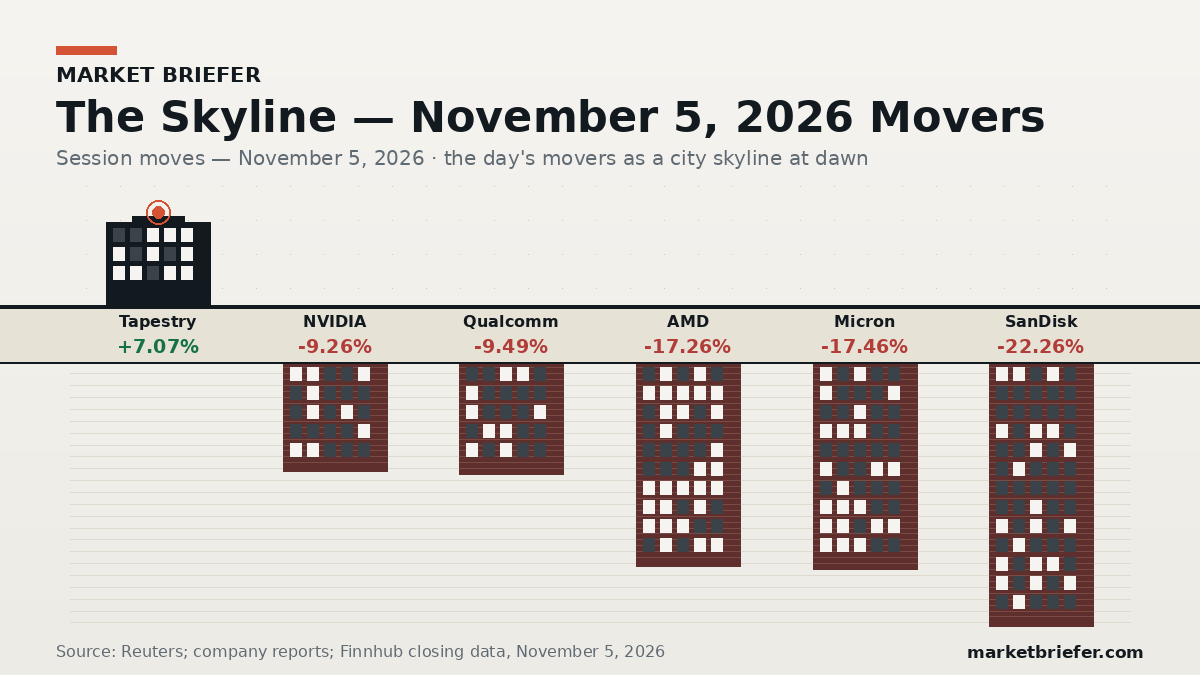
The damage, tracked throughout on our Corporate America desk, was concentrated where the AI trade had been richest. SanDisk closed down 22.26%, Micron Technology fell 17.46% and Advanced Micro Devices fell 17.26%, while Nvidia fell 9.26% and Qualcomm fell 9.49% to $156.75 after its fourth-quarter smartphone chip sales missed estimates on sluggish demand and declining Apple-related revenue. Tapestry was the day’s conspicuous exception, closing up 7.07% at $134.17 after Coach carried it to a beat and a raised outlook. It was the kind of session the Earnings Season Playbook warns about: in a crowded trade, the quarter in front of investors matters less than the future they suddenly decide to reprice.
Earnings: Coach, Oil and a Beat That Still Fell
Tapestry’s first quarter showed the accessible-luxury consumer still spending. Sales rose 11.1% to $1.89 billion, ahead of the $1.86 billion analysts expected on LSEG data compiled by Reuters, and adjusted earnings rose to $1.82 a share, topping estimates of $1.57, as Coach revenue rose 16% while Kate Spade sales fell 10%. Greater China revenue jumped 43% on a reported basis, and the company added 2.1 million new Coach customers in the quarter. Tapestry raised its fiscal 2027 revenue forecast to $8.5 billion to $8.6 billion, from $8.4 billion to $8.5 billion, lifted its earnings forecast to $8.25 to $8.35 a share, from $7.80 to $7.90, and raised planned share buybacks to $1.7 billion, part of $2 billion in capital returns, alongside a quarterly dividend of $0.4625 a share.
Ralph Lauren beat and was sold anyway. Adjusted earnings were $4.64 a share against a $4.27 consensus on Zacks data, and revenue rose 9.1% to $2.19 billion, ahead of the $2.14 billion expected, yet the shares closed down 7.35% at $381.78 as the broader selloff overwhelmed the print. Energy and health care held up better in the morning wave. ConocoPhillips posted adjusted earnings of $3.27 a share, ahead of the $2.97 average estimate on LSEG data cited by Reuters, as a realized price of $61.40 a barrel of oil equivalent, up 32% from a year earlier, and cost cutting offset a production dip to 2.3 million barrels of oil equivalent a day from 2.4 million. The largest U.S. independent producer raised its quarterly dividend 11% to $0.93 a share, returned $3.4 billion to shareholders in the quarter, including $2.4 billion of buybacks, and forecast fourth-quarter production of 2.32 million to 2.36 million barrels a day. Cigna also beat, with earnings of $7.98 a share against estimates around $7.50, and raised its outlook, according to the morning earnings reports.
The jobs backdrop, notably, gave sellers no support. Initial claims for state unemployment benefits fell 6,000 to a seasonally adjusted 189,000 for the week ended October 31, the Labor Department said, matching a mid-July reading that was the lowest since 1969 and coming in below the 196,000 economists polled by Reuters had forecast. A separate Labor Department report showed nonfarm productivity rising at a 3.6% annualized rate in the third quarter, ahead of the 2.8% forecast, while unit labor costs fell 0.7%, the first decline in more than a year, reinforcing the view that the labor market is not a source of inflation.
After the Close: Travel and the Cloud Buck the Rout
Two of the evening’s reports drew the buying the regular session had denied almost everyone. Airbnb shares rose about 10% in extended trading after revenue rose 19% to $4.87 billion, ahead of the $4.75 billion expected, and diluted earnings reached $3.16 a share, up from $2.21 a year earlier and ahead of the $2.85 consensus. Net income was $1.89 billion, nights and seats booked rose 16% to 155.0 million, and gross booking value rose 21% to $27.7 billion. Airbnb raised its 2026 revenue growth forecast to the high teens, from at least mid-teens, guided fourth-quarter revenue to $3.22 billion to $3.28 billion, and authorized up to an additional $12 billion of share repurchases.
Cloudflare climbed about 17% after hours on the fastest growth in nearly four years. Revenue rose 39% to $782.5 million, ahead of estimates around $737 million, non-GAAP earnings were $0.38 a share against a $0.34 estimate, and free cash flow was $82.1 million, even as the company posted a GAAP net loss of $34.1 million. Cloudflare raised its full-year outlook, guiding fourth-quarter revenue to $845 million to $846 million and full-year revenue to $2.963 billion to $2.964 billion. Atlassian told the opposite after-hours story: revenue rose 24% to $1.77 billion, ahead of the $1.71 billion expected, adjusted earnings of $1.65 a share beat the $1.43 consensus, cloud revenue rose 31% to $1.302 billion and free cash flow reached $463 million, yet the shares fell more than 17% in extended trading after the company forecast subscription annual recurring revenue growth slowing to about 18.5% by fiscal year-end, from the 22.5% it just reported.
The one to watch is Friday, November 6. The October jobs report lands at 8:30 a.m. Eastern, with economists expecting a net rise of about 65,000 in nonfarm payrolls after September’s 29,000, according to Reuters, a print that will feed directly into expectations for the Federal Reserve’s December meeting after Thursday pushed rate traders to reassess the path. Moderna and Humana are also scheduled to report, according to the week’s earnings calendars. After a day when a handset miss helped sink an entire trade and two guidance raises were enough to defy it after hours, Friday will test whether the selling was about the economy at all, or simply about how much future investors had already paid for.
This is not investment advice. Corporate America is AI-assisted research produced with automated data checks; figures are verified against the cited sources at publication time.
See Market Briefer first in Google
Add to Preferred Sources