Corporate America: November 4, 2026 — CVS Breaks Itself in Two and the Market Says No
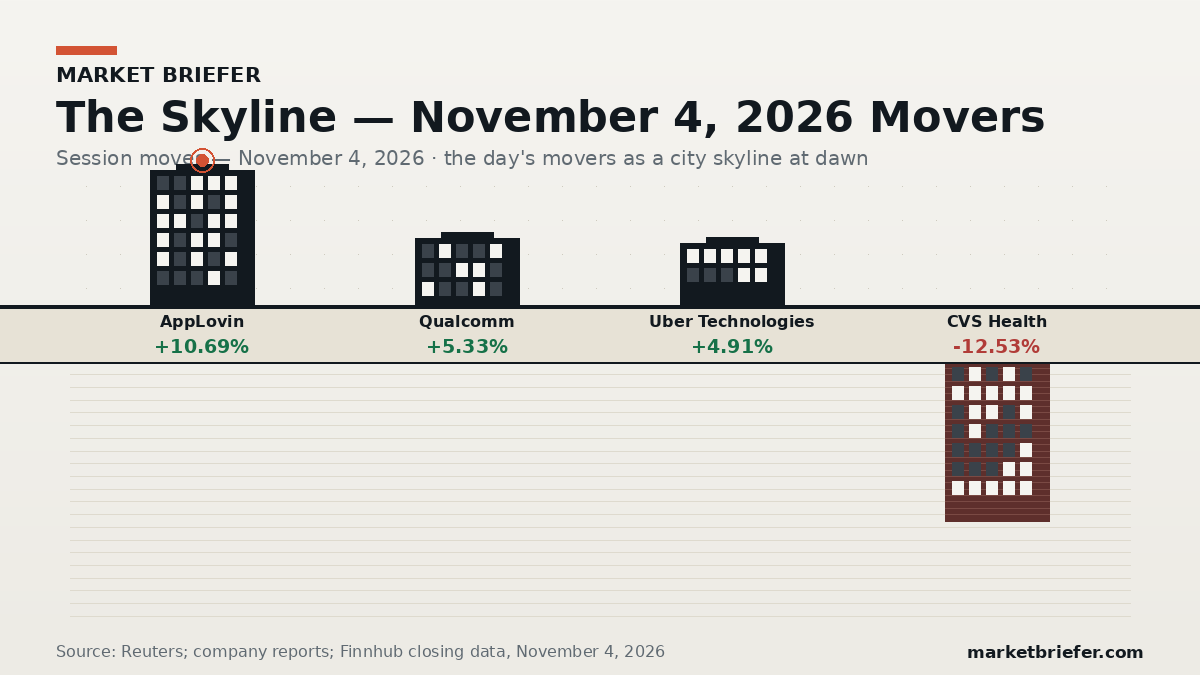
CVS Health beat earnings and raised guidance but fell 12.53% after announcing a split into two companies by 2028, as AppLovin, McDonald's and Uber rose and Qualcomm's handset slump hit after hours on November 4, 2026.
5 min read
CVS Health gave Wednesday its biggest corporate story and its harshest verdict. The company beat earnings, raised its full-year outlook and announced it will separate into two independent, publicly traded companies in the first half of 2028, unwinding the healthcare conglomerate it spent years building. Investors sold the plan: CVS closed down 12.53% at $79.96, a fall Reuters put at nearly $15 billion in market value, on a day the broader market rallied after Democrats won control of both chambers of Congress in the midterm elections — the Dow Jones Industrial Average rose 3.03% to 53,356.12, the S&P 500 gained 1.58% to 7,688.62 and the Nasdaq Composite added 1.44% to 25,736.51, Reuters reported. The split, tracked throughout on our Corporate America desk, is intended to be tax-free to CVS and its shareholders, the kind of structure our Tax Desk follows, and it tested the lesson in our Earnings Season Playbook: the quarter matters less than the future investors are asked to price.
Elsewhere, beats were rewarded. AppLovin closed up 10.69% and surged further after hours on record results and a larger buyback. McDonald’s jumped after a profit beat even as its U.S. sales slipped, and Uber closed up 4.91% on record bookings. Qualcomm closed up 5.33% in the regular session, then fell in extended trading when its handset numbers landed. The jobs backdrop held up: ADP reported private employers added 86,000 jobs in October, ahead of the 69,000 economists polled by Reuters had forecast.
Earnings: A Breakup Overshadows a Beat
CVS’s quarter, on its own, was strong. Total revenue rose 5.4% to $108.4 billion, GAAP diluted earnings were $1.68 a share against a loss of $3.13 a year earlier, when the quarter carried a $5.7 billion goodwill impairment, and adjusted earnings rose to $2.09 a share from $1.60, topping the $1.65 estimate cited by Reuters on LSEG data, as its medical benefit ratio improved to 91.3% from 92.8%. CVS raised its full-year 2026 adjusted earnings guidance to at least $8.20 a share, from $7.90 to $8.10, raised its operating cash flow guidance to at least $15.5 billion, from at least $11.5 billion, and forecast 2027 adjusted earnings of at least $8.65 a share, ahead of analysts’ estimates of $8.53. The separation will leave one company, referred to for now as CVS Health, holding insurer Aetna, pharmacy benefit manager CVS Caremark, CVS Specialty, Oak Street Health and Signify Health, led by Chairman and Chief Executive David Joyner, and a second, CVS Pharmacy, holding about 9,000 pharmacies, mail pharmacy, MinuteClinic and the Health100 technology business, led by Prem Shah. Shareholders will own shares in both when it completes, subject to final board approval and other customary conditions.
McDonald’s told a smaller version of the consumer story. Adjusted earnings rose 11% to $3.57 a share, beating the $3.38 expected on LSEG data, while revenue rose 1% to $7.16 billion and missed the $7.29 billion consensus. Global comparable sales rose 1.5%, ahead of the 1.3% estimate, but U.S. comparable sales fell 0.2%, slightly worse than the 0.1% decline expected, as fewer guest visits outweighed a higher average check. Net income rose 9% to $2.49 billion, operating income rose 7% to $3.6 billion, and the quarterly dividend rose 4% to $1.93 a share. Chief Executive Chris Kempczinski said he was encouraged by improvement as the quarter progressed following the company’s intervention on value.
Uber’s growth came with an accounting asterisk. Gross bookings rose 20% to $59.8 billion on 4.1 billion trips, up 16%, and revenue rose 10% to $14.8 billion even though a U.K. Mobility business-model change reduced revenue by $1.1 billion. Non-GAAP earnings were $0.88 a share, adjusted EBITDA rose 31% to $3.0 billion and free cash flow was $2.5 billion, but GAAP net income fell to $512 million after a $476 million pre-tax loss from revaluing equity investments. Uber guided fourth-quarter gross bookings to $63.25 billion to $65.25 billion and non-GAAP earnings to $0.95 to $0.99 a share.
Chips After the Close, and a New Chief at HP
Qualcomm and Arm, reporting after the close, showed the two sides of the chip trade a day after AMD’s beat. Qualcomm’s adjusted earnings were $2.17 a share, just ahead of the $2.16 expected, and adjusted sales fell 7% to $10.44 billion, beating estimates of $10.11 billion on LSEG data compiled by Reuters, but handset chip revenue fell 26% to $5.14 billion, below the $5.25 billion Visible Alpha estimate, as smartphone shipments fell and Apple-related revenue declined. Automotive revenue surged 89% to $1.99 billion, and Qualcomm forecast first-quarter revenue of $10.4 billion to $11.2 billion, noting the forecast includes no further sales from Apple. Its shares fell more than 4% in extended trading, Reuters reported. Arm’s revenue rose 27% to $1.44 billion, beating the $1.38 billion estimate, and adjusted profit of 52 cents beat estimates of 47 cents, but royalty revenue of $670 million missed estimates of $720.8 million, and its shares fell about 2% in extended trading. Snap fell more than 10% after hours after revenue of $1.72 billion, up 14%, just missed the $1.73 billion expected and daily active users of 495 million missed the 499 million expected, despite net income swinging to $56 million from a $104 million loss.
AppLovin supplied the day’s cleanest beat. Revenue jumped 55% to $2.185 billion, ahead of the $2.07 billion FactSet consensus cited by MarketWatch, earnings were $4.30 a share against $4.03 expected, net income rose 72% to $1.439 billion and adjusted EBITDA reached $1.842 billion. The board authorized up to $3.2 billion more in buybacks, lifting the total authorization to $3.6 billion, and fourth-quarter revenue guidance of $2.365 billion to $2.395 billion beat expectations of $2.25 billion. Leadership news came from HP, which named former GSK chief Emma Walmsley as chief executive effective January 4, 2027, succeeding interim chief Bruce Broussard, who becomes board chair, Reuters reported; Walmsley, who led GSK from 2017 to December last year, takes over a PC maker facing a memory-chip crunch. At Uber, President and Chief Corporate Affairs Officer Jill Hazelbaker will step down on November 30, the company said in a filing.
The one to watch is Thursday, November 5. Airbnb, Cloudflare and Atlassian report after the close, according to the week’s earnings calendars, alongside Lyft, DraftKings and Lumentum, ahead of Friday’s October jobs report. After a day when a breakup, a handset slump and a buyback each moved a stock more than the quarter did, Thursday will test the same question from travel, software and betting.
This is not investment advice. Corporate America is AI-assisted research produced with automated data checks; figures are verified against the cited sources at publication time.
See Market Briefer first in Google
Add to Preferred Sources