Corporate America: November 18, 2026 — Anthropic Prices at $83 as Nvidia’s Beat Fades
Stocks split on November 18 as Nvidia's earnings beat faded, Target, Lowe's and TJX beat with help from tariff refunds, Palo Alto Networks bought Applied Compute for $4.5 billion, health insurers tumbled on a CMS audit proposal, and Anthropic priced its IPO at $83 a share.
5 min read
Corporate America spent Wednesday deciding that good news was not quite good enough. The S&P 500 fell 18 points, or 0.24%, to 7,322.53, its fifth straight decline and its longest losing streak since June, while the Dow Jones Industrial Average dropped 566.39 points, or 1.12%, to 50,193.03 and the Nasdaq Composite rose 101.50 points, or 0.39%, to 24,429.89, snapping a four-day skid. Six of the S&P 500’s sectors fell and five rose, with energy down 3.5% and consumer discretionary shares up 2.2%, according to Reuters, in a session tracked throughout the day on our Corporate America desk.
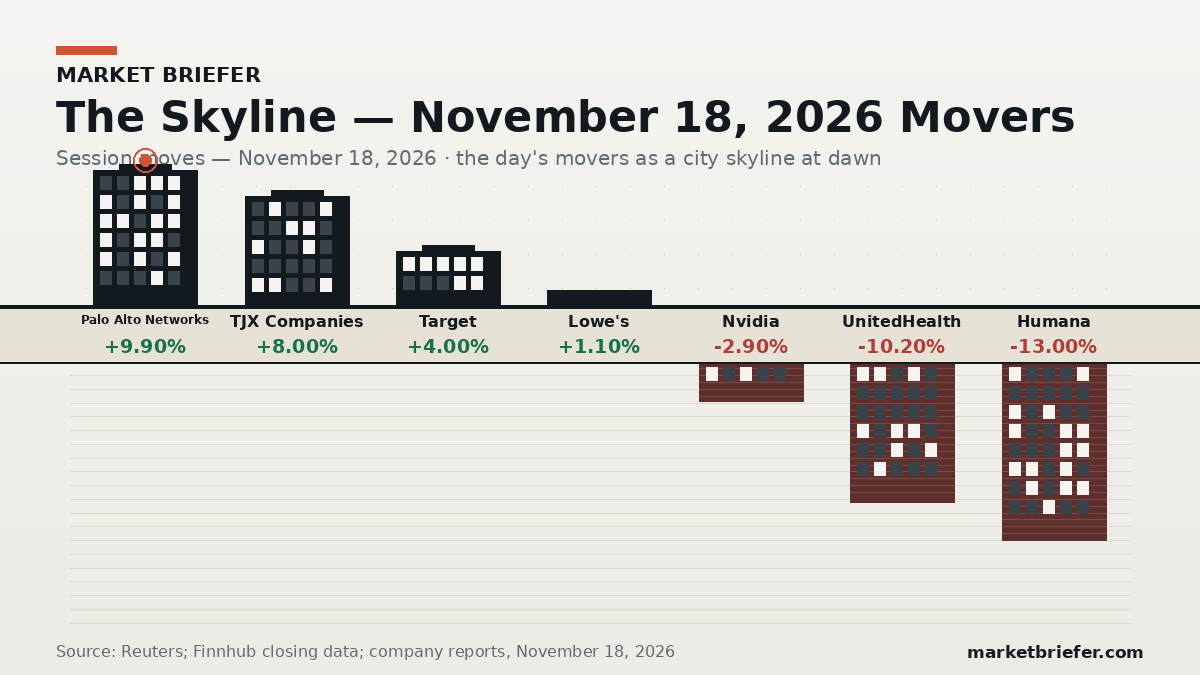
Nvidia supplied the refusal. The chipmaker opened up 2.7% after Tuesday evening’s record quarter, then slid all session to close down 2.9% at $150.96, extending its loss to 36% from its October 6 record-high close, Reuters reported. Analysts raised earnings estimates on the $130 billion fourth-quarter revenue guide while cutting the average price target to $251.74 from $265.70 on Monday — the numbers cleared every bar, and the stock still fell, with the board’s refusal to consider rehiring founder Jensen Huang hanging over the name. The AI trade’s next test priced after the close instead. Anthropic priced its initial public offering at $83 a share, above its targeted range of $70 to $78, with reports that the offering was increased to meet demand and a valuation set north of the expected $1.4 trillion, Reuters reported. The Claude developer is expected to begin trading on the Nasdaq on Thursday under the ticker ANT, alongside a separate $26 billion private placement of non-voting shares to strategic investors.
The minutes of the Federal Reserve’s October 27–28 meeting, released at 2 p.m. Eastern, removed any doubt about where policy leans. The committee held the federal funds rate at 3.75% to 4% by a 10–2 vote, with Governor Lisa Cook and Cleveland Fed President Beth Hammack dissenting in favor of an immediate increase, and almost all participants judged that further increases would likely be appropriate in the months ahead to return inflation to the 2% target. A couple of participants said an increase of more than 25 basis points could warrant consideration in December if inflation data proved unfavorable, and Governor Christopher Waller said on Wednesday that a 50-basis-point move in December may be needed. Twelve-month PCE inflation stood at 3.6% in September.
Retail Beats, With an Asterisk
The morning’s retail reports were the day’s cleanest corporate story, and even they came with fine print — the pattern our Earnings Season Playbook describes. Target posted its best sales growth in five years: comparable sales rose 5.6%, against 3.8% expected, driven by a 5% jump in traffic with the average ticket up just 0.6%, digital comparable sales rose 9.8%, revenue reached $27.1 billion against about $26.5 billion expected, and adjusted earnings reached $2.65 a share against about $2.07 expected. A $301 million tariff refund added about $0.50 a share to that result. Target raised its full-year earnings guidance to $10.65 to $11.40 a share, from $9.90 to $10.90, with sales growth now expected at about 6%, and shares closed up 4.0% to $165.93.
Lowe’s beat on the same help and guided more cautiously. Adjusted earnings reached $3.10 a share, against about $2.88 expected, sales rose 9.3% to $22.8 billion, comparable sales rose 1.8% against 0.4% expected, and online sales jumped 17.4% on strength with professional customers. Tariff refunds added $0.34 a share, and gross margin still fell 124 basis points to 32.95%. Management raised full-year sales guidance to about $92.5 billion and comparable sales to about 0.5%, guided adjusted earnings to $12.25 a share, just under consensus, and trimmed its operating margin outlook to about 11.1%. Shares recovered from an early fall to close up 1.1% to $222.78. TJX was the trio’s strongest tape: sales rose 6% to $16.0 billion, comparable sales rose 4% against a 2% to 3% plan, GAAP earnings were $1.39 a share and adjusted earnings $1.34, in line with expectations, and the company raised full-year comparable sales guidance to 4%, even as its fourth-quarter adjusted earnings guide of $1.42 to $1.45 a share sat below the $1.48 expected. TJX shares closed up 8.0% to $140.30.
Palo Alto Buys, Insurers Sink
Palo Alto Networks had the day’s biggest corporate move in both directions of the clock. Shares closed up 9.9% to $339.92 ahead of the report, and after the bell the cybersecurity company beat and bought: fiscal first-quarter revenue rose 39% to $3.44 billion, against $3.31 billion expected, adjusted earnings reached $1.05 a share against $0.97 expected, and Next-Generation Security annual recurring revenue rose 66% to $9.73 billion. The GAAP picture was messier, with operating income down to $96 million from $309 million a year earlier and net income of $482 million lifted by a $457 million tax benefit, while non-GAAP operating income rose to $1.06 billion. Management raised fiscal 2027 revenue guidance to $14.52 billion to $14.57 billion and adjusted earnings guidance to $4.26 to $4.30 a share, and the company agreed to acquire Applied Compute, an AI platform business, for $4.5 billion in stock, in a deal expected to close in its fiscal third quarter.
The Dow’s weight came from healthcare, where the Centers for Medicare & Medicaid Services’ proposed CRUSH rule — Comprehensive Regulations to Uncover Suspicious Healthcare — would expand Medicare Advantage audits and let the agency recover improper payments dating back to 2018, a package CMS estimates could return nearly $90 billion to taxpayers over a decade. Humana fell 13.0% to $385.78 and UnitedHealth Group fell 10.2% to $349.91, making UnitedHealth, one of the Dow’s largest components, the index’s biggest decliner, while CVS Health and Cigna also fell. Public comment on the proposal runs through January 19, 2027. The housing data underneath Lowe’s cautious guide pointed the same way: housing starts rose 9.9% in October to a 1.31 million annual rate, their first increase in four months, but building permits fell 7.4% to 1.295 million, the lowest since the early months of the pandemic.
The one to watch is Thursday, November 19. Walmart reports before the open, with consensus at $0.64 a share on about $187 billion of revenue, completing the week’s retail read on the American consumer. Anthropic begins trading on the Nasdaq under ANT after its $83 pricing, weekly jobless claims and the Philadelphia Fed’s November business index land in the morning, and a full slate of Fed officials speaks through the day.
This is not investment advice. Corporate America is AI-assisted research produced with automated data checks; figures are verified against the cited sources at publication time.
See Market Briefer first in Google
Add to Preferred Sources