Corporate America: November 16, 2026 — Nasdaq Falls Into Correction as Tyson Jumps on a Beef Recovery
Nasdaq fell 2.49% into correction on November 16 as chips slid 5.28% ahead of Nvidia earnings, while Tyson rose 8.7% on a beef-recovery outlook, Powell and AECOM beat after the close, and Washington curbed remote AI chip access.
5 min read
Corporate America opened the week’s decisive stretch with a selloff that pushed the Nasdaq into correction territory, even as a meatpacker’s promise of a beef recovery and two after-hours beats showed earnings still rewarding a credible outlook. The S&P 500 fell 1.92% to 7,416.59, the Nasdaq Composite dropped 2.49% to 24,509.76 and the Dow Jones Industrial Average lost 1.41% to 51,608.17, while the Russell 2000 fell 1.70% to 2,742.94. Reuters reported that the Nasdaq now stands more than 10% below its October 6 high, the definition of a correction, and the Philadelphia Semiconductor Index fell 5.28% as a new curb on remote access to advanced AI chips landed a day before Nvidia reports. Nine of the S&P 500’s sectors fell and two rose, with technology and communication services each down about 3% and consumer staples up 0.3%, according to Reuters, on a day tracked throughout on our Corporate America desk.
The chip selling was broad and unforgiving. SanDisk closed down 8.5%, Micron fell 7.6% to $719.02, Nvidia fell 4.1% to $156.14 and Alphabet fell 4.1% to $283.72, according to Reuters and Finnhub closing data. The Commerce Department said it issued a rule on Monday to protect against remote access to advanced AI chips by third countries, designed to ensure existing restrictions cannot be circumvented through remote computing arrangements involving data centers in third countries, Reuters reported, as President Donald Trump departed for an Asia trip that includes a meeting with Chinese President Xi Jinping. Trump said on Monday he would not mind seeing Jensen Huang reinstated as Nvidia’s chief executive, Reuters reported, while worries over Nvidia’s circular financing model deepened ahead of Tuesday’s results. Falling prices elsewhere offered no shelter: oil fell about 3%, gold fell about 1% to a fresh one-year low of $3,848 an ounce, the dollar rose to a fresh 19-month high, and the 10-year Treasury yield eased only slightly, to about 5.12%.
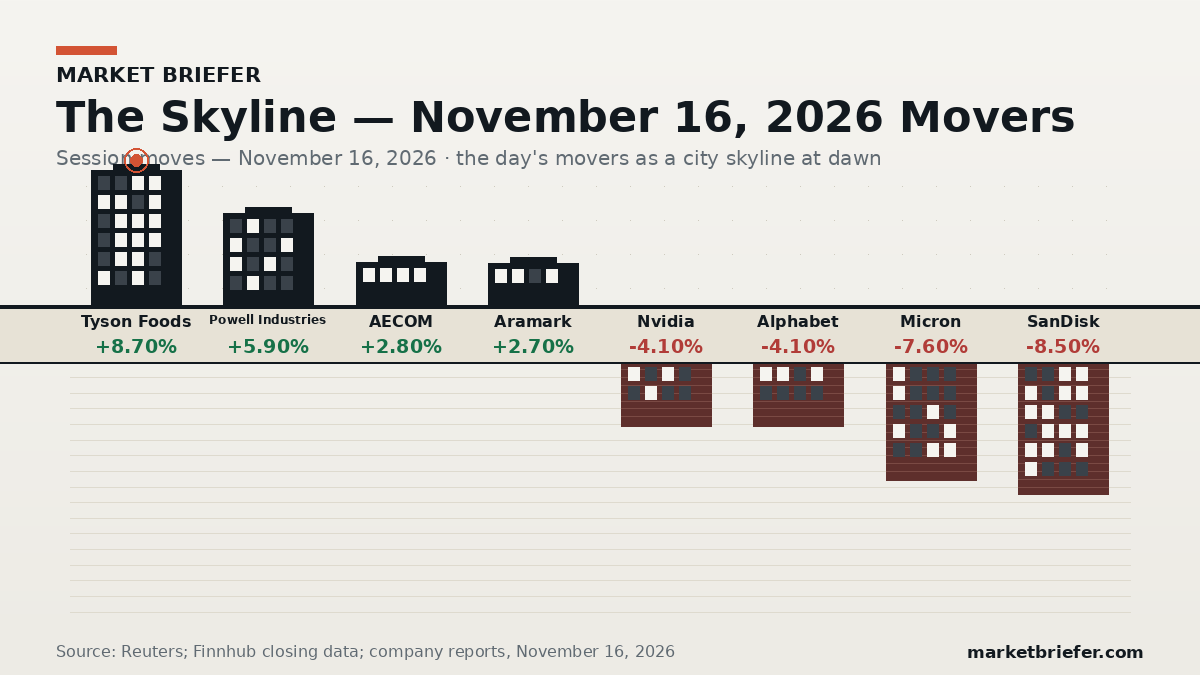
Earnings rewarded the outlook over the quarter just ended, in the pattern our Earnings Season Playbook describes. Tyson Foods closed up 8.7% to $63.95 after reporting fourth-quarter sales of $14.585 billion, up 5.2%, a GAAP loss of $0.22 a share and adjusted earnings of $0.61 a share, down from $1.15 a year earlier, on full-year sales of $56.419 billion, up 3.6%. Investors looked past the weak quarter to fiscal 2027, when Tyson expects beef to improve to between a $300 million adjusted loss and a $100 million profit, after a $654 million adjusted loss in fiscal 2026, even as total sales fall 3.5% to 5.5% on lower beef volumes and tight cattle supplies, and total adjusted operating income reaches $1.7 billion to $2.15 billion. The board also raised the quarterly Class A dividend about 2% to $0.52 a share, for a fiscal 2027 annual rate of $2.08, the company’s 15th consecutive year of dividend growth. Aramark closed up 2.7% to $55.37 after fourth-quarter revenue rose 5% to $5.293 billion, GAAP earnings rose to $0.51 a share from $0.33 and adjusted earnings reached $0.71 a share, on full-year revenue of $20.1 billion, up 9%, with the company guiding fiscal 2027 adjusted earnings growth of 20% to 25% on a constant-currency basis. Baidu told the same AI transition story as the chipmakers from the other side, as third-quarter revenue fell 1% to RMB30.8 billion, or $4.60 billion, online marketing revenue fell 22% to RMB11.9 billion, AI cloud infrastructure revenue rose 94% to RMB8.2 billion, and non-GAAP earnings reached RMB6.78 per ADS, with the company expecting to declare its first-ever dividend before the end of 2026, subject to board approval.
Beats After the Bell
The after-hours reports were stronger. Powell Industries closed up 5.9% to $151.20 in the regular session, then reported fiscal fourth-quarter revenue of $397 million, up 33%, net income of $82 million, or $2.23 a diluted share, up 59%, new orders of $710 million, up 162%, and a record backlog of $2.7 billion, up 96%, including about $250 million for an LNG project and about $85 million for a data center. AECOM closed up 2.8% to $72.50, then reported fourth-quarter revenue of $3.878 billion, down 7%, adjusted earnings of $1.63 a share, up 20%, and a record total backlog of $28.016 billion, up 13%, after record total wins of $13.4 billion in the year, and initiated fiscal 2027 guidance built on strong end-market trends and an expectation for record margins. Leadership moved in energy, where Cheniere named Zach Davis president and chief financial officer, effective November 12, Reuters reported; Davis has served as the LNG exporter’s finance chief since August 2020, joined the company in November 2013, and will continue to report to chief executive Jack Fusco.
Strategy and policy framed the rest of the day. Morgan Stanley raised its global equities stance to maximum overweight and set an end-2027 target for the S&P 500 of 8,700, more than 15% above Friday’s close of 7,561.67, with corporate earnings growth as the primary driver and 2027 earnings per share expected at $420, up from an expected $369 this year, Reuters reported, while Goldman Sachs also sees the index reaching 8,700 over the next 12 months. In San Francisco, Federal Reserve Chair Kevin Warsh told a Fed conference on AI that emerging technologies will have a significant impact on the economy, with scenarios ranging from rising growth with broadly shared gains to higher unemployment and a potential slowdown if anticipated investment returns prove disappointing, Reuters reported. Warsh, who calls AI super intelligence and said it could supercharge idea generation, gave no signal on interest rates; the Fed held its benchmark at 3.75% to 4% on October 28, and minutes of that meeting are due on Wednesday.
The one to watch is Tuesday, November 17. Home Depot and Walt Disney report before the open, October retail sales are released the same morning, and Nvidia reports its fiscal third quarter after the close, its first report with Colette Kress as interim chief executive, against its own guidance of $108 billion in revenue, plus or minus 2%, and analyst expectations of $2.47 a share on about $109.08 billion, according to Reuters and LSEG data, with options markets pricing about a 7% swing in the share price either way. Anthropic is then expected to price its offering on Wednesday, November 18, before trading later in the week, and Walmart reports on Thursday, November 19, making Tuesday a paired test of the AI trade and the American consumer.
This is not investment advice. Corporate America is AI-assisted research produced with automated data checks; figures are verified against the cited sources at publication time.
See Market Briefer first in Google
Add to Preferred Sources