Corporate America: November 12, 2026 — Nvidia Loses Its Founder as Huang Resigns
Nvidia founder Jensen Huang resigned effective immediately, with CFO Colette Kress as interim CEO, as Cisco and Applied Materials beat after the close, Nebius and Corteva plunged, and Hancock Whitney struck a $3.2 billion deal for Trustmark.
5 min read
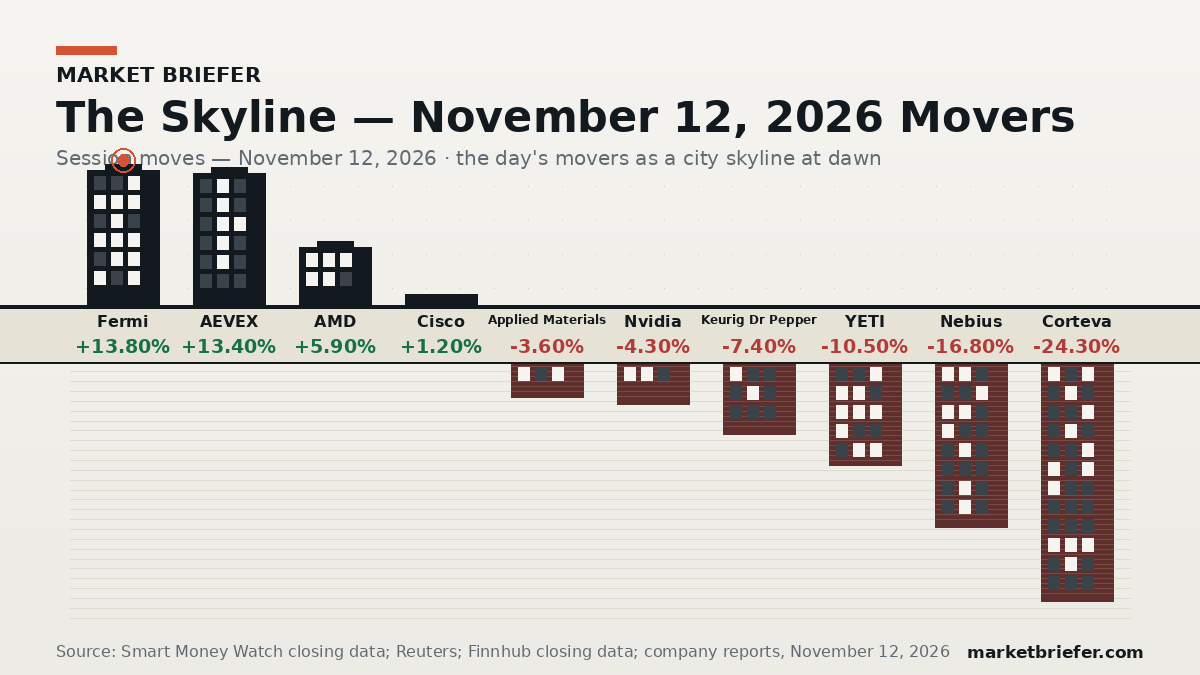
Corporate America spent Thursday absorbing its biggest leadership shock, and the market’s verdict was calmer than the headline. Nvidia said Jensen Huang, the co-founder who built it over 33 years into the engine of the AI boom, had resigned as president, chief executive and director, effective immediately, with chief financial officer Colette Kress named interim chief executive. The S&P 500 slipped 0.35% to 7,592.40, the Nasdaq Composite fell 0.39% to 25,366.09 and the Dow Jones Industrial Average lost 0.36% to 52,297.09, while the small-cap Russell 2000 dropped 1.66%, according to Reuters. Nine S&P 500 sectors fell, as yields rose as much as 17 basis points at the short end, oil rose about 3%, gold fell 3% to a one-year low of $3,853 an ounce and the dollar hit its highest since April 2025.
Nvidia’s announcement, followed on our Corporate America desk, gave no reason for the departure. The board accepted the resignation on November 11, according to the company’s Form 8-K, named Kress interim chief executive while she keeps the finance role, began a search considering internal and external candidates, and appointed director Harvey C. Jones, the former Synopsys chief executive, as its first-ever chair. The exit follows the board’s November 8 announcement of an independent investigation into reports that Huang had been the target of a foreign intelligence operation, and reporting about extramarital relationships; the company has stated no findings, and Thursday’s statement did not link the resignation to the inquiry. The stock fell more than 13% at the open before recovering to close down 4.3% to $166.19, taking its fall this week to 11% and its drop from the October 6 peak to more than 30%, about $1.8 trillion of market value lost in five weeks, according to Reuters. The damage did not spread evenly: Super Micro Computer fell 11%, while Advanced Micro Devices closed up 5.9% and Broadcom gained about 6% as investors rotated toward Nvidia’s rivals.
Earnings Punished Guidance, Not Growth
Earnings delivered the day’s sharpest falls, in the pattern our Earnings Season Playbook describes, where guidance outweighs the quarter itself. Nebius, the AI cloud provider, reported third-quarter revenue of $980.8 million, up 571% from a year earlier and above the $907.5 million expected, with adjusted EBITDA of $465.8 million against a $5.2 million loss a year earlier. Investors sold the outlook instead: third-party capacity due this year has slipped into the first half of 2027, 2026 revenue is now expected at $3 billion to $3.2 billion, the low end of the previous range, and 2026 capital spending is now put at about $27 billion, up from $20 billion to $25 billion. Nebius closed down 16.8% to $128.64. Corteva fared worse, closing down 24.3% to $9.19 after third-quarter net sales fell 9% to $1.59 billion, below the $1.77 billion expected, adjusted earnings of $0.06 a share missed the $0.10 expected, and the crop-protection company cut its full-year adjusted operating EBITDA forecast to $1.1 billion to $1.125 billion from about $1.3 billion and its adjusted earnings view to $0.76 to $0.80 a share, blaming a Brazilian market hit by high dealer stocks and high interest rates, in its first report since separating its seed business into Vylor. YETI closed down 10.5% to $38.30 after third-quarter revenue rose 4% to $509.4 million, short of the $523.1 million expected, even as adjusted earnings of $0.91 beat the $0.84 expected; the cooler maker cut its 2026 sales growth view to about 6% from 7% to 8% and its adjusted earnings range to $2.90 to $2.95. The gainers were smaller: Fermi closed up 13.8% to $2.06 after an investment-grade cloud company signed an agreement with the data centre power developer, AEVEX closed up 13.4% to $13.76 after revenue rose 56.5% to $189.7 million and it raised its 2026 revenue outlook to $820 million to $840 million, and Intuitive Machines rose 7.0% to $13.03 on record revenue of $269 million and a record $1.9 billion backlog.
After the close, the week’s two largest reports steadied the AI story. Cisco Systems, which closed up 1.2% to $102.01 in the regular session, reported record fiscal first-quarter revenue of $18.5 billion, up 24%, above the $18.14 billion average estimate, with non-GAAP earnings of $1.40 a share against its own $1.32 to $1.34 forecast, and raised its fiscal 2027 revenue forecast to $74.8 billion to $75.8 billion from $72.2 billion to $73.4 billion. Applied Materials, which closed down 3.6% to $380.95 before reporting, posted record fiscal fourth-quarter revenue of $10.41 billion, up 53%, above the $10.30 billion expected, with adjusted earnings of $4.16 a share against $4.06 expected and net income up 43% to $2.72 billion, and forecast first-quarter revenue of about $11.1 billion, plus or minus $500 million, above the $10.89 billion expected.
A $3.2 Billion Bank Deal and a $2 Billion Offering
Deals and capital moves ran underneath the earnings. Hancock Whitney agreed to acquire Trustmark in an all-stock transaction valued at about $3.2 billion, with Trustmark holders receiving 0.7463 Hancock Whitney shares for each share held, a value of $54.02 a share and an 18.6% premium to Trustmark’s last close, according to Reuters. The combined Gulf South bank will hold about $58 billion in assets, with closing expected late in the first quarter of 2027, subject to regulatory and shareholder approvals. Keurig Dr Pepper announced a $2 billion underwritten stock offering, with a further $300 million available to underwriters, to repay debt ahead of its planned separation into Beverage Co. and Global Coffee Co. in early 2027; the shares closed down 7.4% to $35.42.
The backdrop offered no relief. Initial jobless claims rose 9,000 to a seasonally adjusted 200,000 in the week ended November 7, above the 195,000 expected, while continuing claims fell 20,000 to 1.697 million, and claims have stayed at or below 200,000 since mid-September, via Reuters. The Treasury’s 30-year auction drew lacklustre demand, on the day Reuters noted the United States began fiscal 2027 with a record October budget deficit of $404 billion, and October consumer prices, reported Tuesday, had risen 0.4% with core prices up 0.3% for a third straight month.
The one to watch is Friday, November 13, which brings the October producer price index at 8:30 a.m. Eastern, the week’s second inflation test, alongside scheduled remarks from Federal Reserve officials Susan Collins, Lorie Logan, Michelle Bowman and Mary Daly, according to Reuters, and the first trading in Cisco and Applied Materials after their beats. Beyond Friday, the calendar builds to Tuesday, November 17, when Nvidia reports its fiscal third quarter, in Colette Kress’s first earnings call as interim chief executive, on the same day as Disney and Home Depot, before Anthropic’s offering is expected to price on November 18.
This is not investment advice. Corporate America is AI-assisted research produced with automated data checks; figures are verified against the cited sources at publication time.
See Market Briefer first in Google
Add to Preferred Sources