The Global Close: October 9, 2026 — Relief rally as Trump takes Iran strike off the table
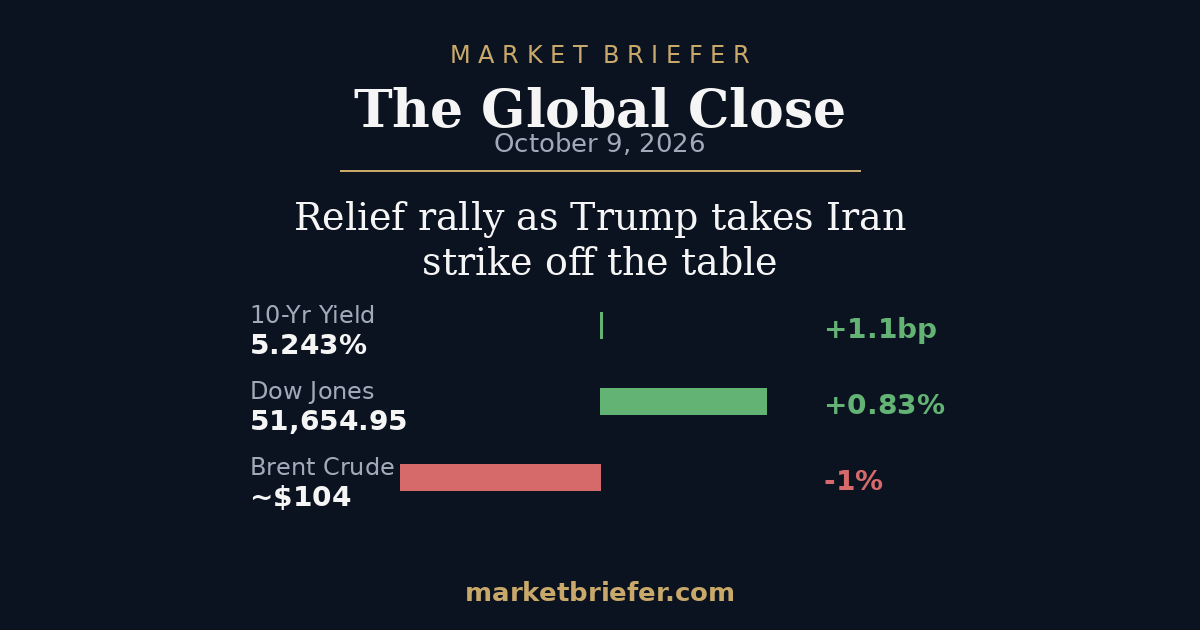
Stocks rallied Friday as Trump took an Iran strike off the table, but the 10-year Treasury held near 24-year highs at 5.243% — the binding constraint on every asset class.
The 60-Second Brief
- WHAT MOVED: The Dow added 423 points (+0.83%) to 51,654.95, the S&P 500 rose 0.59% to 7,811.54 near all-time highs, and the Nasdaq climbed 0.64% to 27,366.17. Europe recovered roughly 1% as oil eased; Hong Kong surged 1.8%.
- WHY: President Trump said the U.S. would not strike Iran before the midterm elections, easing crude-oil and inflation fears, while tech stocks rebounded from Thursday’s AI-driven selloff. SpaceX’s spectrum deal sank telecom carriers.
- WHAT IT MEANS: Relief, not conviction — the 10-year Treasury stayed within 7 basis points of a 24-year high at 5.243%, keeping the rate constraint firmly in place.
- WHAT TO WATCH: September CPI on Wednesday and bank earnings starting Tuesday; Asia reopens on a softer tone after Friday’s oil retreat.
The Number That Matters: 5.243% — the yield on the 10-year Treasury note at Friday’s close. It sits within seven basis points of a 24-year high and is the binding constraint on every asset class: it sets the discount rate that punishes long-duration tech stocks, anchors the mortgage rates choking housing, and feeds the dollar that tightens global financial conditions. Today’s rebound was genuine relief on the geopolitical front, but equities rallied into punishing rates, not away from them — which is why the number that matters more than the 423-point Dow gain is the one that barely moved. A decisive break above 5.35% would make yields the story again; a cool CPI print next week would hand the spotlight to oil and earnings.
The single most important market story on Friday was a relief rally built on one presidential sentence: with Donald Trump declaring that the U.S. will not attack Iran before the midterm elections, crude prices eased, bond yields held below their midweek extremes, and risk assets recovered — the S&P 500 and Dow closing out a winning week while Europe bounced back from a near four-month low.
United States
U.S. stocks rose on Friday as fears of a Middle East escalation subsided (WSJ). The Dow Jones Industrial Average gained 423.31 points, or 0.83%, to 51,654.95. The S&P 500 rose 46.18 points, or 0.59%, to 7,811.54, closing near all-time highs. The tech-heavy Nasdaq Composite climbed 172.83 points, or 0.64%, to 27,366.17. For the week, the S&P 500 finished up 1.2%, the Dow up 0.9%, and the Nasdaq up 0.6% — the Nasdaq’s fourth consecutive weekly gain (Barron’s).
Technology led the rebound after Thursday’s AI-driven slide, when a Financial Times report that OpenAI’s annualized revenue was around $50 billion — roughly $20 billion below expectations — sent semiconductor and AI-infrastructure shares tumbling. The Magnificent Seven group recovered more than 1% on Friday.
The day’s biggest movers were in telecoms. Elon Musk’s SpaceX (SPCX) announced a deal to acquire a nationwide low-band spectrum portfolio to advance Starlink Mobile toward becoming a major U.S. mobile carrier. Shares of T-Mobile US, AT&T, and Verizon sank between 8.5% and 13%, making them the three biggest decliners in the S&P 500 (Investopedia). On the other side of the trade, tower operators Crown Castle, SBA Communications, and American Tower surged 7% to 16%. Elsewhere, Humana soared 11% after reporting improved Medicare Advantage plan star ratings for 2027, while Delta Air Lines ended near flat after missing profit estimates and trimming its full-year outlook, blaming persistently high fuel prices.
Communication services was the clear sector laggard on the SpaceX news, while technology and energy paced the advance.
Europe
European stocks recovered on Friday as oil prices eased on hopes of a pause in the Middle East war (Reuters). The pan-European STOXX 600, which had closed Thursday at a near four-month low of 625.51 (down 0.8%), rebounded roughly 1% to trade near 631 intraday. Telecoms were the weak spot: the sector index fell 2.7% as the SpaceX shock crossed the Atlantic — Deutsche Telekom dropped 7%, while Vodafone fell 3.5%, Orange 2.4%, and Telefónica 2.3%.
Eurozone bond yields pulled back after touching multi-decade highs earlier in the week, when inflation worries and soaring government debt burdens rattled fixed income. France remained the epicenter of concern, with 10-year OAT yields near multi-year highs as lawmakers scrutinized the contentious 2027 budget ahead of formal debate starting October 13.
Asia
Asian markets were mixed. Japan’s Nikkei 225 eased 11.19 points, or 0.02%, to 69,030.92, pressured by AI-valuation fears — SoftBank Group was a heavy faller, with the Financial Times reporting it is in talks with Gulf investors to raise up to $100 billion for AI bets, while Advantest and Kioxia also fell sharply. In Hong Kong, the Hang Seng Index climbed 1.8% to 24,211.35, with tech heavyweights Alibaba, Tencent, and Xiaomi — up 7.5% on 70,000 orders for its SkyNomad model in the first month — leading the advance. Mainland China was subdued: the Shanghai Composite closed at 3,813.79, up 0.05%, as film, precious-metals, and cybersecurity shares offset weakness in semiconductors and banks after a weak PBoC liquidity operation. India’s Sensex jumped 1.23% to 72,472.33 after Tata Consultancy Services posted a 15% jump in net profit. South Korea and Taiwan were closed for holidays.
Currencies & rates
The dollar was mixed. EUR/USD traded at 1.1215, GBP/USD at 1.3235, and USD/JPY at 158.32, with the Dollar Index at 102.16 (marketbriefer.com data, delayed).
Treasury yields held near recent extremes but lost some steam. The 10-year yield ticked up to 5.243%, closing within seven basis points of its 24-year high reached Wednesday at 5.31%; the 30-year bond eased to 5.598% after touching 5.7315% on Thursday; the 2-year rose to 4.789%. A $22 billion 30-year auction on Thursday drew solid demand at a 5.618% high yield — the highest since August 2000 — with an above-average bid-to-cover ratio (WSJ). Policy chatter remained hawkish at the edges: St. Louis Fed President Alberto Musalem said rates may need to climb for six to nine more months to subdue inflation, while money markets priced only a 19% chance of a hike at the October 28 meeting — a December increase, however, is fully priced in.
Credit
Credit stress stayed concentrated in the weakest borrowers. The ICE BofA U.S. high-yield index’s effective yield reached 8.11% at the October 8 close, up from 7.22% a month earlier (TokenPost). The broad high-yield option-adjusted spread stood at 315 basis points on October 8 — still below its 346-basis-point level in March. But the CCC-and-lower spread surged to 1,252 basis points from 807 on September 30, while the BB spread rose only to 194 from 179. Investment-grade spreads were steady at about 0.85%. The message: investors are demanding far more compensation for the riskiest debt, even as the broad market holds. No notable new corporate debt developments were sourced for today.
Commodities
Oil eased but stayed historically elevated. WTI crude added 36 cents, or 0.4%, to $91.85, while Brent traded around $103–104, down about 1% on the session after Trump’s no-strike pledge eased supply fears (WSJ; Reuters). The backdrop remains tense: Houthi attacks on tankers in the Strait of Hormuz, Saudi-led retaliatory strikes, and Hurricane Isaias threatening Gulf Coast refining capacity earlier in the week. Gold rose about 1% to $4,206–4,210 an ounce as investors kept hedges in place. Copper gained 1.2% to $6.67 a pound; natural gas rose 1.7% to $3.12; silver slipped to $60.50.
Crypto
Crypto was soft. Bitcoin traded at $82,384, down 0.31%, after recovering from a Thursday low near $80,300. Ethereum fell 2.47% to $2,487. Altcoins lagged further: Solana down 4.3%, Dogecoin down 3.7%, Cardano down 6.0% (CoinGecko via marketbriefer.com).
The news behind the numbers
The day’s dominant development was geopolitical. Trump’s Truth Social post — no U.S. attack on Iran before the midterms, with “productive” talks underway — was the single biggest market-moving event, transmitting through crude prices into yields and equities (NYPost; Reuters). Oil also got a demand-side wrinkle: Trump said Russia would sell hundreds of thousands of tons of diesel to the U.S. in coming months, pushing diesel futures lower (WSJ). Domestically, Trump said he would convene a White House committee to review mortgage-fraud allegations against Fed Governor Lisa Cook, with a November 5 hearing — a move former Fed Chair Jerome Powell has flagged as a threat to central-bank independence (WSJ). Data was soft: the University of Michigan’s preliminary October consumer-sentiment index fell to 46.3 from 48.1 in September.
What Would Change This Read: This interpretation — relief rally against a binding rate constraint — would weaken if the 10-year yield falls back below 5.10% while equities continue climbing, suggesting this week’s equity pressure was not primarily rate-driven. In particular, watch Wednesday’s CPI: a cool print with yields sliding would distinguish between the “relief” reading and a genuine “rates peak” alternative. Conversely, if Brent breaks above $108 while yields stay flat, geopolitics rather than rates is the binding constraint — and today’s read would be wrong about what matters most.
What to watch tomorrow
Monday’s bond market is closed for Columbus Day/Indigenous Peoples’ Day while equities trade normally. Asia reopens with oil off its highs and Trump’s no-strike pledge as the new baseline. The week’s main events: Tuesday brings bank earnings — JPMorgan, Wells Fargo, Citigroup, plus Johnson & Johnson and UnitedHealth; Wednesday is the big one — September CPI (consensus around 0.6% m/m and 3.6% y/y, with core at 0.2% m/m and 2.4% y/y) alongside the Fed’s Beige Book; Thursday follows with PPI, retail sales, and jobless claims; Friday brings industrial production. China releases money-supply data Monday and CPI/PPI on October 14.
This is not investment advice. Scenarios discussed here are possibilities grounded in the calendar and current levels — not certainties.
Sources: Reuters, Wall Street Journal, Barron’s, Investopedia, Hargreaves Lansdown/ShareCast, Baystreet, Xinhua via AD HOC NEWS, CryptoRank, TokenPost, FRED/ICE BofA, marketbriefer.com live data (delayed ~15 min).