The Global Close: October 8, 2026 — AI doubts and $105 crude halt the record run
The Nasdaq fell 1.3% — its worst day in nearly two months — as the FT reported OpenAI's annualized revenue is $20 billion lighter than previously signaled; Brent crude spiked 4% toward $105 on Middle East escalation while a strong 30-year auction pulled yields off multidecade highs. The full global wrap.
The 60-Second Brief
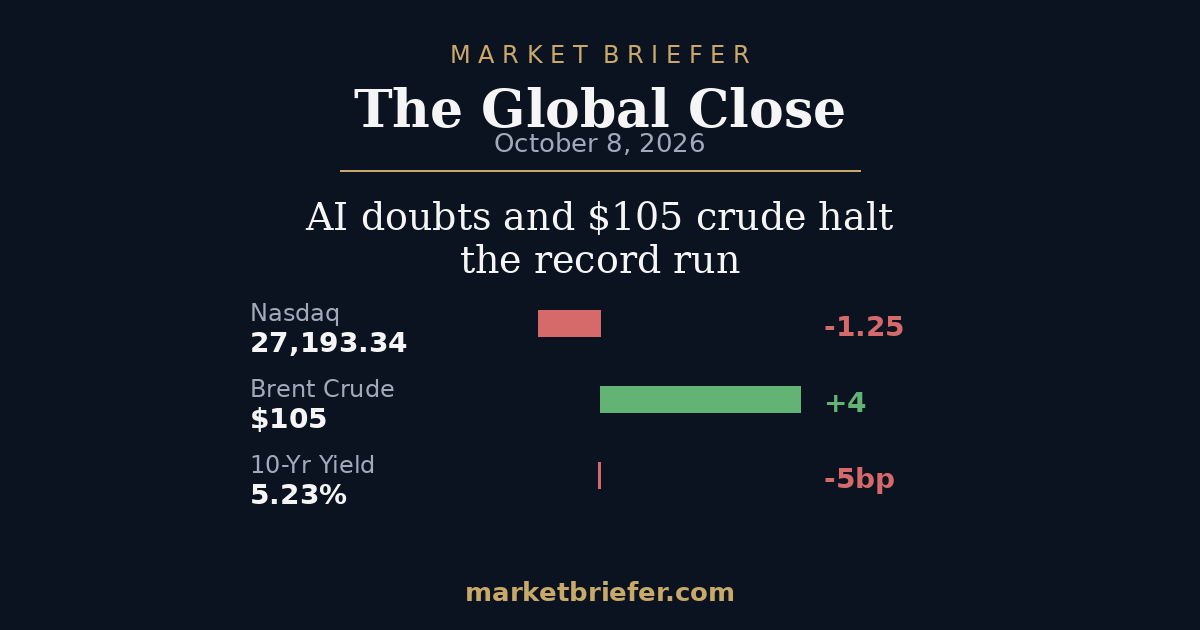
- WHAT MOVED: The S&P 500 fell 0.47% to 7,765.36, the Nasdaq Composite sank 1.25% to 27,193.34 — its worst day since mid-August — and the Dow held flat at 51,231.64 (+0.10%). Brent crude jumped about 4% toward $105, its best day in a month, while the 10-year Treasury eased to 5.23% after a strong $22 billion 30-year auction.
- WHY: The Financial Times reported OpenAI’s annualized revenue is about $20 billion less than the $70 billion previously signaled, reviving doubts about the AI trade’s profitability; oil spiked as Iran struck a vessel near Qatar and reports surfaced that the White House has asked the Pentagon for Iran strike options ahead of the midterms; bond buyers showed up at the day’s 30-year auction.
- WHAT IT MEANS: This was a multiple repricing, not a growth scare. Chip stocks fell 4% while energy rose 2.9% and consumer staples 2.1%; six of eleven S&P sectors finished higher, and a 2.54 bid-to-cover on the 30-year shows long bonds still find buyers near the highest yields since 2000.
- WHAT TO WATCH: Friday’s September nonfarm payrolls and the University of Michigan’s preliminary inflation expectations — the two prints that decide whether Thursday was an AI-headline dip or a rate-regime repricing.
The Number That Matters: 5.23% — the 10-year Treasury’s closing yield, down about 5 basis points on the day after touching 5.35% intraday and a 24-year high of 5.36% on Wednesday. It is the key number because the AI selloff was Thursday’s catalyst, but the risk-free rate is what decides how much pain that selloff can inflict: yields set equity discount rates, corporate borrowing costs, and mortgage rates in a single stroke. It matters more than the Nasdaq’s 1.3% drop because a single-company headline fades; a 5%+ cost of money is the regime. A decisive move back through 5.35% on Friday’s payrolls report would make the jobs data the more important signal — and would confirm the bond selloff is not over.
The day in one paragraph: two sessions after record closes, the market got hit from two directions at once. AI-profitability doubts returned after the FT reported that OpenAI’s annualized revenue is $20 billion lighter than investors had been signaled, sending the Nasdaq to its worst day in nearly two months and chip stocks down 4%. At the same time, crude oil spiked 4% toward $105 after an Iranian strike on a tanker near Qatar and reports that the White House is weighing new strikes on Iran before the November 3 midterms repriced supply risk across the Strait of Hormuz. Bonds were the one bright spot: a strong $22 billion 30-year auction — clearing at 5.618%, the highest since 2000, with a 2.54 bid-to-cover — pulled yields off their multidecade highs and cushioned the close. The tape’s open question is whether the AI trade can keep earning its multiple at 5%+ rates.
United States
Wall Street split along the fault line between AI doubts and energy gains. The Dow added 51.77 points, or 0.10%, to 51,231.64; the S&P 500 fell 36.41 points, or 0.47%, to 7,765.36; the Nasdaq Composite dropped 345.35 points, or 1.25%, to 27,193.34. The small-cap Russell 2000 was essentially flat at about 2,792. It was the second straight decline for the S&P 500 and the Nasdaq, and the Dow has now shed roughly 290 points across two sessions from Tuesday’s record 51,521.28 finish.
Breadth actually told a calmer story than the headline indexes. Technology (-1.78%), consumer discretionary (-0.47%), health care (-0.41%) and utilities (-0.26%) fell; communication services was flat; and six sectors rose — industrials (+0.30%), materials (+0.46%), real estate (+0.58%), financials (+0.91%), consumer staples (+2.12%) and energy (+2.92%). The pain was concentrated in the AI complex: chip stocks fell 4%, the iShares Semiconductor ETF lost 3.5%, Intel and Oracle each dropped about 5.5%, Nvidia fell nearly 3% as the worst Dow component, and Microsoft slid 1.4%. On the other side, Palantir rose 5%, Chipotle jumped about 6% on a report that Starbucks had explored a takeover, and Home Depot added 3.5%.
Corporate news fed both narratives. The Wall Street Journal reported Broadcom is arranging more than $50 billion of financing for OpenAI’s custom AI chips — the AI buildout’s credit appetite in one headline. PepsiCo topped expectations but cut its profit forecast; Levi Strauss posted light revenue; Applied Digital gained after a big revenue jump; and Wolfspeed announced a conditional 30-year, $1.5 billion loan commitment from the US Department of Defense.
Europe
European equities fell to near four-month lows as the bond selloff and the oil spike hit an energy-importing continent at once. The pan-European STOXX 600 ended roughly 0.5% lower; the Euro Stoxx 50 fell 0.94% to 6,122; Germany’s DAX dropped 1.12% to 24,823; France’s CAC 40 lost 0.51% to 7,730; the UK’s FTSE 100 slipped 0.16% to 10,442; and Italy’s FTSE MIB fell 1.35% to 49,298.
Banks were again the weak point — the sector hit a more than three-month low as euro-zone bond yields climbed back toward recent peaks. UK gilt yields sat at a 19-year high, with the 30-year gilt at 6.036%, its highest since January 1998, and the 10-year gilt at 5.49%, highest since July 2007. Italian yields reached a three-year high, though euro spreads tightened. ECB policymaker Primoz Dolenc said the central bank may have to keep raising rates given upside inflation risks, even as markets increasingly price the chance the ECB pauses its hiking cycle this year. Bank of England Governor Andrew Bailey spoke at the Istanbul Economic Forum ahead of the UK’s October 28 budget, in which the chancellor is expected to raise taxes to rebuild fiscal headroom.
Single names told the day’s themes. Bavarian Nordic gained 2.9% after raising its 2026 revenue and margin guidance. Tesco rose 4.5% after lifting its profit forecast to £3.15–£3.3 billion. Aberdeen Group added 0.9% after selling a 52-million-share stake in Standard Life for about £436 million. HSBC slipped 2.1% on an FT report of deep job cuts in its UK wealth business. Markets will parse the ECB’s September meeting accounts, due before Friday’s session, for clues on the policy outlook.
Asia
Asia bore the brunt of the session as rising oil and bond yields traveled east to west. Japan’s Nikkei 225 fell 993.6 points, or 1.4%, to 69,042.11, slipping back below 70,000; the TOPIX underperformed as banks sank 3% and the Tokyo Stock Exchange announced plans to cut the index’s constituents by roughly 40%, to 986 stocks. Hong Kong’s Hang Seng Index fell 344.71 points, or 1.4%, to 23,785.79, its lowest since early July. Mainland markets reopened after the Golden Week holiday and the Shanghai Composite dropped 1.1% to 4,310.28; the CSI 300 fell 1.35%. South Korea’s Kospi sank 2.6% to 6,625.93 as foreigners sold tech for a fourth straight session: Samsung’s preliminary third-quarter operating profit — a near-ninefold increase to KRW 107.4 trillion — still missed lofty expectations, while TSMC’s September revenue rose 54.6% year-on-year to NT$511.86 billion. India’s Nifty fell to an 18-month low after the RBI’s 25-basis-point hike to 5.50%, its first increase since February 2023. Singapore’s Straits Times dropped 3.5% as its bank heavyweights sold off. Reuters summed it up: India at a three-year low, China at a 14-month low.
Currencies & rates
The dollar gave back early gains as Treasury yields eased into the 30-year auction. The Dollar Index traded in a 102.06–102.40 range and closed near 102.1, close to its highest in more than three months. The euro held near 17-month lows at about $1.1214, little changed; the yen lagged on widening yield differentials with the dollar at about ¥158.2; and sterling bounced 0.14% to $1.3230 after bottoming at 1.3184, as Fed Governor Christopher Waller signaled he favors a pause at the October meeting. The Mexican peso was the day’s biggest FX decliner, down 1.3% on hot inflation and central-bank minutes. The offshore yuan sat near 6.70 per dollar after Beijing said it has no intent to devalue the yuan for trade advantage, and China defended its currency policy as Europe stepped up pressure over the trade surplus.
In rates, the star was the auction. The 10-year Treasury yield fell 4.9 basis points to 5.232% after a $39 billion 10-year sale on Wednesday and Thursday’s 30-year reopening both cleared with strong demand. The $22 billion 30-year sale cleared at 5.618% — the highest since 2000 — with a bid-to-cover of 2.54, one of the decade’s strongest, and heavy indirect-bidder (foreign central bank) participation. The 30-year yield fell 5.5 basis points to 5.606%; the 2-year slipped 0.8 basis point to 4.753%. France’s 10-year OAT held near 4.9%, up about 67 basis points in a month. With 30-year US mortgage rates at a near three-year high, homebuyers can size the damage on the calculators at Cents & Sense. More on how bond yields transmit through markets in the Explainers desk.
Credit
Corporate credit bent but did not break, and the stress remains concentrated at the bottom of the ratings ladder. The latest FRED daily readings (October 2) put the ICE BofA investment-grade option-adjusted spread at 0.85%, broad high yield at 3.10%, and CCC-and-lower at 12.02% — each easing from October 1 but still above late-September levels. The CCC spread crossed the 1,000-basis-point distressed threshold on September 30, the first breach since March 2023, and high-yield spreads have widened 48 basis points since late August, with the weakest borrowers absorbing nearly all of it. AI-related borrowing in US leveraged finance has surged to roughly $88 billion this year against about $20 billion in early 2025 — one reason credit desks watched Thursday’s OpenAI headlines as closely as the rate tape. On the primary side, this week’s investment-grade issuance slate is set to miss the $25 billion low end of syndicate forecasts by a wide margin; Tencent is reportedly considering a $5 billion bond offering to fund its AI push; Volkswagen extended Rivian a $1 billion, 10-year term-loan facility at 6.03% under their joint venture; and NatWest announced it will exit as a primary dealer for US and European government bonds.
Commodities
Energy was the day’s macro amplifier. Brent crude surged about 4% to roughly $104–105, its best day in a month, after Iran struck a vessel near Qatar — tanker attacks are at a wartime high — and Axios reported the White House asked the Pentagon to draw up options for large-scale strikes on Iranian energy, infrastructure and nuclear targets. The approach of Hurricane Isaias also threatened US Gulf production. President Trump said the US would not attack Iran before the November 3 midterms, but oil largely shrugged off the pledge. WTI crude gained $3.21, or 3.6%, to $91.49. European natural gas futures rose 3.2% to €78.08/MWh, closing back in on September’s high. Gold rose about 0.6% to $4,137 an ounce, recovering from a two-month low as the dollar rally stalled. Live levels on the Commodities desk.
Crypto
Crypto spent the day as a spectator to the macro repricing. Bitcoin dropped about 2.5% to near $81,300, sliding below $85,000; Ethereum held near $2,568, down about 0.2%. With the bond market setting the risk-free rate and equity risk appetite wobbling, digital assets’ correlation to tech kept them pinned in a tight, downward-drifting range. Market Briefer’s delayed crypto data tracks the majors through the close.
The news behind the numbers
Five developments carried the day. First, the OpenAI report: the FT’s account of a $20 billion gap between signaled and actual annualized revenue hit the heart of the market’s AI-profitability anxiety — the borrowing, off-balance-sheet debt and circular financing behind the buildout — and chip stocks fell 4% in response. Second, the Middle East: the tanker strike near Qatar, the Hormuz risk and Hurricane Isaias put a geopolitical bid back under oil, forcing energy-importing markets from Europe to Japan to reprice inflation risk. Third, the Fed: September meeting minutes showed officials divided on further hikes, most expecting another increase before year-end, while Governor Waller said more hikes may be needed but there is “flexibility” on pace — and 197,000 weekly jobless claims kept the labor market looking firm. Fourth, the bond auctions: $61 billion of 10- and 30-year supply across two days cleared cleanly at the highest yields since 2000, proving buyers still emerge at 5%+ — the reason equities cut their losses into the close. Fifth, the policy backdrop: a New York Fed paper found tariffs have added nearly 3 percentage points to US goods-price inflation; the EU is preparing a temporary import cap on Chinese hybrid cars; and the US and Russia are reportedly exploring gas sales to Europe.
What Would Change This Read: This interpretation — that stretched valuations plus a 5%+ cost of money, triggered by an AI-profitability headline and amplified by an oil spike, drove Thursday’s selloff — would weaken if Friday’s September payrolls print comes in hot while the 10-year holds below 5.30% and oil retreats under $100. That combination would suggest Thursday was a positioning flush into heavy Treasury supply and one FT headline, not a regime repricing of the risk-free rate. In particular, watch how the 10-year reacts to payrolls: a jobs beat that pushes the yield back through 5.35% while equities keep falling would distinguish the stagflationary variant (policy stays tight into a supply shock) from the AI-profitability variant that drove Thursday — and would argue the equity dip was the warning, not the buying opportunity.
What to watch tomorrow
Friday’s calendar is the week’s main event: September US nonfarm payrolls at 8:30 a.m. ET, followed by the preliminary University of Michigan consumer sentiment and inflation-expectations gauges. Canada reports September employment, Brazil releases September inflation, and ECB speakers Piero Cipollone and Isabel Schnabel are on the tape after the central bank’s meeting accounts. Overnight, Asia reopens after a bruising Thursday — with mainland China back in full swing and the Nikkei below 70,000 — and Brent’s hold above $104 will set the morning tone from Tokyo to London.
This is not investment advice. The Global Close is AI-assisted market research produced with automated data checks; figures are verified against market-close reports and the site’s delayed data feeds at publication time.