The Global Close: October 7, 2026 — The 10-year’s 24-year high ends the record run
The 10-year Treasury spiked to a 24-year high of 5.361%, reversing Tuesday's record rally. The full global market wrap — indices, yields, oil, gold and crypto.
The 60-Second Brief
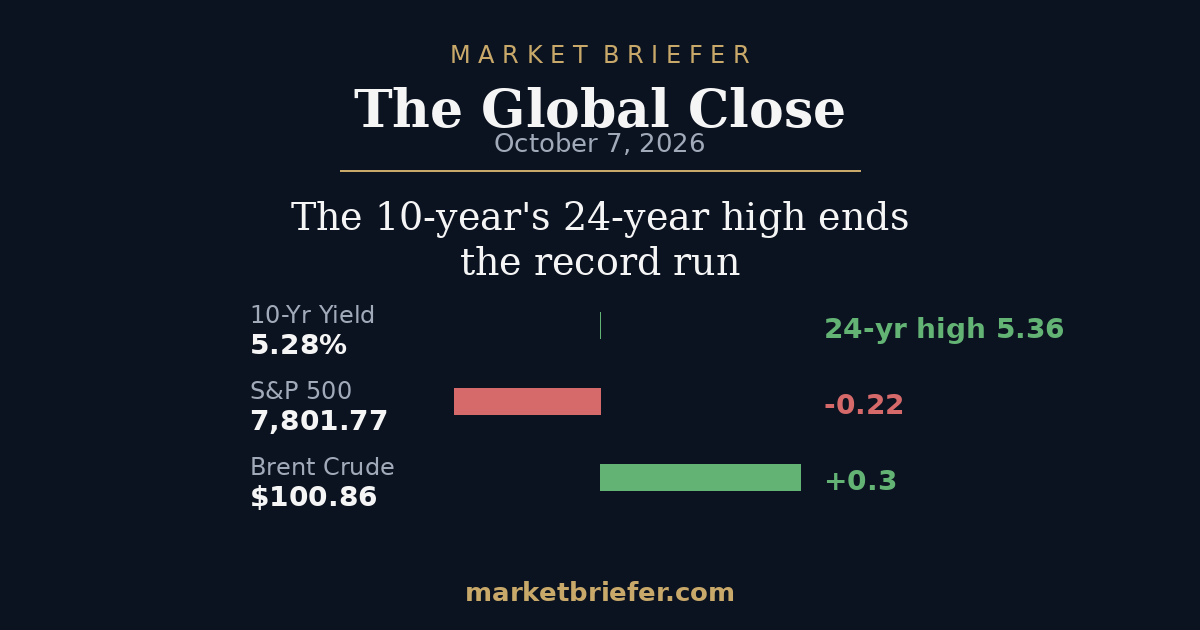
- WHAT MOVED: The S&P 500 fell 0.22% to 7,801.77, the Dow lost 0.66% to 51,179.87 and the Nasdaq slipped 0.22% to 27,538.69 — all one session after record closes. Europe’s STOXX 600 dropped 1.1% to 629.95, the Nikkei shed 0.9% to 70,035.71, and Brent crude held above $100 a barrel.
- WHY: The bond market reclaimed the narrative. The 10-year Treasury spiked to 5.361%, a 24-year high, after Fed minutes showed most officials expect another rate hike this year; a well-subscribed $39 billion 10-year auction only partly calmed the move. Houthi attacks on Saudi Arabia and an Iranian warning over Hormuz shipping kept oil bid.
- WHAT IT MEANS: Duration risk repriced everything not priced like an AI franchise: small caps fell 1.3%, homebuilders slid 2.6% as 30-year mortgage rates touched 7.52%, while megacap tech declined far less than the Dow.
- WHAT TO WATCH: Thursday brings a $22 billion 30-year Treasury auction — the next real test of bond demand — plus weekly jobless claims, the ECB’s meeting accounts, and mainland China’s reopen after Golden Week.
The Number That Matters: 5.36% — the intraday high on the 10-year Treasury yield, its highest print since January 2002. It is the key number because everything else today was a derivative of it: higher long yields lift discount rates on equities, raise corporate borrowing costs, and pull the dollar higher — the exact chain that turned Tuesday’s record rally into Wednesday’s retreat. It matters more than any single index move because a 0.2% equity dip is one day’s noise, while a multidecade yield high is regime. A decisive drop back toward 5.10% on strong auction demand would make the equity tape the more important signal again.
The day in one paragraph: twenty-four hours after the S&P 500 and Nasdaq closed at records, the bond market took the tape back. A spike in the 10-year Treasury yield to its highest since 2002 — amplified by hawkish Fed minutes, Brent crude back above $100 on Middle East escalation, and France’s fiscal worries pushing its 10-year toward 5% — drove a global risk-off session from Tokyo to London to New York. Equities pared their worst losses into the close after a solid 10-year auction, but the day’s message was unambiguous: with the risk-free rate above 5.3%, every risk asset has to earn its keep.
United States
One day after record closes — the S&P 500 at 7,818.93 (+0.58%), the Nasdaq Composite at 27,599.79 (+0.45%) and the Dow at 51,521.28 (+0.49%) — Wall Street retreated across the board. The Dow fell 341.41 points, or 0.66%, to 51,179.87; the S&P 500 gave back 17.16 points, or 0.22%, to 7,801.77; the Nasdaq Composite slipped 61.20 points, or 0.22%, to 27,538.69. The damage was worse at the open — the Dow was down more than 550 points at its lows — before buyers emerged after the Fed minutes and the Treasury auction.
Breadth was poor and the pain concentrated where duration hurts most. The Russell 2000 fell 1.3% to 2,793.20, leaving small caps roughly 9% below their earlier-2026 highs. The names that powered Tuesday’s broadening — power producers, nuclear suppliers and infrastructure contractors that had carried 10 of 11 S&P sectors higher — sat atop Wednesday’s losers. The SPDR S&P Homebuilders ETF fell 2.6% and is down more than 8% this year as the average 30-year mortgage rate reached 7.52%, a three-year high (see what a 7.52% rate means for a monthly payment via the calculators at Cents & Sense).
Megacap tech held up comparatively — Nvidia was down only about half a percent in morning trade — and a handful of defensives finished higher, including AbbVie, Amgen, NetApp and Micron. Constellation Energy, Tuesday’s 12.25% standout, eased just 0.3% to $299.59 and held above its 200-day average. Webull was down about 20% to $5.80 in morning trade after a House report on China. Caterpillar struggled.
Tuesday’s record run, for context, had been an AI-and-yields story in reverse: Marvell Technology rose 5.8% after raising its long-term revenue target, AMD added nearly 3% after Citi lifted its price target to $800, Broadcom gained 3.7%, and Google signed a 20-year, 890-megawatt nuclear power deal with Constellation Energy backed by $4.3 billion of investment — while the 10-year yield fell more than 4 basis points and the Treasury Secretary reassured investors on the borrowing trajectory.
Europe
European equities gave back three days of gains in a firm risk-off session. The STOXX 600 fell 1.1% to 629.95, with banks among the worst performers; benchmarks in Frankfurt, Paris and London all finished lower. The bond selloff was the engine: France’s 10-year OAT yield surged 13.7 basis points to 4.892%, heading back toward the 5% mark briefly touched on Monday — a level not seen since July 2002 — as fiscal worries ahead of the 2027 presidential election kept pressure on French debt. The spread of French yields over German Bunds stood at 131 basis points, down from nearly 160 last week but still wide; Germany’s 10-year Bund yield rose 1.6 basis points to 3.4969%.
Oil above $100 compounded the pressure on an energy-importing continent. Brent rose to $101.58 in morning trade before settling 0.3% higher at $100.86, as traders weighed Houthi attacks on Saudi Arabia, a storm threatening US Gulf oil production, and an Iranian warning that southern routes out of Hormuz could be closed.
Single names told the day’s themes. BE Semiconductor Industries fell 7.2% after UBS downgraded the chip-equipment maker to sell. British water utility Pennon Group slumped after launching a fully underwritten £550 million rights issue and cutting its dividend. HSBC was in the red on reports of sweeping job cuts in its UK wealth business. Continental banks — Société Générale, BNP Paribas, UBS, Deutsche Bank, Intesa Sanpaolo — all fell. On the plus side, Porsche edged higher after an investor event laid out a profitability strategy through 2035, and Renault, Volkswagen and Stellantis rose on reports the EU is considering import restrictions on Chinese hybrid vehicles.
Asia
Asia closed lower as rising oil and bond yields traveled west through the trading day. Japan’s Nikkei 225 fell 548.27 points, or 0.9%, to 70,035.71. Hong Kong’s Hang Seng Index slipped 150.06 points, or 0.6%, to 24,130.50. Mainland China’s markets remained shut for the Golden Week holiday and reopen Thursday. South Korea’s Kospi fell 2% to 6,303.90, Taiwan’s Taiex eased 0.03% to 49,806.37, Australia’s ASX 200 slipped 0.1% to 8,727.68, and the MSCI Asia-Pacific ex-Japan index dropped 0.5%.
The pullback followed a strong Tuesday: the Nikkei had added 1.1% to 70,684, the Hang Seng 1% to 24,281, and Taiwan’s Taiex closed at a record for a fifth straight session — while Foxconn reported record September revenue of NT$1.16 trillion on AI-server demand.
Currencies & rates
The dollar resumed its climb toward multiyear highs as investors sought cover, while the euro sagged under the weight of French fiscal worries and oil above $100. Market Briefer’s delayed FX data showed the euro at $1.1264, down 0.68% on the day; the yen at 158.13 per dollar, up 0.46%; sterling at $1.3277; and the Dollar Index at 101.86. In rates, the 10-year Treasury touched 5.361% — its highest since January 2002 — before a well-subscribed auction of $39 billion in new notes pulled it back to 5.276%, up less than a basis point on the day. The 2-year yield fell 2.7 basis points to 4.762%, while the 30-year bond rose 2 basis points to 5.660%, near its highest since 2002 after touching roughly 5.72% intraday. The minutes of the Fed’s September meeting showed most officials expect another rate hike this year, framed by some as insurance against future inflation rather than a response to current conditions. Markets still expect the Fed to hold at its late-October meeting.
Credit
Corporate credit kept its footing but the stress remains concentrated at the bottom of the ratings ladder. The latest FRED daily readings (October 2) put the ICE BofA investment-grade option-adjusted spread at 0.85%, broad high yield at 3.10%, and CCC-and-lower at 12.02% — each eased from October 1 but still above late-September levels. The CCC spread crossed the 1,000-basis-point distressed threshold earlier this month, and high-yield spreads have widened 48 basis points since late August, with the weakest borrowers absorbing nearly all of it. AI-related borrowing in US leveraged finance has surged to roughly $88 billion this year against about $20 billion in early 2025 — one reason credit desks are watching the AI capex cycle as closely as the rate cycle.
Commodities
Energy was the day’s macro amplifier. Brent crude settled at $100.86, up 0.3%, after pushing past $101.58 in morning trade; WTI swung from an intraday high near $90.98 to close about 1% lower as US supply concerns competed with global demand worries. The drivers were all geopolitical: Houthi attacks on Saudi Arabia, a storm near US Gulf production, and Iran’s warning about Hormuz shipping lanes. Gold held near $4,203 an ounce, essentially flat — the classic haven bid muted by the gravitational pull of 5.3% yields. Natural gas jumped about 5% to $3.11, and copper added 2.8% to $6.66, a reminder that the industrial cycle hasn’t rolled over even as financial conditions tighten.
Crypto
Crypto was quiet relative to the macro noise. Bitcoin traded near $85,517, down 0.06%, and Ethereum near $2,690, down 0.71%. Solana added 0.6% to $120.78. Digital assets spent the day as spectators: with the bond market repricing the risk-free rate, crypto’s correlation to equity risk appetite kept it pinned in a tight range.
The news behind the numbers
Three developments carried the day. First, the Fed minutes: most officials anticipated another rate hike this year, cementing the market’s read that the Fed will not be hurried into easing — the single biggest input into the morning’s yield spike. Second, the Middle East: Houthi strikes on Saudi Arabia plus Iran’s Hormuz warning put a geopolitical bid back under oil, with Brent reclaiming $100 and forcing energy-importing markets from Europe to Japan to reprice inflation risk. Third, France: with the 2027 election approaching and the budget debate looming, the OAT-Bund spread near 131 basis points and the 10-year OAT knocking on 5% kept European risk sentiment fragile. The counterweight was the afternoon’s strong 10-year auction, which proved that at 5.36%, buyers still show up for duration — the reason equities cut their losses into the close.
What Would Change This Read: This interpretation would weaken if the 10-year yield falls back below about 5.10% while the S&P 500 reclaims 7,850 — a combination that would suggest today’s selloff was a positioning flush into heavy Treasury supply rather than a genuine regime repricing of the risk-free rate. In particular, watch Thursday’s $22 billion 30-year auction and Friday’s Michigan inflation expectations: soft auction demand alongside rising inflation expectations would confirm an inflation scare, while strong demand with anchored expectations would distinguish a technical bond selloff from a macro one — and would argue the equity dip was the buying opportunity, not the warning.
What to watch tomorrow
Thursday’s calendar is bond-centric: the $22 billion 30-year Treasury auction at 1:00 p.m. ET is the day’s main event after today’s 10-year test, alongside weekly jobless claims at 8:30 a.m. ET (expected around 200,000–205,000 versus 197,000 prior), the ECB’s September meeting accounts at 7:30 a.m. ET, and August wholesale inventories. Fed speakers Kashkari and Musalem are also on the tape. Overnight, Japan holds a 30-year JGB auction and releases its Eco Watchers survey, and mainland China reopens after the week-long Golden Week break — the first chance for Shanghai to react to a week of global bond-market drama. Friday then brings preliminary University of Michigan consumer sentiment and, more important for the rate debate, its inflation-expectations gauges.
This is not investment advice. The Global Close is AI-assisted market research produced with automated data checks; figures are verified against market-close reports and the site’s delayed data feeds at publication time.