The Global Close: October 6, 2026 — S&P 500’s first record since August as the bond rout pauses
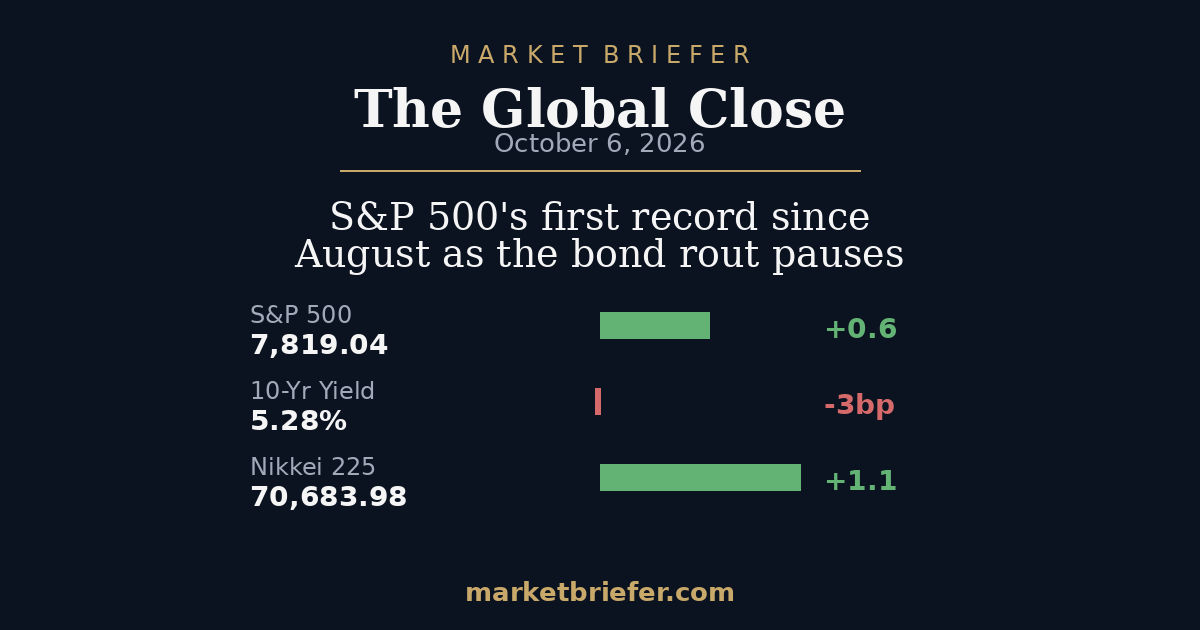
The S&P 500 closed at 7,819.04, its first record since August, while the Nasdaq notched a second straight record as the 10-year Treasury yield pulled back from a 24-year high. Europe rallied, Japan topped 70,000. Today's global market wrap.
The 60-Second Brief
- WHAT MOVED: The S&P 500 rose 0.6% to 7,819.04 — its first record close since August — while the Nasdaq added roughly half a percent for a second straight record. Europe gained nearly across the board, the Nikkei closed above 70,000, and the 10-year Treasury yield eased back to 5.28%.
- WHY: A pullback in oil and long-dated yields from Monday’s extremes gave stocks room to breathe; AI earnings optimism did the rest, with consensus third-quarter S&P 500 profit growth now seen near 30%.
- WHAT IT MEANS: Equities are pricing earnings momentum ahead of the discount rate — but records at a 5.28% 10-year is a combination with almost no historical precedent, so the tension has not resolved, only paused.
- WHAT TO WATCH: Wednesday’s FOMC minutes from the September meeting (2 p.m. ET) and the 10-year Treasury auction — both will test whether today’s rate relief is durable.
The Number That Matters: 5.28%.
The 10-year Treasury yield finished near 5.28%, down roughly 3 basis points from Monday’s 24-year high of 5.31% after touching above 5.35% intraday on Monday. It is the key number because it is the hinge on which everything else turns: it sets the floor under mortgage rates, the discount rate on every growth stock, and the dollar’s bid. It matters more than the S&P 500’s record because the record was enabled by the yield’s retreat — a few basis points of relief converted instantly into index points, which is exactly how today’s tape traded. A failed 10-year auction that pushes the yield back above 5.35%, or a hawkish FOMC minutes that reprices October hike odds above 50%, would make the Fed’s posture — not the relief rally — the more important signal.
The day in one paragraph
Tuesday was the bond market’s apology tour. After Monday’s record Nasdaq met 24-year Treasury yields, the 10-year eased back to 5.28%, oil slid then steadied, and stocks converted every point of relief into fresh highs: the S&P 500’s first record close since August (its 28th of 2026), a second straight Nasdaq record, and a Dow up 253 points that remains about 5% shy of its own early-August high. Europe shook off France’s fiscal drama — the CAC 40 bounced 0.8% as the government’s 2027 draft budget narrowed French–German yield spreads — and Japan’s Nikkei closed above 70,000 for a second day. The macro calendar was quiet ahead of Wednesday’s FOMC minutes, so price action did the talking, and the message was: earnings are carrying this tape, yields are merely permitting it.
United States
The S&P 500 added 45.09 points (+0.6%) to 7,819.04, closing above 7,800 for the first time and hitting an intraday record of 7,844.52 (WSJ, Barron’s). The Nasdaq Composite rose roughly 0.5% for a second consecutive record close, after Monday’s 1.05% surge to 27,477.31. The Dow Jones Industrial Average gained 253 points (+0.5%) to 51,520.90, though CNN notes it remains down about 5% from its early-August record, lagging badly behind the other two benchmarks.
Breadth was the story underneath the indexes. Nearly every S&P sector rose — and the leader was utilities, an unusual outcome for a record day: Barron’s notes that in the 61 prior instances since 1990 of the S&P 500 hitting its first record in more than 30 days, utilities led only twice; today was the third. Constellation Energy surged 12.2% — one of the day’s top S&P gainers — after sealing a 20-year power purchase agreement with Google, and Vistra was close behind as investors treated electricity demand as an indirect AI play. Consumer discretionary also ran, led by Cisco (+4.5%), Walmart, Amazon and Home Depot (each around +2%); healthcare was the lone declining sector.
Among single names: Nvidia set a third straight intraday record before closing up 0.1%, inching toward becoming the first $6 trillion company; SpaceX rose 0.5% to follow Monday’s 7.5% surge (Forbes: Musk a trillionaire again); Astera Labs and Nebius each gained more than 7% on AI-hardware bids. On the downside, Seagate sank after a big run, Salesforce fell 2.1% to lag the Dow, and Option Care Health jumped 32.9% to $31.06 on a reported $5 billion-plus McKesson and CD&R buyout. Small caps struggled: the Russell 2000 fell 0.7%.
Europe
Europe built a floor after Monday’s violent bond rout. The FTSE 100 rose 0.85% to 10,587.50, the DAX gained 0.90% to 25,481.97, and the CAC 40 rebounded 0.80% to 7,896.47 as French–German yield spreads narrowed from crisis-era peaks following the government’s 2027 draft budget (FXStreet). The Euro Stoxx 50 added 0.91%, with the FTSE MIB (+1.27%), SMI (+1.25%) and IBEX 35 (+1.22%) leading the regional scoreboard. German 10-year bund yields fell 5 basis points to 3.44%, and Brent’s slide below $100 helped the rate-sensitive bid (Reuters).
France remains the continent’s fault line — the 10-year French yield still trades about 100 basis points over German bunds — but Tuesday was about relief, not resolution. The notable movers: Genmab surged 8.5% after a Phase III trial showed epcoritamab plus R-CHOP significantly cut progression-or-death risk in untreated diffuse large B-cell lymphoma; Sartorius and Alstom each rose about 4%, the latter on a Vingroup order for 200 Hanoi metro trains. Schneider Electric fell 2% on a JPMorgan downgrade as analysts questioned its $22.6 billion swoop for PTC, and Wienerberger dropped 2.5% after cutting full-year EBITDA guidance (FXStreet).
Asia
Asia rode Wall Street’s tailwind. Japan’s Nikkei 225 advanced 1.05% to 70,683.98, holding above the 70,000 threshold after Monday’s 2.4% surge; Hong Kong’s Hang Seng gained 1.00% to 24,280.56, reclaiming the 24,000 level; and India’s Sensex rose 0.92% to 73,047.43 (SKN, MarketWatch). South Korea’s KOSPI fell 0.89% on its return from holiday, and mainland China remained closed for the National Day Golden Week holiday (through Oct 7), so the region’s largest market was a spectator. MSCI’s Asia-Pacific index ex-Japan was roughly flat. Reuters’ wrap framed the session as tech-led rate relief: Monday’s Nasdaq record and softer oil prices allowed buyers to focus on earnings instead of yields.
Currencies & rates
The dollar’s bid softened as yields eased. The euro languished near 17-month lows — around $1.12, after briefly touching $1.116 overnight — as French fiscal concerns kept sellers on the bid (Reuters, site data). Sterling held near $1.3228; the yen traded around ¥158.19 per dollar with intervention chatter sitting up near 164; the Dollar Index hovered near 102.2.
The rate move was the macro event. The 10-year finished near 5.28%, down about 3bp from Monday’s 24-year-high close, after briefly topping 5.35%; Germany’s 10-year fell to 3.44% (WSJ, Reuters). For context, that 10-year yield is the direct floor beneath U.S. mortgage rates — the site’s Cents & Sense mortgage calculator shows what a basis point costs in real dollars. On the policy side, the September FOMC’s unanimous 25bp hike to 3.75–4.00% is the backdrop for tomorrow’s minutes, with traders now pricing only about a 20–24% chance of another hike at the October 27–28 meeting, down from roughly 70% a week ago (CME FedWatch, Reuters).
Credit
No fresh ICE BofA prints for today were verifiable from FRED or a market-close report, so this is context. The FRED October 2 readings: investment-grade 0.85%, broad high-yield 3.10%, CCC-and-lower 12.02% — all eased from October 1 but remain above September 25 levels, with the pain concentrated at the weak end of the curve. All-in yields on highly rated U.S. corporate bonds eclipsed 6% for the first time since 2023 this week, mostly from the Treasury component (MarketWatch). Primary-market softness is showing: SoftBank’s late-September bond deal traded poorly, and Paramount Skydance’s new debt to fund its Warner Bros. Discovery bid met a cautious market — “credit is a little bit choppy,” as Madison Investments’ Mike Sanders put it (MarketWatch). European investment-grade spreads sit around 0.9 percentage points, the highest since April but a fraction of crisis levels. Credit is priced for yields to stop rising; they have not — today’s pause was in stocks’ favor, not credit’s.
Commodities
Oil fell in the morning, then clawed back. WTI closed up 0.4% at $89.80 and Brent up about 0.3% to $100.58 after trading comfortably lower through the morning (WSJ). The early weakness came from supply headlines: Saudi Arabia unexpectedly cut its November oil prices for Asia to a six-year low, and the G7 pledged to release 100 million barrels from emergency reserves and to impose no export restrictions (Reuters). The rebound came from risk: Iran-backed Houthi rebels attacked Saudi targets, and traders weighed pickup in tanker shipments through the Strait of Hormuz against Iran’s attempts to curb flows — Gulf oil flows excluding Iran are running above 81% of pre-war levels (Reuters). Gold rose $32.70 to $4,189.50, and silver firmed 0.8% to $61.19; copper was up 2.6% near $6.65 and natural gas gained 4.1% — the AI-data-center electricity bid quietly showing up in metals and energy.
Crypto
Crypto drifted while equities ran. Bitcoin hovered near $85,600, down about 1%; Ether traded around $2,699, down roughly 0.9%. Both remain in narrow ranges as the rate story — not risk appetite — dominates capital allocation; the credit data above shows why leverage-heavy crypto bids are not pressing right now.
The news behind the numbers
The day’s tape was price action, but the news framed it. The macro spine was the bond selloff’s partial unwind: Monday’s 24-year-high yields were driven by a robust ISM services print (54.9 in September, with the prices-paid component at 74.0, a post-2022 high) and persistent energy inflation — and Tuesday’s relief came as oil eased and the G7 pledged supply. That relief arrives with a caveat: the Fed is in a hiking cycle again, markets now price at least three more hikes over the next 12 months (WSJ), and tomorrow’s FOMC minutes cover a meeting that pre-dates Friday’s soft payrolls report.
On the corporate side, the AI capex machine kept printing: Nvidia’s approach to a $6 trillion valuation, Google’s 20-year power deal with Constellation Energy, and the reported $5 billion-plus McKesson/CD&R buyout of Option Care Health. Europe’s politics stayed in the headlines — Spain’s Pedro Sánchez set a November 29 snap election after his housing measures were rejected, France’s 2027 budget fight narrowed spreads but settled nothing — and the Trump administration signed an executive order allowing dyed diesel on public roads through year-end, a small consumer-price gesture ahead of elections. Earnings season begins in earnest next week with the big U.S. banks.
What Would Change This Read
This interpretation — that rate relief, not earnings alone, is carrying the rally — would weaken if the 10-year yield reclaims 5.35% and holds there while stocks keep setting records: that combination would show the rally has decoupled from rates entirely, which is either a genuine earnings story or momentum running on fumes. In particular, watch Wednesday’s FOMC minutes and the 10-year auction. A hawkish read that reprices October hike odds back above 50% while utilities — today’s leadership — roll over would distinguish the “Fed-path relief” story in this briefing from the alternative, which is that AI profit growth near 30% is simply outrunning any discount rate, at least for now.
What to watch tomorrow
Wednesday is the week’s main event: the FOMC minutes from the September 15–16 meeting at 2 p.m. ET — traders will hunt for the balance of concern between inflation and employment and any signal about October — preceded by the 10-year Treasury auction at 1:01 p.m. ET, whose demand will say whether the rate selloff is really exhausting itself. Also on the calendar: U.S. weekly crude inventories (10:30 a.m. ET), German industrial production, French trade balance, NY Fed consumer inflation expectations, BoJ Governor Ueda’s speech, Dallas Fed President Logan, and earnings from Applied Digital and Levi Strauss. Thursday brings the ECB meeting accounts, weekly jobless claims, PepsiCo earnings and the 30-year auction; Friday brings Michigan consumer sentiment and Delta earnings. Asia opens with China’s Golden Week ending — foreign-exchange reserves data Wednesday, then mainland trading resuming Thursday. Follow the data live on marketbriefer.com.
This is a market briefing, not investment advice. Nothing here predicts what markets will do next.