The Global Close: October 23, 2026 — Dow drops 653 points as oil spikes and the 10-year returns to 5%
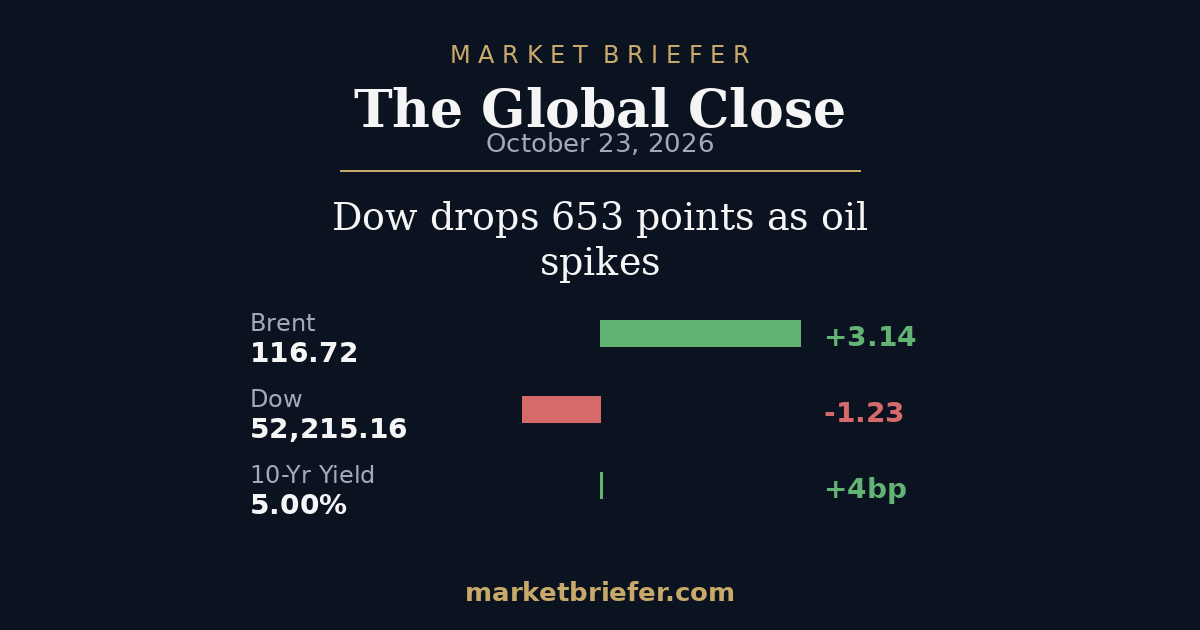
The Dow fell 1.23% to 52,215.16 as Brent jumped 3.14% to $116.72 and the 10-year Treasury yield returned to 5.00%; Europe posted its worst week since early September and Asia diverged.
The 60-Second Brief
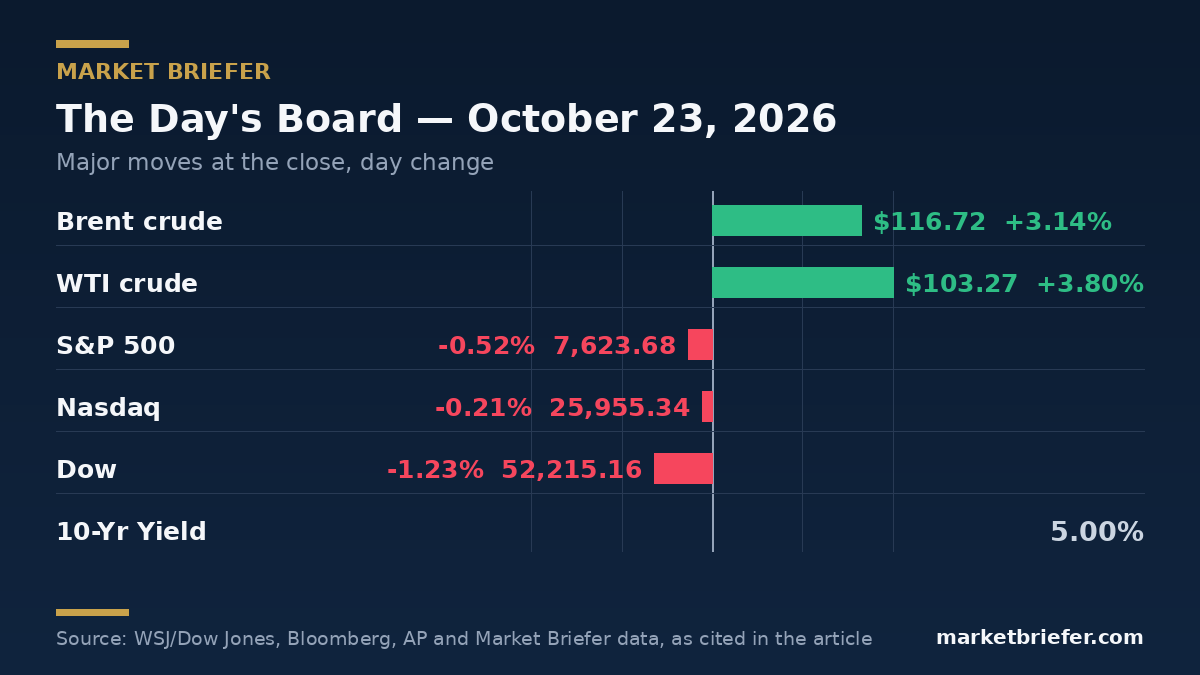
- WHAT MOVED: The Dow fell 652.82 points, or 1.23%, to 52,215.16; the S&P 500 lost 0.52% to 7,623.68 and the Nasdaq Composite slipped 0.21% to 25,955.34, while Brent crude jumped 3.14% to $116.72 and WTI rose 3.8% to $103.27.
- WHY: Houthi attacks on Saudi energy sites and fears of renewed U.S.–Iran strikes rebuilt the oil risk premium, and hot U.S. PMI data pushed the 10-year Treasury yield back to 5.00%.
- WHAT IT MEANS: Energy was the only shelter — the S&P 500 energy sector rose 2.60% — while consumer and rate-sensitive sectors absorbed the cost of dearer fuel and money.
- WHO IS AFFECTED: Borrowers and homebuyers, with the 10-year at 5.00% and the average 30-year mortgage at 7.32%; airlines and transport firms facing higher fuel costs; and American Express workers, after the company announced cuts of about 5% of its workforce.
- WHAT TO WATCH: The Federal Reserve decision on Wednesday, October 28, with Microsoft and Alphabet earnings the same evening, after Tuesday’s consumer confidence and durable goods data.
The Number That Matters: Brent crude at $116.72 a barrel
Brent settled up $3.55, or 3.14%, at $116.72 — its highest close since April 29 and a 6.2% gain for the week, according to Dow Jones Market Data reported by the Wall Street Journal and Morningstar. It matters more than the Dow’s 653-point fall because oil is the transmission mechanism: dearer crude feeds inflation expectations, which lifted Treasury yields across the curve on Friday, which in turn pressured the consumer and financial shares that dragged the indexes lower. A decisive retreat in Brent back below $110 while the 10-year yield held at 5.00% would make the yield, not oil, the more important signal.
Wall Street closed a bruising week in the red, not because the AI selloff deepened — technology was comparatively calm after Thursday’s rout — but because two forces outside the stock market tightened conditions at once: oil surged on Middle East escalation fears, and Treasury yields climbed back to the 5% threshold investors have treated all month as a warning line.
United States
The Dow Jones Industrial Average dropped 652.82 points, or 1.23%, to 52,215.16. The S&P 500 fell 39.75 points, or 0.52%, to 7,623.68, and the Nasdaq Composite eased 53.52 points, or 0.21%, to 25,955.34. The Russell 2000 slipped 0.29% to 2,775.90, and the CBOE Volatility Index rose 2.21% to 19.45. For the week, the Dow still gained 0.41%, while the S&P 500 fell 0.47% and the Nasdaq 100 fell 0.79%.
Sector breadth told the oil story. Energy led the S&P 500 sectors, up 2.60%. Consumer staples fell 1.92%, communication services 1.78%, consumer discretionary 1.66% and financials 1.32%. Semiconductors rose 0.44%, stabilising after Thursday’s 6.7% drop on AI funding doubts.
American Express fell 3.3% to $314.57 after reporting higher profit and raising its outlook, but announcing cuts of about 5% of its workforce — roughly 3,500 roles — to reduce layers and prepare for wider AI use, Dow Jones reported. Instacart surged about 9% on reports it is exploring a sale, with Uber and DoorDash named as suitors. Drilling and oilfield-services shares gained roughly 5%.
Europe
European stocks closed lower and posted their steepest weekly loss since early September. The pan-European STOXX 600 fell 0.31% to 635.77, for a weekly decline of about 1.4%. Germany’s DAX fell 0.75% to 25,181.65, France’s CAC 40 slipped 0.36% to 7,782.82, and the UK’s FTSE 100 eased 0.32% to 10,690.36. Spain’s IBEX 35 rose 0.40% and Italy’s FTSE MIB added 0.36%, against the regional slide.
Qatar News Agency attributed the caution to France’s political situation and rising oil, despite improved earnings forecasts. UK retail sales volumes fell 0.4% in September, steeper than the 0.1% forecast in a Reuters poll, ahead of the October 28 budget. Oil and gas was the lone strong sector, up about 1.7% — BP +1.8%, Shell +1.5% — and Holcim jumped 5.7% after raising its forecasts.
Asia
Asia diverged. Japan’s Nikkei 225 fell 0.34% to 62,693.16, extending a weekly decline of about 4% as the tech selloff weighed on chip names, Reuters reported. Hong Kong’s Hang Seng rose 0.69% to 23,093.37, and China’s Shanghai Composite gained 0.89% to 3,690.48, with the CSI 300 up about 0.8% after blue chips hit their lowest since July 2025, Reuters said. South Korea’s KOSPI added 0.30% to 5,550.30; Australia’s ASX 200 was flat at 8,795.20.
Reuters described bargain hunting after the steep selloff, with the broad Asia-Pacific index outside Japan set for a fourth straight weekly loss — stabilisation, not recovery.
Currencies and rates
Treasury yields rose across the curve: the 10-year climbed 4 basis points to 5.00%, the 2-year to 4.69% and the 30-year to 5.33%, reversing part of Thursday’s haven rally — the biggest daily fall in yields in over a year. Reports linked the rise to hot flash PMI data and oil-driven inflation concern. The average 30-year mortgage was 7.32% in Freddie Mac’s October 22 survey, down from 7.40% — a level at risk if the 10-year holds at 5%.
The dollar was softer against most majors despite the yield rise. The Dollar Index eased 0.22% to 101.75, EUR/USD was at 1.1204, GBP/USD rose 0.29% to 1.3375, and USD/JPY fell to 156.81 as the yen drew haven demand. The currencies desk tracks the full board.
Credit
No verified investment-grade or high-yield spread print from FRED or a market-close report was available at publication time, so no spread figure is reported here. The credit-adjacent story was American Express: a profitable quarter, a raised outlook, and a restructuring charge tied to its workforce plan.
Commodities
Oil dominated. WTI settled up 3.8% at $103.27, a 4.3% weekly gain, and Brent rose 3.14% to $116.72, up 6.2% on the week, the Wall Street Journal and Dow Jones Market Data reported. Bloomberg reported Houthi claims of attacks on the Saudi port of Yanbu and on an oil field and airport, alongside reports that the U.S. and Israel have developed plans for renewed strikes on Iran after the November 3 elections — not yet approved. “Weekend escalation fears are adding fuel,” CIBC’s Rebecca Babin told Bloomberg. With Hormuz flows recovered toward prewar levels, Friday’s move was a risk premium, not lost barrels. See the commodities desk.
Gold closed at $3,999.90 an ounce, down 0.7%, after dipping below $4,000 for the first time since July — an unusual failure to rally on a risk-off day, as investors favoured Treasuries, the yen and the Swiss franc for shelter. Copper was at $6.50 and natural gas at $3.05 in Market Briefer’s delayed data.
Crypto
Bitcoin was little changed at $81,279, down 0.13%, and Ethereum rose 0.28% to $2,397 in Market Briefer’s CoinGecko-sourced data. Earlier softness below $82,000 was linked in reports to $635 million of U.S. spot Bitcoin ETF outflows; by the close both majors were flat, holding while oil and yields set the tone.
The news behind the numbers
Three developments drove the session. First, Middle East escalation lifted crude for a third straight session, lifting energy shares and pressuring airlines, transport and consumer names. Second, rates: the 10-year’s return to 5.00% kept borrowing costs central for borrowers, homebuyers and rate-sensitive businesses. Third, the AI question lingered: Thursday’s 2.6% Nasdaq fall, on data-centre funding concerns, left Friday’s tech stabilisation fragile — and American Express’s AI-linked cuts showed workers at a profitable company among those affected by the same trade.
Brent’s close is its highest since April 29 — the last time the war premium, not physical supply, set the price. The pattern is similar: prices rose as Gulf exports recovered, because traders paid for November’s risk, not October’s barrels.
What Would Change This Read
This interpretation would weaken if the 10-year yield falls back below 4.90% while Brent holds above $110, suggesting Friday’s equity pressure was not primarily an oil-and-rates move. In particular, watch Wednesday’s Fed decision and Microsoft and Alphabet earnings, because they would distinguish between the current interpretation — an externally driven cost shock — and the alternative explanation that AI funding concerns are becoming the dominant driver of the whole market, not just technology.
What to watch tomorrow
Tomorrow is Saturday, so the next trading day is Monday, October 26 — a quiet calendar day, with a 2-year Treasury note auction the main scheduled event and Asia’s open the first test of weekend oil headlines. Tuesday, October 27 brings U.S. durable goods orders, Case-Shiller home prices, new home sales and Conference Board consumer confidence, and the FOMC begins its two-day meeting. The decision lands Wednesday, October 28 at 2:00 p.m. ET, followed by Microsoft and Alphabet earnings after the close; Thursday brings advance third-quarter GDP and the September PCE price index. Our explainers cover how the Fed decision transmits to mortgage and borrowing rates.
This is not investment advice. The Global Close is AI-assisted market research produced with automated data checks; figures are verified against market-close reports and the site’s delayed data feeds at publication time.