The Global Close: October 22, 2026 — Nasdaq sinks 2.6% as the AI bill comes due
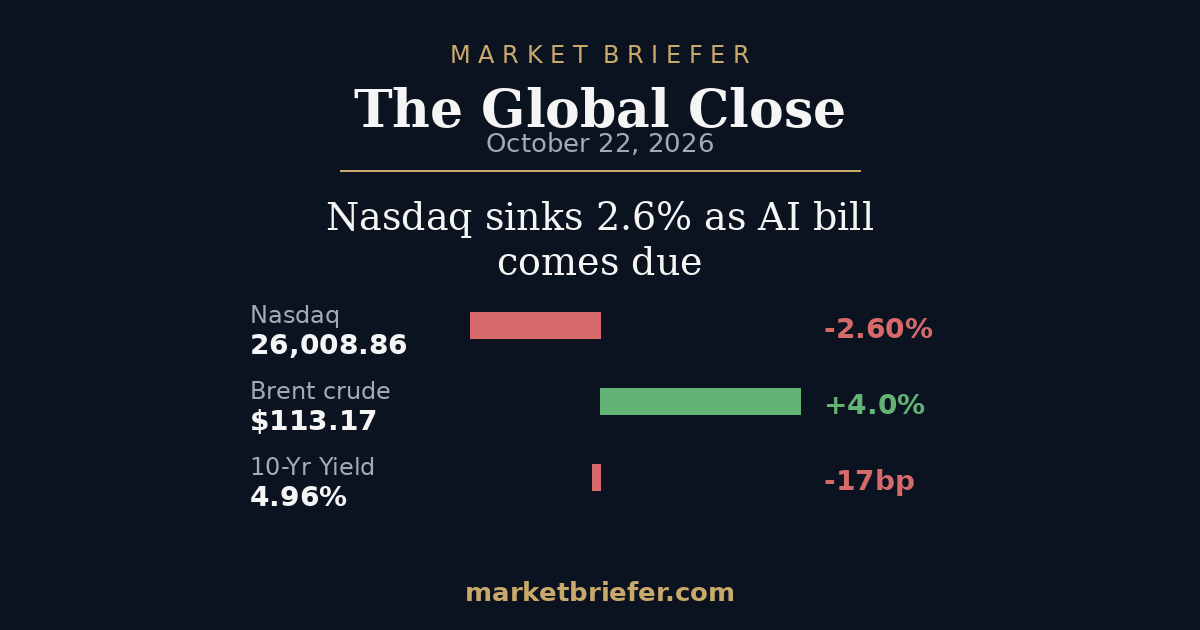
The Nasdaq fell 2.6% to 26,008.86, semiconductors dropped 6.7% and Brent settled at $113.17 as AI financing fears met a Middle East oil spike, while Treasury yields posted their biggest fall in over a year.
The 60-Second Brief
- WHAT MOVED: The Nasdaq fell 2.60% to 26,008.86 — its worst day since June — and the S&P 500 lost 1.21% to 7,663.43, while the Dow finished flat. Semiconductors plunged 6.72%, Brent settled up 4% at $113.17, and every major index in Asia and Europe fell.
- WHY: Meta’s plan to raise funds for still-rising AI capital spending, and Lam Research’s supply-constrained outlook, forced a reassessment of what the AI build-out costs and who pays — as Houthi attacks in Saudi Arabia and reports of planned U.S.–Israeli strikes on Iran lifted oil to a five-month high.
- WHAT IT MEANS: A financing repricing, not a broad exit from equities: the equal-weight S&P 500 rose 0.73%, six of eleven sectors gained, and Treasury yields posted their biggest fall in more than a year.
- WHO IS AFFECTED: Energy importers and borrowers — Japan fell 2.65% with Brent above $112, while U.S. borrowers saw the 10-year yield drop back below 5% to 4.96%, relief that holds only if oil does not feed into inflation expectations.
- WHAT TO WATCH: Friday’s flash PMIs for the U.S., euro zone, Japan and the U.K., final University of Michigan sentiment, and whether Brent holds above $113 into the weekend.
The Number That Matters: $113.17
The Number That Matters: $113.17 — Brent’s settlement, up 4% to its highest since May 4. The Nasdaq’s fall was the headline, but oil transmits furthest: it raises the inflation path the Fed must price against, squeezes importers from Tokyo to Frankfurt, and explains why gold fell 2.6% on a risk-off day — the market chose Treasuries, not bullion, as its hedge. An AI-spending reassessment can reverse on the next earnings print; a barrel sustained above $110 reprices fuel, freight and rates for months. A decisive Brent close back below $105 would make the 10-year yield the more important signal again.
The day in one paragraph: Thursday was the day the AI trade’s invoice arrived. A day after Meta committed to $135–145 billion of 2026 capital spending, investors focused on how it gets financed — a new class of shares — and on Lam Research’s supply-constrained outlook. Chips fell 6.72% in the U.S., Seoul 3.52%, Europe posted its biggest fall in three weeks and China’s CSI 300 crossed into a bear market — while oil jumped and bonds rallied the other way.
United States
The Nasdaq Composite fell 694.00 points, or 2.60%, to 26,008.86, its biggest fall since June 5, shedding about $1 trillion of market value, per Reuters. The S&P 500 lost 93.74 points, or 1.21%, to 7,663.43. The Dow rose 11.89 points, or 0.02%, to 52,867.98, and the Russell 2000 added 0.11%. The VIX jumped 14.09% to 19.03. Inside the index: staples rose 3.11%, utilities 1.98%, health care 1.33% and financials 1.18%, while technology fell 3.00% and communication services 3.02%. The equal-weight S&P 500 gained 0.73%.
The selling sat in the AI complex. Lam Research fell 11.76% after its outlook, AMD lost 8.10%, Intel 8.04%, Micron 6.26% and Nvidia 4.40%. Meta sank 6.98% to $648.85 — its largest fall since July, per Reuters — after its plan to issue a new class of shares to fund AI investment revived the return-on-investment question; its credit-risk pricing hit a record high. SpaceX gave back 9.14% of Wednesday’s rally, Tesla fell 3.08% and Amazon 4.57%. Moderna was the S&P 500’s worst stock, down 18% after an apparent leak of cancer-vaccine data. Against that, Procter & Gamble rose 5.6% on better-than-expected results, Blackstone gained 8% and Spotify surged 11%. More on our Stocks desk.
Europe
Europe fell everywhere. The STOXX Europe 600 lost 1.05% to 637.74, its biggest decline in three weeks, with banks down 3.54% and basic resources 3.89%, while health care rose 2.07%. The Euro Stoxx 50 fell 1.94% to 6,087.01, Italy’s FTSE MIB 2.54% and Spain’s IBEX 35 2.12%. The DAX closed 1.04% lower at 25,379.49 — SAP rose 3.21% after its results, but Siemens Energy fell 8.56% — and the CAC 40 dropped 1.39% to 7,811.26. London’s FTSE 100 eased 0.26% to 10,725.03, dragged by banks; Barclays and Hermès disappointed, per Reuters. See our Markets coverage.
Underneath sat a sovereign stress line: the French–German 10-year spread widened to 175 basis points, the widest since 2011, per Reuters — the euro crisis era, when France’s premium last forced a euro-area policy response. France’s fiscal position is again the region’s pressure point.
Asia
Asia sold off first and hardest. South Korea’s Kospi fell 3.52% to 5,533.77 — its third move above 3% in three sessions — as SK Hynix lost 5.56% and Samsung Electronics 3.80%; the Bank of Korea held at 3.00%, as expected. Japan’s Nikkei 225 fell 2.65% to 62,907.84, with chip-equipment names hit and Brent above $112 raising costs for an economy that imports almost all its crude. Hong Kong’s Hang Seng lost 3.03% to 22,934.68 and the Shanghai Composite fell 1.48% to 3,658.03. The CSI 300 fell about 1.8% to 4,036.30, taking it over 20% below its June 22 peak — a bear market, per Reuters. Taiwan’s Taiex lost 1.81%.
Currencies & rates
Bonds were the refuge. The 10-year yield fell 17 basis points to 4.96% — back below 5% — the 2-year fell 16 to 4.65% and the 30-year 13 to 5.29%, the curve’s biggest one-day drop in more than a year, even as oil spiked; a 5-year TIPS auction was soft, per Reuters. Jobless claims fell to 194,000, below the 200,000 expected, and the Conference Board’s leading index was unchanged in September. The Dollar Index eased 0.2% to 101.63; the yen and Swiss franc were the biggest G10 gainers, with the dollar at ¥157.11, the euro little changed at $1.1244 and sterling at $1.3404. Our Currencies desk tracks the board; our Explainers cover how the 10-year reaches mortgage rates.
Credit
No fresh FRED spread prints were available at publication, so no spread levels are reported today. The credit story ran through AI financing: Meta’s credit-risk pricing hit a record high as its plan to raise capital — including a new class of shares — reignited fears that technology firms will issue more debt and equity to fund the build-out, and Nomura’s FOMC preview noted financial conditions have tightened most notably in credit markets. The build-out has been financed with huge sums of borrowed money over the past year, per Reuters; a market that charges more for that paper changes its pace.
Commodities
Oil did the geopolitical work. Brent settled up 4% at $113.17, its highest since May 4, and WTI rose 2.4% to $99.47, after a Houthi drone strike on Aramco’s Shaybah field killed two people — operations unaffected — an attack on King Fahd International Airport in Dammam, and Houthi claims against Yanbu. The U.S. ordered non-emergency personnel and families to leave Saudi Arabia, and the New York Times reported the U.S. and Israel have developed plans for renewed strikes on Iran after next month’s midterms. Gold went the other way: futures fell 2.6% to $4,040, the lowest in over two months, as safe-haven flows chose Treasuries. Copper fell to $6.40 and silver to $54.63. The full board is on our Commodities desk.
Crypto
Crypto fell with the risk complex. Bitcoin dropped about 4% — its biggest fall since June — to around $81,400, and Ethereum fell 4.26% to $2,391 on the site’s CoinGecko feed; Strategy, Coinbase and Robinhood fell with it. Our Crypto desk tracks the board.
The news behind the numbers
Three threads tied the day together. First, financing: Meta’s results were strong, but Thursday’s question was the funding — equity issuance dilutes, debt costs more at 5% yields, and the market marked down the whole chain from Meta to SK Hynix. Second, energy: Brent above $113 with U.S. gasoline above $4 a gallon is a direct cost to households and freight, and why the bond rally is fragile — Vital Knowledge noted yields would probably be below 4.5% without oil and the Iran war. Third, France: a 175-basis-point spread over Bunds is the euro crisis’s signature number. A global scramble to patch critical PHP flaws added a cybersecurity edge to the AI anxiety, Reuters reported. The groups absorbing Thursday are Asian energy importers, French borrowers pricing off OATs, and U.S. drivers paying above $4 at the pump.
What Would Change This Read
This interpretation would weaken if Friday’s flash PMIs come in strong while Brent falls back below $105 and semiconductors stabilise — evidence Thursday was a positioning flush, not a financing repricing. In particular, watch Meta and the Philadelphia Semiconductor Index, because they would distinguish between the current interpretation — that the cost and funding of AI spending is now the binding constraint — and the alternative, that a crowded trade simply unwound on one day’s headlines.
What to watch tomorrow
Friday, October 23 brings flash PMIs for the U.S. (9:45 a.m. ET; prior 55.9 manufacturing, 58.8 services), the euro zone, Japan and the U.K., final Michigan sentiment at 10:00 a.m. ET (preliminary 46.3), U.K. retail sales and Canadian retail sales. ECB board members Cipollone and Montagner speak. Asia’s open will show whether Seoul’s rout has a fourth day — five days before the Fed’s October 27–28 meeting.
This is not investment advice. The Global Close is AI-assisted market research produced with automated data checks; figures are verified against market-close reports and the site’s delayed data feeds at publication time.