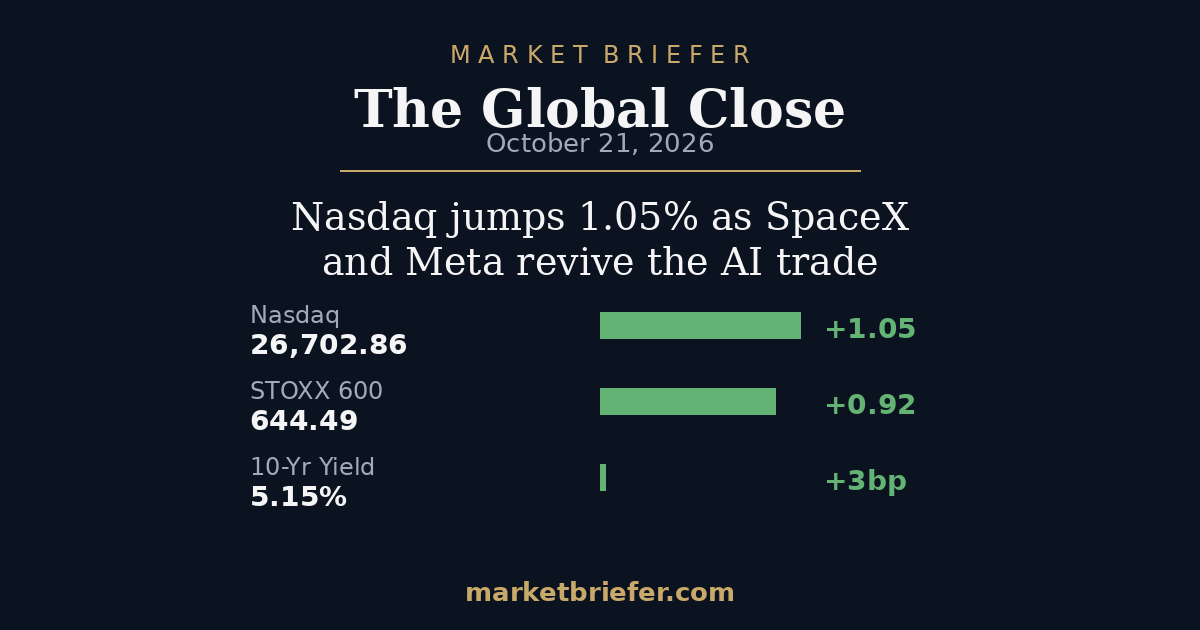
The Global Close: October 21, 2026 — Nasdaq jumps 1.05% as SpaceX and Meta revive the AI trade
The Nasdaq rose 1.05% to 26,702.86 as SpaceX's first profit and Meta's after-hours beat revived the AI trade; Europe rebounded, UK inflation hit 3.5%, and the 10-year yield rose to 5.15%.
The 60-Second Brief
- WHAT MOVED: The Nasdaq Composite jumped 1.05% to 26,702.86, the S&P 500 rose 0.58% to 7,757.17 and the Dow added 0.69% to 52,856.09. Seoul’s KOSPI rebounded 3.3%, and the STOXX Europe 600 added 0.92% to 644.49.
- WHY: SpaceX posted its first profit as a public company and Super Micro guided above estimates, reversing Tuesday’s AI scare; Meta then beat on revenue and narrowed 2026 capex to $135–145 billion.
- WHAT IT MEANS: Earnings answered the AI trade’s proof problem, but the cost of capital did not ease: the 10-year yield rose 3 basis points to 5.15% and the 2-year about 4 to 4.82% on late escalation headlines around Iran.
- WHO IS AFFECTED: Homebuyers — mortgage applications fell 5.3% even as the 30-year fixed dipped to 7.41%, with purchases 18% below a year ago — and British households, after 3.5% inflation left a Bank of England hike to 4% on November 5 priced as near-certain.
- WHAT TO WATCH: Meta and Tesla meet the cash market Thursday, with jobless claims and Barclays and Nokia reporting; Brent settled at $108.82 after trading above $110.
The Number That Matters: $135–145 billion
The Number That Matters: $135–145 billion — the 2026 capital-spending range Meta narrowed to after the close, alongside a third-quarter revenue beat. Tuesday’s global chip rout was, at bottom, one question — whether AI spending earns its keep — and the biggest spender answered by committing to more of it. It transmitted everywhere: server makers and chip stocks surged, the AI borrowers whose credit cracked last week recovered, and the bar is set for Microsoft and Alphabet on October 28. A decisive Brent close above Tuesday’s five-month high of $111.99 would make the barrel the more important signal.
The day in one paragraph: Wednesday was Tuesday turned inside out. The AI complex that Seoul’s Elice flop had rattled roared back — SpaceX’s first public-company profit, a blowout guide from Super Micro and, after the bell, Meta’s beat — carrying the Nasdaq up 1.05% and Europe up nearly 1%, even as bonds refused to join in: yields rose into the close on Gulf embassy-evacuation reports, UK inflation jumped to 3.5%, and Brent settled flat after a trip above $110.
United States
The Nasdaq Composite rose 278.04 points, or 1.05%, to 26,702.86. The S&P 500 added 44.60 points, or 0.58%, to 7,757.17, and the Dow Jones Industrial Average rose 360.21 points, or 0.69%, to 52,856.09. The Russell 2000 added 0.27%; the VIX fell 3.64% to 16.68. Information technology rose 1.67%; industrials added 0.91% and financials 0.57%. Communication services fell 1.11%, the worst sector; real estate lost 0.76% and health care 0.49%.
SpaceX rose 7.79% after its first public-company profit — revenue up 161%, its AI business nine times larger — as Elon Musk said each company has formed a special committee to discuss a merger; Tesla added 3.41%. Super Micro Computer jumped 9.55% on a forecast above estimates. The Philadelphia Semiconductor Index rose 1.97%. Against that, AT&T fell 6.45% despite beating estimates — an analyst told Reuters SpaceX’s results and a spectrum purchase fanned fears of a stronger wireless rival — Netflix fell 5.31% on its soft forecast, and Abbott lost 1.89% after cutting its outlook. More on our Stocks desk.
After the close, Meta rose about 5% after hours, per CNBC: revenue of $64.60 billion beat the $63.37 billion LSEG consensus and fourth-quarter guidance of $73–76 billion topped estimates. Tesla edged higher after adjusted EPS of $0.48 beat estimates and free cash flow of about $1.5 billion confounded expectations of a cash burn, even as operating income fell 56% on flat revenue.
Europe
Europe recouped nearly all of its losses since the weekend unrest in France. The STOXX Europe 600 rose 0.92% to 644.49, per Reuters; the DAX jumped 1.35% to 25,645.04; the CAC 40 rose 1.06% to 7,921.68; and the FTSE 100 added 0.19% to 10,752.88. Earnings did the lifting: Randstad jumped 20% and EssilorLuxottica rose 15.5%. Carrefour fell 13.8% after cutting its annual forecast — riots, looting and curfews had raised costs — Michelin dropped 7.2% on weaker nine-month sales, and autos fell 1.7%. See our Markets coverage.
The data told a harder story. UK inflation rose to 3.5% in September from 3.1% in August — above the 3.4% forecast and the Bank of England’s own 3.0% projection — as motor fuel prices rose 29.8% year on year, the steepest increase since August 2022, with petrol dearest since that summer and diesel since July 2022: the last energy shock’s peak. Core inflation rose to 2.8%. Markets now price a Bank Rate hike to 4% on November 5 — the first increase in three years — and French 10-year OAT yields rose 6 basis points to just under 5%, on course for their highest close since July 2002, per Dow Jones Newswires.
Asia
Asia split along the AI line. South Korea’s KOSPI rebounded 3.3% to 5,735.66 a day after falling 3.73%, as Elice — whose debut collapse on Tuesday started the global chip scare — rose by its 29.9% daily limit. Japan’s Nikkei 225 rose 545.82 points, or 0.85%, to 64,621.24. Japan’s September exports rose 16.7% year on year, but imports surged 18.9% as energy costs bit, nearly doubling the trade deficit to ¥536.6 billion against a ¥181 billion forecast. Greater China lagged: the Hang Seng fell 0.90% to 23,651.87 and the Shanghai Composite eased 0.60% to 3,713.03. Australia’s ASX 200 added 0.16% to 8,831.30.
Currencies & rates
The dollar barely moved: the Dollar Index held at 101.71, the euro was little changed at $1.1231, sterling rose to $1.3397, and the dollar eased to ¥158.10. Treasuries sold off late. The 2-year yield rose about 4 basis points to 4.82% — its largest one-day gain since September 28 — the 10-year rose 3 to 5.15% and the 30-year 1 to 5.44%, per Dow Jones Newswires, after Reuters reported the State Department will order some staff out of Gulf embassies. Money markets price an 85% probability the Fed holds at its October 27–28 meeting, per LSEG. Our Currencies desk tracks the board; our Explainers cover how the 10-year reaches mortgage rates.
Credit
Credit spreads ground wider through the AI scare. The ICE BofA high-yield spread widened 4 basis points to 3.33% in FRED’s latest print, for October 20 — up from 3.11% on October 12 — while the investment-grade spread held at 0.87%. The equity read was relief: CoreWeave, which plunged 25% last week amid concern over its debt, rose 2.5% as SpaceX’s and Meta’s results spoke to the demand behind AI borrowing. France remained the sovereign pressure point.
Commodities
Oil travelled far and ended where it began. Brent rose above $110 — near Tuesday’s five-month intraday high of $111.99 — as tanker attacks bid the premium, then faded on a U.S. emergency heating-oil release. December Brent settled 3 cents higher at $108.82, per Dow Jones Market Data; December WTI settled at $97.71, down 0.11%. The EIA reported crude inventories down 3.1 million barrels to 412.5 million — 3% below the five-year average — and distillates 9% below theirs. December gold rose 0.41% to $4,159.50. The full board is on our Commodities desk.
Crypto
Crypto rose with risk appetite. Bitcoin gained 2.42% to $84,496 and Ethereum 2.53% to $2,496 on the site’s CoinGecko feed, and bitcoin-treasury names followed (Strategy +7.54%). No crypto-specific catalyst stood out. Our Crypto desk tracks the board.
The news behind the numbers
Three threads tied the day together. First, the AI build-out produced receipts: SpaceX’s first profit, Super Micro’s forecast and Meta’s beat landed a day after a rout caused by doubts about that very spending; the chip index answered with a 1.97% gain. Second, the war’s energy premium refused to die: Brent’s morning trip above $110, Japan’s energy-swollen trade deficit and Britain’s fuel-led inflation print are the same fact, and a late Gulf embassy headline pushed yields up into the close. Third, housing keeps paying for 5% money: mortgage applications fell 5.3% in the week to October 16 even as the 30-year fixed dipped to 7.41%, its first fall in over two months. Homebuyers are the concrete group absorbing the long end’s level.
What Would Change This Read
This interpretation would weaken if Microsoft and Alphabet, reporting on October 28, pair strong results with trimmed capital-spending guidance while Meta surrenders its after-hours gain — a sign investors now reward restraint over AI spending. In particular, watch the Philadelphia Semiconductor Index and CoreWeave, because they would distinguish between the current interpretation — that earnings evidence has durably re-rated the AI trade — and the alternative, that Wednesday was a one-day, short-covering bounce in an unproven spending cycle.
What to watch tomorrow
Thursday, October 22 brings jobless claims at 8:30 a.m. ET — last reported at 199,000 — and the cash market’s verdict on Meta and Tesla. Barclays and Nokia report in Europe, and traders will watch whether France’s 10-year OAT closes at its highest since 2002. Asia’s open will test Seoul’s two-day round trip.
This is not investment advice. The Global Close is AI-assisted market research produced with automated data checks; figures are verified against market-close reports and the site’s delayed data feeds at publication time.