The Global Close: October 20, 2026 — Dow jumps 1.02% as health care leads a rotation out of tech
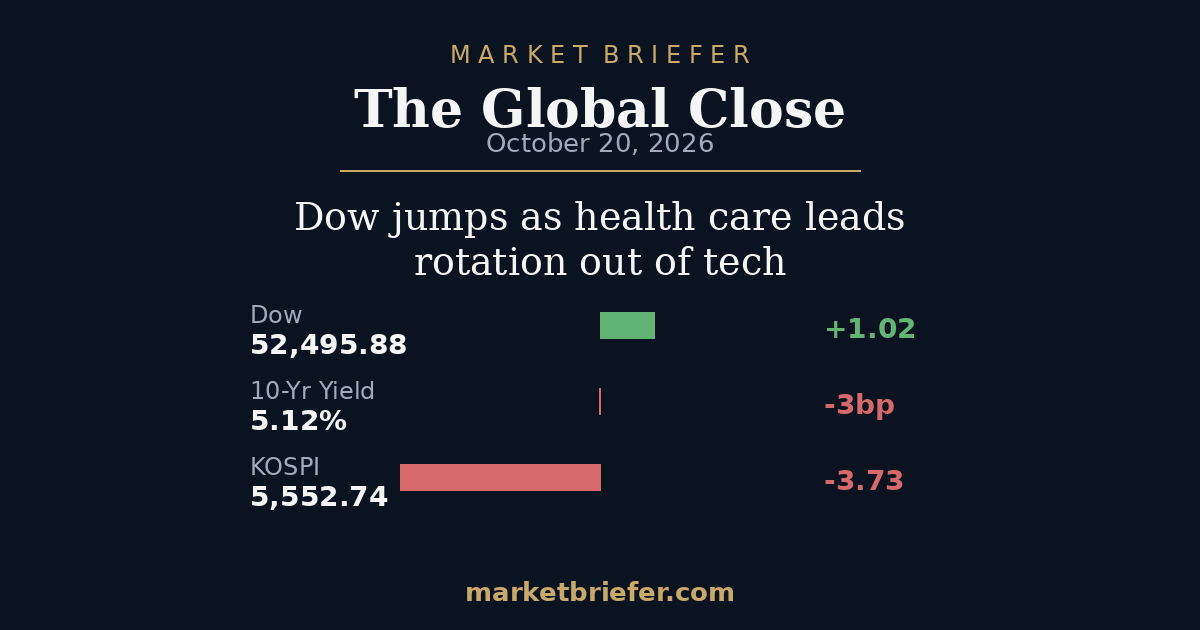
The Dow rose 1.02% to 52,495.88 and the S&P 500 gained 0.28% as health care hit a record and money rotated out of tech, while Seoul fell 3.73%, Europe slipped and oil whipsawed on U.S.-Iran proposal reports.
The 60-Second Brief
- WHAT MOVED: The Dow Jones Industrial Average jumped 529.85 points, or 1.02%, to 52,495.88 and the S&P 500 rose 0.28% to 7,712.57, while the Nasdaq Composite eased 0.02% to 26,424.82. Health care rose 2.34% to a record high; Seoul’s KOSPI fell 3.73% and the STOXX Europe 600 eased 0.14% to 638.64.
- WHY: Money rotated out of the AI complex — rattled by Elice’s weak Seoul debut and questions over AI spending — into health care and small caps, while oil whipsawed on reports, then pushback, of a Qatar- and Pakistan-brokered U.S.-Iran peace proposal.
- WHAT IT MEANS: Breadth improved — nine of eleven sectors rose — but leadership changed, not the cost of capital: the 10-year yield still closed at 5.12%, and technology and communication services were the only sectors lower.
- WHO IS AFFECTED: Homebuyers and builders, after September housing starts fell 5.2% and pending home sales dropped 7.3%; and borrowers generally, with the 2-year yield up 2 basis points to 4.79% even as the long end rallied.
- WHAT TO WATCH: Meta and Tesla earnings after Wednesday’s close, UK CPI, the EIA’s weekly oil inventories, and whether Netflix’s soft fourth-quarter forecast, issued after Tuesday’s close, pressures streaming and megacap names.
The Number That Matters: 5.12%
The Number That Matters: 5.12% — the 10-year Treasury yield, down 3 basis points, with the 30-year down 6 to 5.42% and the 2-year up 2 to 4.79%. It is the key number because the long end rallied while the short end rose: investors bought duration as oil retreated and housing data missed, even as the front end still priced a Fed that holds on October 27–28 and could hike in December. That split let rate-sensitive real estate rise 1.69% while the AI trade stalled. A decisive Brent move back above $110, rebuilding inflation expectations, would make the barrel, not the yield, the more important signal.
The day in one paragraph: Tuesday was a rotation, not a rally. The selloff that began in Seoul’s chip names travelled west and reached New York as a flat Nasdaq, while money leaving technology bought health care to a record, lifted the Dow by more than 500 points and pushed the Russell 2000 up 1.65%. Oil swung more than $5 intraday on U.S.-Iran headlines, and weak housing data showed again what a 5%-plus long yield does to the real economy.
United States
The Dow rose 529.85 points, or 1.02%, to 52,495.88, rebounding after two declines. The S&P 500 added 21.84 points, or 0.28%, to 7,712.57, and the Russell 2000 rose 1.65% to 2,773.42. The Nasdaq Composite eased 6.07 points, or 0.02%, to 26,424.82, giving back a sliver of Monday’s rebound. Nine of eleven sectors rose: health care led, up 2.34% to a record, carried by Eli Lilly up 3.75%, Merck up 3.25% and UnitedHealth up 3.06%, per Reuters. Real estate added 1.69%, utilities 1.15% and financials 1.12%. Technology fell 0.34% and communication services 0.89% — the only two lower — with Meta down 1.63% for a fifth straight day ahead of Wednesday’s results. The VIX closed 6.13% lower at 17.31.
Earnings split the Dow’s names. General Motors fell 6.83% after signaling pressure from higher commodity costs and lower truck sales, despite beating estimates and announcing a $20 billion buyback alongside a lowered outlook. 3M rose 5.86% after expanding its data-centre partnership with Amazon and raising its forecast, and Equifax and Hasbro each jumped more than 11% on results. Salesforce’s plan to buy Braze for $5.66 billion sent Braze sharply higher while Salesforce fell. After the close, Netflix issued a fourth-quarter profit forecast below Wall Street’s and cut its 2026 advertising outlook; third-quarter revenue rose 11.8%, its slowest increase in nearly three years, per Reuters, and the stock traded lower after hours. More on our Stocks desk.
Europe
Europe slipped for a second day as the chip selloff crossed from Seoul. The STOXX Europe 600 closed at 638.64, down 0.14%, and the Euro STOXX 50 fell 0.38% to 6,121.66. Germany’s DAX eased 0.06% to 25,304.42, France’s CAC 40 fell 0.38% to 7,838.49 and Britain’s FTSE 100 lost 0.29% to 10,733.00. Zurich’s SMI rose 0.76% to 14,478.37 and Madrid’s IBEX 35 added 0.28%. Technology fell 0.91% — ASML about 3% lower, STMicroelectronics and Infineon more than 3%, and equipment names Aixtron, Soitec and Siltronic down 5–6% — on concerns over the credit and profitability of AI investment, per Investing.com. Health care led, up 1.83%, while oil and gas fell 1.16%. See our Markets coverage.
Asia
Asia took the day’s hardest hit. South Korea’s KOSPI fell 3.73% to 5,552.74 as chipmakers came under pressure and Elice tumbled about 30% on its debut, per CNBC reporting. Japan’s Nikkei 225 fell 841.28 points, or 1.30%, to 64,075.42. Hong Kong’s Hang Seng fell 1.32% to 23,867.74 on its return from Monday’s holiday. China’s Shanghai Composite rose 0.12% to 3,735.37, the region’s exception; the People’s Bank of China left its loan prime rates unchanged at 3.0% and 3.5%, as expected. Australia’s S&P/ASX 200 fell 0.33% to 8,816.90. India was closed for Dussehra.
Currencies & rates
The dollar eased against every major. The Dollar Index fell 0.26% to 101.71, the euro rose 0.22% to $1.1235, sterling rose 0.56% to $1.3376 — leading the majors after UK unemployment fell to 4.7% against a 4.9% forecast — and the dollar fell 0.20% to ¥158.17. In Treasuries, the official par curve put the 2-year at 4.79%, up 2 basis points, the 10-year at 5.12%, down 3, and the 30-year at 5.42%, down 6, narrowing the 2s10s gap to 33 basis points from 38. Weak housing data pulled yields lower intraday before the long end settled off its lows. Our Currencies desk tracks the board, and our Explainers cover how the 10-year transmits into mortgages and valuations.
Credit
No verified ICE BofA spread print was available from FRED or the close reports read, so none is published. The credit thread ran through equities: concern over the cost of borrowing to build AI infrastructure kept CoreWeave under pressure, and Europe’s chip-equipment names fell hardest on the same questions.
Commodities
Oil whipsawed on diplomacy headlines. WTI climbed to near $102.90 in the morning, sank to near $97.40 as reports spread that Qatar and Pakistan had put forward a U.S.-Iran peace proposal, then recovered after a diplomat disputed that a deal was close. The expiring November WTI settled 1.80% lower at $101.79 on its final day, handing the front month to December at $97.82, and December Brent settled 0.69% lower at $108.79, per Dow Jones Newswires — after Brent had topped $110 intraday, its highest since May, on increased attacks on ships in the Persian Gulf, per ANZ. Gold eased: COMEX December gold was $4,140.90, down 0.46% in the late U.S. reading, while silver rose 1.28% to $58.005. The full board is on our Commodities desk.
Crypto
Crypto tracked the broader risk swing. Bitcoin rose 0.81% to $82,486.75 in the late U.S. snapshot, and Ethereum rose 1.85% to $2,436 on the site’s CoinGecko feed. No crypto-specific catalyst stood out. Our Crypto desk tracks the board.
The news behind the numbers
Three developments tied the day together. First, the AI trade met a proof problem: Elice’s roughly 30% debut fall in Seoul hit chip names from the KOSPI to Amsterdam to CoreWeave in New York, a day before Meta’s earnings put AI spending directly in front of investors. Second, U.S.-Iran diplomacy moved every asset at once — the reported proposal dropped oil, yields and the dollar together in the U.S. morning, and the pushback reversed much of the move. Third, housing is the real-economy cost of 5% yields: starts down 5.2% and pending sales down 7.3% in September, with homebuyers and builders the concrete group feeling it.
What Would Change This Read
This interpretation would weaken if Meta and Tesla on Wednesday deliver AI spending plans that investors reward — technology leading the S&P 500 higher with breadth intact — while Brent holds below $110, suggesting Tuesday’s rotation was profit-taking ahead of earnings rather than a durable repricing of the AI trade. In particular, watch the Philadelphia semiconductor index and CoreWeave, because they would distinguish between the current interpretation — skepticism about AI financing and monetization spreading from Seoul — and the alternative, that Elice’s debut was a single-name IPO failure with no read-across.
What to watch tomorrow
Wednesday, October 21 brings UK CPI, the EIA’s weekly U.S. petroleum inventories, and speeches from Bank of England Governor Bailey and ECB President Lagarde. Meta and Tesla report after the U.S. close, testing the AI trade directly, and investors will digest Netflix’s soft forecast. Asia’s open will be read for whether Seoul’s chip selloff extends, with India back from Dussehra. The Fed’s October 27–28 meeting, where Reuters-polled economists expect a hold, anchors the week after.
This is not investment advice. The Global Close is AI-assisted market research produced with automated data checks; figures are verified against market-close reports and the site’s delayed data feeds at publication time.