The Global Close: October 19, 2026 — Nasdaq rebounds in a narrow bounce as yields climb to 5.15% and Europe slides
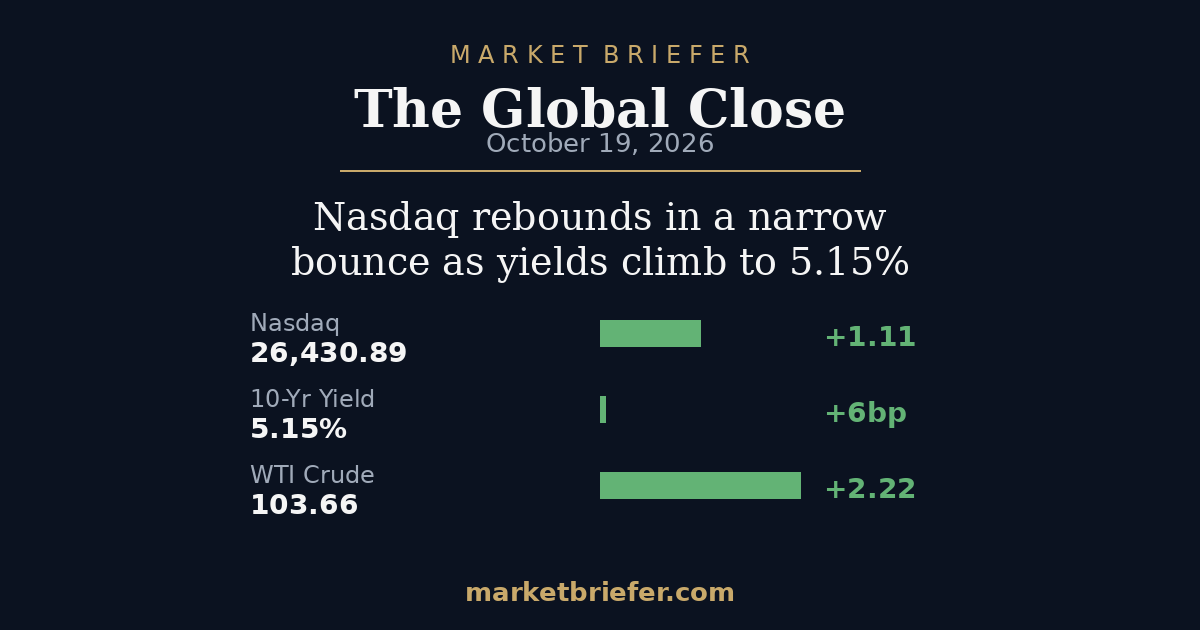
Nasdaq rose 1.11% to 26,430.89 and the S&P 500 gained 0.41% in a narrow, four-sector rebound as the 10-year yield climbed to 5.15%, Europe fell about 1% on French unrest and a Barclays probe, and WTI settled at $103.66.
The 60-Second Brief
- WHAT MOVED: The Nasdaq Composite rose 1.11% to 26,430.89 and the S&P 500 gained 0.41% to 7,690.73, while the Dow slipped 0.07% to 51,966.03 — a rebound led by only four of eleven S&P sectors. Europe fell across the board (STOXX 600 -0.87% to 639.10, DAX -1.18%, FTSE 100 -1.08%) and WTI crude settled up 2.22% at $103.66, even as Brent eased 0.28% to $109.55.
- WHY: Investors bought back the AI names sold last week ahead of Tuesday’s Netflix and SpaceX results, while violent weekend protests in France pushed French yields and spreads higher and weighed on Europe, and a reported Bank of England probe into Barclays’ private-credit loans hit UK banks.
- WHAT IT MEANS: This was positioning, not proof. The 10-year Treasury yield rose 6 basis points to 5.15% while stocks rallied, and index breadth stayed weak — 324 S&P securities fell in a late snapshot — so equities paid in advance for earnings that have not yet arrived, at a higher cost of capital.
- WHO IS AFFECTED: Homebuyers and homebuilders, after builder confidence fell to its lowest since 2012 with the 10-year at 5.15%; borrowers more broadly, as yields rose at every maturity; and European savers and taxpayers, as French borrowing costs leapt on political unrest.
- WHAT TO WATCH: Tuesday’s earnings — Netflix and SpaceX after the close, General Motors and GE Aerospace earlier — plus UK jobs data, U.S. housing starts, Hong Kong’s reopening, and whether the 10-year holds above 5.15%.
The Number That Matters: 5.15%
The Number That Matters: 5.15% — the 10-year Treasury yield, up 6 basis points on the day, with the 2-year up 3 basis points to 4.77% and the 30-year up 5 to 5.48%. It is the key number because it rose while equities rallied: the curve charged more for the week it will take earnings to prove the AI rebound, and the two sectors that feel borrowing costs first — utilities, down 1.97%, and real estate, down 1.17% — sat at the bottom of the table. It matters more than the Nasdaq’s 291-point gain because that gain recovered only part of Friday’s loss, while 5.15% sets the discount rate for every claim being bought back. A decisive fall in the 10-year back below 5% on soft data would make breadth, not the yield, the more important signal.
The day in one paragraph: Monday split the world in two. In New York and Seoul, buyers stepped back into the technology names they had dumped last week, before any of the earnings evidence they say they want. In Europe, politics took the session — French unrest, a leap in French borrowing costs, and a private-credit probe at Barclays dragged every major index lower by around 1% or more. Bonds told the less forgiving story on both sides of the Atlantic.
United States
The Nasdaq Composite rose 290.86 points, or 1.11%, to 26,430.89, and the Nasdaq 100 rose 1.17% to 29,529.35, ending five straight declines. The S&P 500 added 31.29 points, or 0.41%, to 7,690.73, and the Russell 2000 rose 0.25% to 2,728.30. The Dow Jones Industrial Average slipped 36.38 points, or 0.07%, to 51,966.03, its second straight fall. The rebound recovered only part of Friday’s technology-led loss, after the Nasdaq’s 4.5% retreat last week, its worst week since late June.
Breadth contradicted the headline. Only four of eleven S&P 500 sectors rose: consumer discretionary led, up 2.73%, technology added 1.19% in its first gain after three declines, communication services rose 0.28% and materials 0.08%. Utilities fell 1.97%, real estate 1.17% and financials 0.79%. A 3:59 p.m. snapshot counted 324 S&P securities falling against 176 advancing. Among movers, Western Digital rose about 6% and Amazon about 5% after Morgan Stanley named it a top pick and raised its price target to $350, Nvidia gained 1.5%, Intel rose 3.6% on a JPMorgan upgrade to Neutral, Datadog added 5.3%, and memory names including Micron, up nearly 3%, led the chip rebound, per Reuters and market reports. Cleveland-Cliffs jumped 17.1% after adjusted EBITDA of $612 million beat its $575 million guidance — what its chief executive called its strongest quarter in three years. CoreWeave, by contrast, gave back an early 7% rise to close down 1.1%, even after a Goldman Sachs upgrade, a reminder that the financing question from last week has not gone away. The VIX fell 7.75% to 18.44. More on our Stocks desk.
Europe
Europe closed lower everywhere. The STOXX Europe 600 fell 0.87% to 639.10, the Euro STOXX 50 lost 1.01% to 6,141.59, Germany’s DAX fell 1.18% to 25,319.77, France’s CAC 40 fell 1.11% to 7,868.05, and Britain’s FTSE 100 fell 1.08% to 10,764.69 — down 117 points, ending a three-session winning streak. Spain’s IBEX 35 fell 1.49% and Italy’s FTSE MIB 1.55%, the region’s deepest falls.
Two stories drove it. In France, weekend protests over living costs turned violent, curfews were imposed in parts of Paris and other cities, and French bond yields and spreads leapt, per Reuters; AJ Bell’s Danni Hewson said markets could not simply shrug off the weekend’s destruction in an economy already paying heavily to borrow. In London, Barclays fell 3.5% after the Financial Times reported the Bank of England’s Prudential Regulation Authority is examining whether traders misrepresented illiquid private-credit loans, and the broader banking sector fell 2.3%; miners also weighed, with Anglo American down 4.1% and Glencore down 3.3% as copper prices declined. See our Markets coverage.
Asia
Asia was mixed, with the day’s strongest move in Seoul. South Korea’s KOSPI closed up 99.96 points, or 1.76%, at 5,768.01, after opening 3.17% lower — institutions bought a net 574.66 billion won as Samsung Electronics rose 1.16% and Hyundai Motor jumped 4.49%, per Yonhap. Japan’s Nikkei 225 fell 407.59 points, or 0.62%, to 64,916.70, while the broader Topix edged up 0.04% to 4,067.48. Hong Kong was closed for the day after the Chung Yeung Festival, so the Hang Seng has no print today.
China provided the fundamental anchor. Third-quarter GDP grew 4.5% year over year, above the 4.4% expected and quickening from 4.3% in the second quarter, with output up 1.2% on the quarter; September industrial production rose 5.5% and retail sales 1.1%, beating the 0.5% expected, even as fixed-asset investment fell 7.2% in the first nine months and real-estate development dropped 20.6%, per the National Bureau of Statistics via Reuters. The Shanghai Composite rose 0.39% to 3,730.92 and the CSI 300 ended about 0.1% higher, led by banks, while the tech-heavy Star 50 fell 2.2% and memory maker CXMT dropped 7.8% — the AI supply-chain caution that started last week’s rout, when the Philadelphia semiconductor index fell for eight straight sessions, its longest losing run since October 2008. That comparison frames the overshoot risk, not a systemic parallel: in 2008 the question was bank solvency; today it is whether chip and data-center earnings can justify the spending.
Currencies & rates
The dollar firmed: the Dollar Index rose 0.15% to 101.99, the euro fell 0.24% to $1.1212, sterling fell 0.19% to $1.3303, and the dollar rose 0.34% to ¥158.52. Treasuries sold off across the curve — the Treasury’s official par curve put the 2-year at 4.77%, up 3 basis points, the 10-year at 5.15%, up 6, and the 30-year at 5.48%, up 5 — steepening the 2s10s gap to 38 basis points from 35. The selling mirrored Europe’s, where French yields surged. With the Federal Reserve in its pre-meeting blackout before the October 27–28 decision, there was no official guidance to offset the move. Our Currencies desk and U.S. Treasury yields page track the board, and our Explainers cover why yields above 5% reprice everything else.
Credit
No verified ICE BofA cash spread print was available for Monday, so none is published. The verifiable credit story was private credit in London: the reported Bank of England examination of Barclays’ illiquid private-credit loan representations knocked 3.5% off the bank’s shares and 2.3% off UK banks, putting the same opacity question that has hung over AI data-center debt onto a systemically important lender. In the U.S., CoreWeave’s early rally fading despite a broker upgrade — with Goldman cutting its price target to $106 from $139 while noting the stock is down 43% since August 11 on credit-market volatility — kept the focus on at what rate the next phase of AI building can be financed.
Commodities
Oil split. NYMEX WTI for November rose $2.25, or 2.22%, to settle at $103.66 a barrel, while ICE Brent for December eased $0.31, or 0.28%, to settle at $109.55, per DTN and AP settlement reports. Washington’s 60-day general license suspending new sanctions and tariffs on Russian energy weighed on seaborne Brent and invited profit-taking from five-month highs, while Strait of Hormuz disruption — including a Sunday strike on a St. Petersburg oil terminal in the wider energy war and tanker damage in the Gulf — drove buyers toward domestic U.S. barrels. Gold edged up: spot gold rose 0.2% to $4,171.62 an ounce and U.S. futures rose 0.2% to $4,190.15, per RTTNews, as traders weighed higher yields against political risk. Copper declined, weighing on London’s miners. The full board is on our Commodities desk, with background on oil prices.
Crypto
Crypto followed the risk rebound. Bitcoin traded near $81,905, up 1.29%, at the U.S. close snapshot, holding above the $80,000 level it briefly broke below last Thursday, and Ethereum traded near $2,430, up about 0.75%, per CoinDesk. DeFi tokens led the broader board, but ether remains well below its third-quarter close as spot ETH ETF outflows in October remain the overhang. Our Crypto desk tracks the board.
The news behind the numbers
Four developments tied the day together. First, the AI trade entered what BakerAvenue’s King Lip called its move “from the promise phase to the proof phase” — the rebound came before Tuesday’s SpaceX and Netflix results and Wednesday’s Meta and Tesla reports, not after them. Second, housing gave the clearest real-economy warning: the NAHB/Wells Fargo Housing Market Index fell three points to 29 in October, its lowest since June 2012, with prospective buyer traffic the weakest since April 2012 outside the pandemic, per CNBC — a direct read on what a 5.15% 10-year does to homebuyers and builders. Third, France showed how affordability politics becomes a bond-market event, as riots and curfews lifted French borrowing costs and dragged every European index lower. Fourth, China’s 4.5% growth beat was export- and technology-led, with retail sales at just 1.1% and property investment down 20.6% — support for global supply chains, not yet a domestic-demand recovery, as ANZ noted. Those affected are concrete: homebuyers facing mortgage rates tied to a 5%-plus long yield, European taxpayers if French spreads stay elevated, and exporters helped by China’s tech demand. See our Economy desk.
What Would Change This Read
This interpretation would weaken if Tuesday’s Netflix and SpaceX results, and Wednesday’s Meta and Tesla reports, deliver revenue and cash flow strong enough to broaden participation beyond four sectors while the 10-year holds at 5.15%, suggesting Monday was the start of a fundamentals-led recovery rather than positioning ahead of proof. In particular, watch S&P breadth and CoreWeave’s bond yields, because they would distinguish between the current interpretation — a narrow, pre-earnings bounce at a higher cost of capital — and the alternative, that last week’s AI financing scare was overdone.
What to watch tomorrow
Tuesday, October 20 brings the week’s first proof points: General Motors and GE Aerospace report before the open, and Netflix and SpaceX report after the close — SpaceX’s second results as a public company, with consensus near $12.74 billion of revenue, per Reuters. In data, the U.K. releases employment and claimant-count figures, Germany publishes September producer prices and the ZEW expectations survey, and the U.S. releases housing starts and building permits. Hong Kong reopens after its holiday, India’s market is closed for Dussehra, and Asia’s open will be read for whether Seoul’s dip-buying survives a second day. Later in the week: UK CPI on Wednesday, Meta and Tesla on Wednesday, and the Fed on October 27–28.
This is not investment advice. The Global Close is AI-assisted market research produced with automated data checks; figures are verified against market-close reports and the site’s delayed data feeds at publication time.