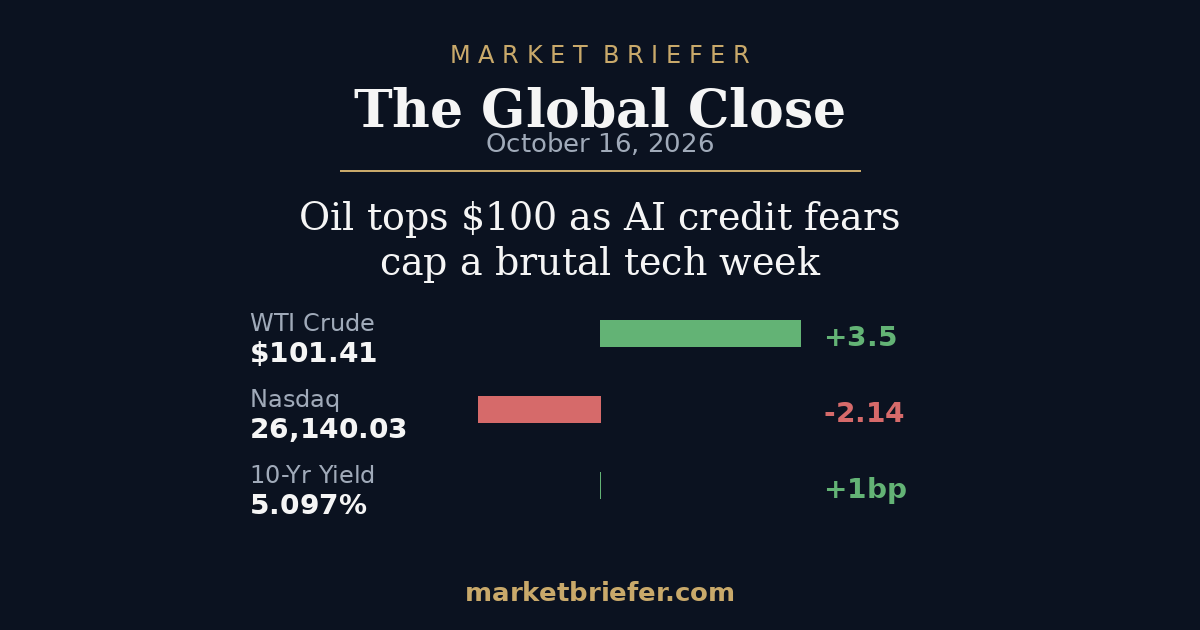
The Global Close: October 16, 2026 — Oil tops $100 as AI credit fears cap a brutal tech week
Nasdaq fell 2.14% Friday and about 4.5% on the week as CoreWeave slid 12% on AI debt fears, while WTI settled above $100 at $101.41 and Brent at $109.86. Europe and Asia rose; the 10-year yield held at 5.097%.
The 60-Second Brief
- WHAT MOVED: U.S. tech fell again — the Nasdaq Composite dropped 2.14% to 26,140.03 and the S&P 500 fell 1.09% to 7,659.44, while the Dow eased 0.34% to 52,002.41 — but oil took the day: WTI settled up 3.5% at $101.41, its first close above $100 since September 21, and Brent rose 3.72% to $109.86. Europe rose across the board (STOXX 600 +0.72% to 644.74) and Asia rebounded (Nikkei 225 +1.39%, KOSPI +2.05%).
- WHY: The AI trade’s problem is now its financing: CoreWeave fell 12% as its bonds yielded above 15%, while renewed Ukrainian attacks on Russian refineries, Strait of Hormuz shipping risk and a large U.S. inventory draw pushed crude higher. Fed Chair Kevin Warsh, in Bangkok, offered no rate guidance.
- WHAT IT MEANS: Two squeezes are running at once — credit costs for leveraged AI builders and energy costs for everyone else. The 10-year Treasury yield held above 5% at 5.097% even after Thursday’s haven rally, and traders still price an 89% chance of a December rate hike.
- WHO IS AFFECTED: Borrowers and homebuyers, because long-term yields above 5% keep mortgage and business borrowing costs elevated; transport and freight users, with diesel at record highs; and leveraged data-center operators, whose refinancing now prices at distressed levels.
- WHAT TO WATCH: The Fed blackout from Saturday, Monday’s Asia open and China’s third-quarter GDP, and next week’s Big Tech earnings — the first direct test of whether AI profits can carry AI debt.
The Number That Matters: $101.41
The Number That Matters: $101.41 — WTI crude’s settlement, up $3.44 on the day and about 10% on the week, its biggest weekly gain since the week ended July 17. It is the key number because it transmits everywhere: crude feeds diesel and gasoline, which feed headline inflation — already 3.7% on CPI and 6.3% year over year on PPI — which keeps the 10-year yield above 5%, which raises the discount rate on the same long-duration AI earnings that credit markets are already repricing. It matters more than the Nasdaq’s 573-point fall because the index move is the symptom; oil resets the inflation path the Federal Reserve takes into its October 28 decision. A decisive fall in the 10-year yield back below 5% while crude holds above $100 would make the yield the more important signal.
The day in one paragraph: the week ended with the split that defined it — Asia and Europe recovered, American technology did not. The question hanging over markets is no longer whether AI spending is real, but whether it can be financed at 5%-plus Treasury yields and 15%-plus corporate borrowing costs while oil above $100 keeps inflation, and the Fed, on edge.
United States
The Dow Jones Industrial Average fell 175.28 points, or 0.34%, to 52,002.41. The S&P 500 lost 84.62 points, or 1.09%, to 7,659.44, and the Nasdaq Composite dropped 572.99 points, or 2.14%, to 26,140.03, per the Wall Street Journal’s close report. A note on the arithmetic: wire point changes are measured against marginally revised Thursday closes (Dow 52,177.69; S&P 500 7,744.06) that sit less than a point from the figures published in Thursday’s edition (52,178.28; 7,744.11); the percentages are unaffected. For the week, the Nasdaq fell about 4.5% — its biggest weekly decline since the week ended June 26 — the S&P 500 also fell, and the Dow still finished higher for a second straight week.
Underneath, most S&P 500 sectors rose. Information technology was the drag: the broader semiconductor index fell 1.8%, on course for its steepest eight-session decline since the April 2025 “Liberation Day” selloff, per Reuters, while energy was among the biggest gainers on crude’s surge and financials rose about 1% as regional bank earnings from M&T Bank and Citizens Financial came in generally strong. CoreWeave fell 12% — the stock is down more than 50% from its highs this year — despite public support from Nvidia chief Jensen Huang. Dell Technologies fell 4.6%, capping a weekly loss above 22%, its worst five days since its 2018 return to public markets; Nvidia eased 1.4% to $214.13. On the other side, Varonis Systems rose 2.9% after Proofpoint agreed to acquire the data-security firm for about $6.3 billion, and Apple added 0.4%. The Russell 2000 sank deeper into correction territory. The day’s data beat expectations: September industrial production rose 0.7% against 0.4% expected, manufacturing output rose 0.3%, and capacity utilization reached 76.9%, per the Federal Reserve. More on our Stocks desk.
Europe
Europe closed its strongest week since late June. The STOXX Europe 600 rose 0.72% to 644.74, up 2.09% on the week; Germany’s DAX gained 0.95% to 25,622.61, France’s CAC 40 rose 0.28% to 7,956.70, Britain’s FTSE 100 added 0.38% to 10,881.90, and the Euro STOXX 50 rose 0.58% to 6,204.23. Earnings did the lifting: Aixtron advanced about 6% on stronger-than-expected order intake, Nordex surged 12.3% on a better core profit and a raised margin forecast, and automobiles and parts led sectors, up 1.55%, while health care — the prior two sessions’ leader — eased 0.25% as the only decliner. London recovered from a morning dip after reports the chancellor plans to raise taxes on bank profits. Eurostat confirmed euro-area inflation at 3.8% in September, a three-year high and well above the ECB’s 2% target, with the deposit rate at 2.50%. See our Markets coverage.
Asia
Asia snapped its rout where it began. South Korea’s KOSPI rebounded 2.05% to 5,668.05, ending seven straight declines, and Japan’s Nikkei 225 gained 898.34 points, or 1.39%, to 65,324.29 after six down sessions. Hong Kong’s Hang Seng rose 0.52% to 24,186.83, the Shanghai Composite added 0.24% to 3,716.28, and the CSI 300 edged up 0.11% to 4,170.61; Shenzhen’s component slipped 0.12%, a fifth straight fall. The rebound only dented the week: the KOSPI still lost about 14% over five sessions — its biggest weekly fall since October 2008, at the onset of the global financial crisis — and sits more than 37% below its summer peak. The comparison frames the speed, not the cause: in 2008 the shock was systemic bank solvency; today it is financing costs concentrated in the AI supply chain. The region’s outlier was Indonesia, where equities suffered their biggest drop since 1998 after index provider MSCI said the market no longer merited emerging-market status and outlined removing it from key indexes, per Reuters.
Currencies & rates
The dollar lost ground on the day and the week: the Dollar Index eased to 101.84 on the site’s delayed feed, the euro rose to $1.1235, sterling to $1.3319, and the dollar held near ¥158.05. Treasuries steepened slightly. The 10-year yield rose 1.1 basis points to 5.097% and the 30-year rose 0.9 basis points to 5.436% — still its biggest weekly drop in more than a year — while the 2-year fell 1.3 basis points to 4.734%, completing its largest one-week retreat since August, per Dow Jones Market Data via the WSJ. Chair Warsh, speaking at an IMF event in Bangkok, declined to signal the October decision. CME FedWatch put the odds of an October hike at 17%, down from 28% a day earlier, with December unchanged at 89%. Our Currencies desk and U.S. Treasury yields page track the board, and our Explainers cover why yields above 5% reprice everything else.
Credit
No verified ICE BofA cash spread print was available for Friday, so none is published; fixed-income briefings describe spreads as stabilising after widening earlier in October, with primary issuance light. The verifiable credit story stayed in AI debt. Reuters reported CoreWeave’s bonds sold off sharply this week, pushing yields above 15%, and the company has borrowed at least $35 billion to build data centers, per the WSJ. Reuters also reported that some Anthropic investors are discussing a possible IPO valuation near $1.5 trillion, down from about $2 trillion previously projected, even after the company told investors third-quarter revenue rose 45% to $16.8 billion. When the marginal AI borrower’s cost of debt is in the mid-teens while the risk-free 10-year pays 5.097%, the equity selloff is a credit repricing working its way up the capital structure — not, so far, a broad spread event.
Commodities
WTI crude rose $3.44, or 3.5%, to settle at $101.41 a barrel in New York — its first close above $100 since September 21 — after Ukraine renewed attacks on Russian refineries and the safety of shipping in the Strait of Hormuz remained in question, on top of the week’s surprisingly large U.S. inventory drawdown; traders weighed IEA plans to accelerate emergency stock releases against that supply risk. Brent rose $3.94, or 3.72%, to settle at $109.86, its highest settlement since May 19, per Dow Jones Market Data. Gold futures rose $11.80, or 0.28%, to $4,159.50 a troy ounce, though the metal still lost 0.8% on the week. Copper eased to about $6.56 and natural gas held near $3.12 on the site’s delayed feed, while U.S. diesel prices sit at record highs — the channel through which $100 oil reaches freight, food and goods prices. The full board is on our Commodities desk, with background on oil prices.
Crypto
Crypto followed risk down late in the day after holding up better earlier. Bitcoin traded near $81,066, down 1.47%, and Ethereum near $2,404, down 1.79%, on the site’s delayed CoinGecko feed at publication time. Bitcoin had recovered above $82,000 earlier Friday after Thursday’s first break below $80,000 in a month; that $80,000 level remains the support traders cite, with easing Treasury yields earlier in the week the main offset to the hotter inflation prints. Our Crypto desk tracks the board.
The news behind the numbers
Four developments tied the day together. First, the Fed went quiet on a neutral note: Warsh’s Bangkok appearance was the last scheduled communication before the blackout, and his refusal to pre-judge October cut priced hike odds for this month even as December’s stayed at 89%. Second, the real economy refused to roll over — industrial production beat expectations even as third-quarter factory momentum faded to a 0.7% annualized pace from 5.6% in the second quarter, per the Fed’s release — which undercuts any claim that Friday’s fall was a growth scare. Third, energy geopolitics tightened: refinery attacks, Hormuz risk and record diesel prices keep an energy floor under inflation in both the U.S. and the euro area, where inflation is confirmed at 3.8%. Fourth, the AI repricing widened its perimeter — from U.S. neocloud debt to Anthropic’s mooted IPO valuation to Indonesia’s index shock. Those affected are concrete: borrowers and homebuyers facing 5%-plus long yields, exporters helped by a softer dollar, and any business whose AI build-out must be refinanced this year. See our Economy desk.
What Would Change This Read
This interpretation would weaken if the 10-year yield falls back below 5% next week while WTI holds above $100, suggesting Friday’s equity pressure is not primarily an energy-to-rates transmission. In particular, watch Big Tech earnings — Netflix on Tuesday, then Meta, Tesla and IBM on Wednesday — and CoreWeave’s bond yields, because they would distinguish between the current interpretation, a financing-cost repricing concentrated in leveraged AI, and the alternative, a broader deterioration in earnings and demand.
What to watch tomorrow
Saturday brings no trading, but the Fed’s pre-meeting blackout begins, freezing official guidance until the October 28 decision. Gulf markets reopen Sunday. Monday, October 19 opens in Asia with China’s third-quarter GDP and September industrial output and retail sales — a direct read on demand for Europe’s luxury, metals and chip exporters — followed by Canada’s September CPI and the Bank of Canada’s Business Outlook Survey. The week’s main event is earnings: Netflix on Tuesday; Meta, Tesla and IBM on Wednesday; SAP, ABB and Barclays in Europe — all reporting into a market asking whether AI profits can service AI debt. Central banks follow: the Fed on October 28, the ECB on October 29 and the Bank of Japan on October 30.
This is not investment advice. The Global Close is AI-assisted market research produced with automated data checks; figures are verified against market-close reports and the site’s delayed data feeds at publication time.