The Global Close: October 15, 2026 — Bonds rally on hot inflation as AI rout goes global
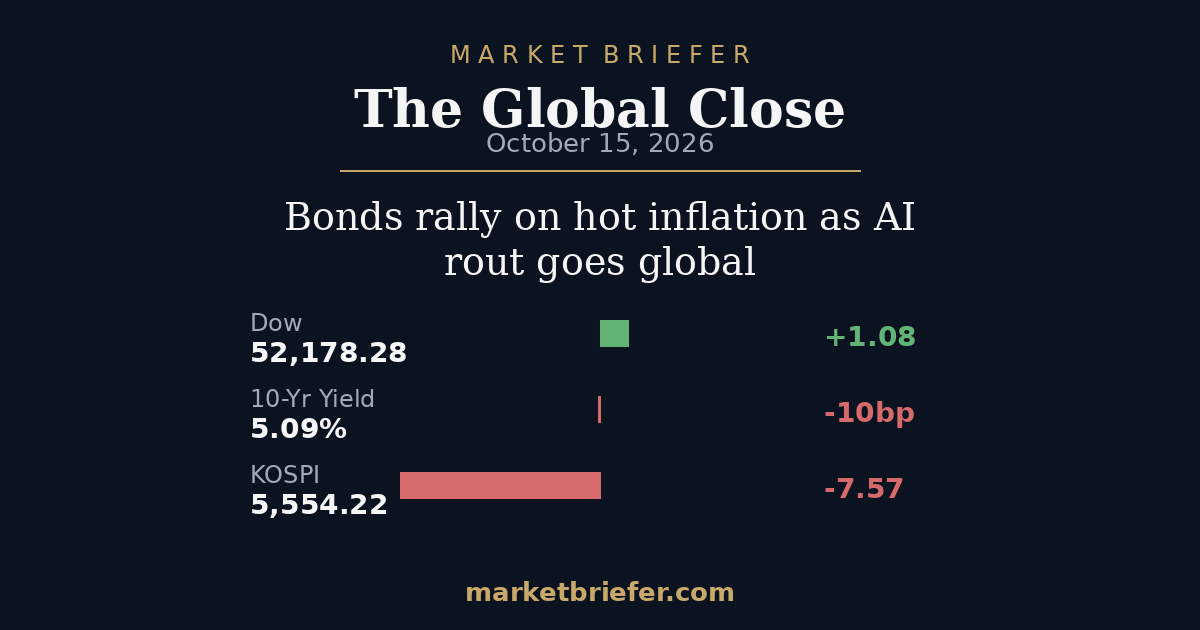
September PPI rose 1.3% in the month, yet the 10-year Treasury yield fell 10 basis points in its biggest drop in over a year as an AI credit scare — CoreWeave CDS near 1,200bp, KOSPI down 7.57% — drove a global rotation out of chips and into bonds, health care and the Dow (+1.08%).
The 60-Second Brief
- WHAT MOVED: Asia’s chip rout went global — the KOSPI fell 7.57% to 5,554.22 and the Nikkei 225 fell 4.90% to 64,425.95 — but U.S. stocks rotated rather than fell: the Dow rose 1.08% to 52,178.28, the S&P 500 rose 0.33% to 7,744.11, and the Nasdaq closed up 0.08% at 26,713.03.
- WHY: September PPI rose 1.3% in the month, far above the 0.6% expected, yet investors bought Treasuries anyway — fear of an AI credit unwind, with CoreWeave’s default protection at record levels above 1,000 basis points, outweighed inflation fear.
- WHAT IT MEANS: Financing risk, not the policy rate, set prices for a day: the 10-year Treasury yield fell 10.2 basis points to 5.086%, its biggest one-day drop in more than a year, on a hotter-than-expected inflation print.
- WHO IS AFFECTED: Borrowers get temporary relief from the yield drop; leveraged AI builders face the opposite — CoreWeave’s 2031 bonds yield above 16%, distressed territory, repricing every refinancing in the sector.
- WHAT TO WATCH: Fed Chair Kevin Warsh’s Bangkok chat with IMF Managing Director Kristalina Georgieva tonight (11:30 p.m. ET) — the last Fed comments before the blackout — plus Friday’s industrial production and Asia’s open.
The Number That Matters: 5.086% — the 10-year Treasury yield’s close, down 10.2 basis points on the day producer prices rose 1.3%, the largest monthly PPI increase in more than four years. It inverts the week’s logic: Wednesday’s hot CPI pushed this yield toward 5.33% and knocked 1.88% off the Nasdaq; Thursday’s hotter PPI pulled it down, and equities rotated instead of falling. Safety demand did the transmitting: chip losses in Seoul and Tokyo and record-wide CoreWeave credit protection sent buyers into duration, lowering discount rates enough to let health care, materials and the Dow absorb a seventh straight down day for semiconductors. It matters more than the Dow’s 556-point rise because it tells you which fear is senior. A decisive move in CoreWeave’s credit-default swaps, from today’s roughly 1,200 basis points, would make that spread the more important signal.
The day in one paragraph: the AI sell-off became a credit event, and credit events reorder everything. Asia absorbed the worst of it, Europe recovered to close higher, and Wall Street split the difference: money left chips for a seventh session and landed in bonds, health care and blue chips.
United States
The Dow Jones Industrial Average rose 556.80 points, or 1.08%, to 52,178.28, carrying forward Wednesday’s published close of 51,621.48. The S&P 500 rose 25.17 points, or 0.33%, to 7,744.11, from 7,718.94, and the Nasdaq Composite rose 20.16 points, or 0.08%, to 26,713.03, from 26,692.87.
Health care led the S&P 500, and consumer discretionary and materials lifted the Dow, with Nike, Salesforce and Home Depot among its leaders, per close reports. The Philadelphia Semiconductor Index fell 0.88% — a seventh straight decline, down roughly 20% from its June peak. Software rallied, and CoreWeave, down 15.5% Wednesday, erased early losses to gain about 6% after Nvidia chief Jensen Huang voiced optimism about the company to Bloomberg.
The data argued the other way: PPI rose 6.3% year over year with core up 5.0%; retail sales rose 0.8%, though ex-gasoline sales rose just 0.2%; jobless claims were 199,000. CME FedWatch put October hike odds at 29%, down from 37% after Wednesday’s CPI, with December at 88%. More on our Stocks desk.
Europe
Europe opened with the rout and closed without it. Britain’s FTSE 100 rose 115.49 points, or 1.08%, to 10,840.35, France’s CAC 40 rose 61.59 points, or 0.78%, to 7,934.70, and Germany’s DAX rose 84.01 points, or 0.33%, to 25,382.62. (No verified STOXX 600 closing print was available at publication; it had fallen 0.35% in early trade, per Reuters.)
U.K. GDP grew 0.1% in August against a 0.1% fall expected, and gilt yields eased with Treasuries. Earnings helped: Ericsson advanced about 9.9% and Pernod Ricard 3.2%, both on smaller-than-expected declines, per Reuters. San Francisco Fed President Mary Daly’s no-need-to-hike comment took the edge off the rate scare. See our Markets coverage.
Asia
Asia took the full force of the chip unwind. Japan’s Nikkei 225 fell 3,318.34 points, or 4.90%, to 64,425.95, from Wednesday’s published 67,744.29 — a sixth straight decline. South Korea’s KOSPI fell 7.57% to 5,554.22, a six-month low, after an intraday fall past 9% triggered a circuit breaker; Samsung Electronics fell about 9.5% and SK Hynix about 11%. Bespoke Investment Group noted the KOSPI is now down about 20% over seven sessions — its worst seven-day stretch since the COVID panic of March 2020 — a comparison that frames the speed, not the cause: in 2020 the shock was a collapsing economy; today it is AI financing costs concentrated in two memory names. Hong Kong’s Hang Seng fell 251.45 points, or 1.03%, to 24,062.72, from 24,314.17; the Shanghai Composite fell 59.75 points, or 1.59%, to 3,707.48, from 3,767.23, and the CSI 300 fell 1.23% to 4,166.01.
The fundamentals refused to cooperate with the panic. TSMC reported record third-quarter net profit of NT$763.06 billion, up 68.7% year over year and above the NT$746.3 billion LSEG estimate, on revenue of NT$1.49 trillion — yet its shares fell about 2% after its chief executive cautioned on component costs and macro uncertainty. SoftBank Group fell 9.3% and Tokyo Electron 7.8% in Tokyo.
Currencies & rates
The dollar gave back Wednesday’s gains: the ICE Dollar Index fell about 0.5% to near 102.0, the euro rose 0.54% to $1.1217, sterling rose 0.62% to $1.3275, and the dollar eased 0.08% to about ¥158.20.
Treasuries rallied hard despite the data. The 10-year yield fell 10.2 basis points to 5.086% — its largest one-day decline in more than a year, per Dow Jones Market Data — the 2-year fell 5.3 basis points to 4.747%, and the 30-year fell 9.7 basis points to 5.427%. Our Currencies desk and U.S. Treasury yields page track the board.
Credit
No verified ICE BofA cash spread print was available, so none is published; the verifiable credit story was in default protection. Reuters reported five-year credit-default swaps on CoreWeave rose above 1,000 basis points — implying roughly a 63% chance of default within five years, up from about 30% a year ago (S&P Global Market Intelligence) — rising a further 74.5 basis points Thursday to almost 1,200, a record, per The Times. Oracle’s CDS traded near 300 basis points, against an investment-grade CDS index near 60. CoreWeave carries about $50 billion of debt, and its bonds due 2031 yielded above 16%. Rising protection costs push holders to sell bonds and raise issuers’ borrowing costs — the self-reinforcing channel connecting a chip sell-off to a Treasury rally.
Commodities
Oil split by benchmark. WTI rose $2.88, or 3%, to settle at $97.97 a barrel after an 8.6 million-barrel EIA inventory draw against expectations of a small build; Hurricane Isaias shut-ins cut Gulf output by 300,000 barrels a day. December Brent slipped 0.1% to $105.92, pressured by reports the administration is considering easing sanctions on Russian shadow-fleet tankers to relieve record freight rates — relief that would compress Brent’s premium specifically. Hormuz shipping risk kept the floor under both. Gold futures rose $62.90, or 1.5%, to $4,147.70 a troy ounce as yields fell; silver rose about 2.5% to near $56.98 and copper eased to about $6.56 on the site’s delayed feed. The full board is on our Commodities desk, with background on oil prices.
Crypto
Bitcoin broke below $80,000 for the first time in a month, touching about $79,806, as the PPI print triggered roughly $937 million of liquidations across about 176,000 traders in 24 hours, longs absorbing the bulk, per CoinGlass data reported by CoinDesk. It then recovered to near $82,258 on the site’s delayed CoinGecko feed late in the U.S. day; Ethereum, off a low near $2,325, recovered to near $2,457. Our Crypto desk tracks the board.
The news behind the numbers
Four developments tied the day together. First, inflation worsened on both gauges in 48 hours — CPI 3.7% Wednesday, PPI 6.3% year over year Thursday — yet October hike odds fell to 29%, because Fed officials split publicly: Daly and Bowman see no urgency, while New York Fed President John Williams has signaled one more hike this year. Second, the AI question moved from valuations to funding: record CoreWeave protection and an IMF warning this week that debt-fueled AI spending puts the global economy at risk gave the chip decline a credit mechanism. Third, TSMC’s record profit contradicted a demand collapse, which is why U.S. losses stayed rotational. Fourth, energy stayed an inflation channel: Brent above $105 and gasoline driving retail sales. Leveraged AI builders and Asian chip exporters feel the funding squeeze first; borrowers feel the yield rally as modest relief. See our Explainers and Economy desks.
What Would Change This Read: This interpretation would weaken if the 10-year yield resumes climbing above Wednesday’s 5.189% close on Friday’s industrial production data while CoreWeave’s credit protection narrows sharply, suggesting Thursday’s bond rally was short-covering rather than credit-driven haven demand. In particular, watch Chair Warsh’s Bangkok remarks tonight and the KOSPI’s open because they would distinguish between the current interpretation — a financing scare reordering markets — and the alternative explanation, that two hot inflation prints are reasserting the rate story and Thursday was only a pause.
What to watch tomorrow
Friday, October 16 opens with Chair Warsh’s Bangkok fireside chat (11:30 p.m. ET Thursday) — the last scheduled Fed communication before the blackout ahead of the October 27–28 FOMC. U.S. data brings September import prices at 8:30 a.m. ET (consensus +0.8%) and industrial production at 9:15 a.m. ET (consensus +0.4%). The eurozone publishes final September CPI. Asia’s open tests whether the KOSPI can hold after a 20% seven-session fall.
This is not investment advice. The Global Close is AI-assisted market research produced with automated data checks; figures are verified against market-close reports and the site’s delayed data feeds at publication time.