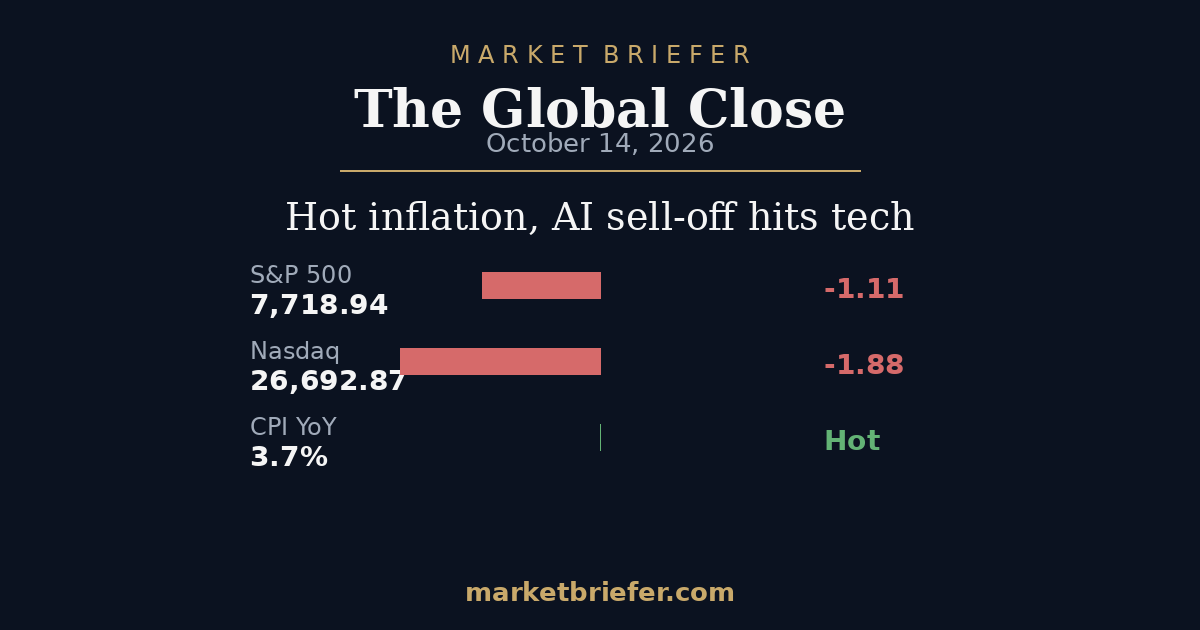
The Global Close: October 14, 2026 — Hot inflation, AI sell-off hits tech
September CPI rose 3.7% year over year, above consensus, lifting October Fed hike odds to 37% as the Nasdaq fell 1.88% and AI stocks and bonds sold off; Europe rose on ASML.
The 60-Second Brief
- WHAT MOVED: U.S. stocks fell sharply — S&P 500 -1.11% to 7,718.94, Nasdaq Composite -1.88% to 26,692.87, Dow -0.09% to 51,621.48 — while Europe rose and Asia was little changed.
- WHY: September CPI rose 3.7% year over year, above the 3.6% expected, with core at 2.6%; traders lifted the odds of a Federal Reserve rate hike this month, and AI-linked stocks and bonds sold off again.
- WHAT IT MEANS: The pressure was concentrated where valuations depend most on cheap financing — technology, semiconductors and small caps — while health care and staples rose, a rotation rather than a broad exit from equities.
- WHO IS AFFECTED: Borrowers and homebuyers: the 2-year Treasury yield ended at 4.80% after spiking higher intraday, and the 10-year held near 5.19%, keeping mortgage and corporate borrowing costs elevated.
- WHAT TO WATCH: September PPI and retail sales on Thursday, October 15 at 8:30 a.m. ET, plus TSMC earnings — a second hot price print could tip October hike odds toward a coin flip.
The Number That Matters: 3.7%
The Number That Matters: 3.7% — September consumer inflation, year over year. It is the key number because it was above the 3.6% consensus, above August’s 3.4%, and broad enough that core inflation also beat, rising to 2.6% from 2.4%. It transmits directly: a hotter print lifted front-end yields and the dollar, raised the priced odds of an October Fed hike to 37% from 22% before the release, and hit the longest-duration equities — chips and AI names — hardest. It matters more than the Nasdaq’s 1.88% fall because it changes the policy path those valuations are priced on. A decisive move in Thursday’s PPI — a soft print that pulls hike odds back down — would make producer prices the more important signal.
The day in one paragraph: inflation, not earnings, set the day. A hotter-than-expected September CPI, driven by energy but with a firm core, revived the prospect of another Fed hike this month, sent technology and AI-linked shares to their worst session since July, and left Europe — helped by ASML — and defensive U.S. sectors as the only places that rose.
United States
The S&P 500 fell 86.51 points, or 1.11%, to 7,718.94, its worst day since July, carrying forward Tuesday’s published close of 7,805.45. The Nasdaq Composite fell 511.51 points, or 1.88%, to 26,692.87, from 27,204.38, and the Dow Jones Industrial Average fell 48.62 points, or 0.09%, to 51,621.48, from 51,670.10. The Russell 2000 fell 1.93% to 2,729.53, entering correction territory, more than 10% below its record highs earlier this year.
Eight S&P 500 sectors fell and three rose, according to Reuters’ close summary. Technology fell 2.6% and the Philadelphia Semiconductor Index fell 4.2%, down for a sixth straight day — its longest losing streak in nearly two years. Health care and consumer staples rose about 2.4%. Financials were the second-worst sector as bank earnings landed.
CoreWeave fell 15.5%, Dell fell more than 11%, and Oracle and Marvell fell about 9% on concern about AI financing costs. Hewlett Packard Enterprise fell 8.3% after a Barclays downgrade. UnitedHealth, Moderna and Bristol-Myers Squibb rose 4% to 5%, and Eli Lilly and Amgen rose more than 3%.
Bank earnings were mixed. Bank of America fell about 7% to 8% after profit fell to $6.9 billion, or $0.91 a share, hit by a $1.2 billion regulatory penalty. State Street fell more than 8% on a revenue miss, and Progressive fell more than 7%. Morgan Stanley fell 2.8%. BlackRock was the exception, rising about 0.7% after earnings beat and assets under management climbed 15% to $15.5 trillion. More detail is on our Stocks desk: https://marketbriefer.com/category/stocks/
Europe
Europe closed higher, shrugging off the U.S. inflation print that arrived late in its session. The pan-regional STOXX 600 rose 0.4% to 637.75. Britain’s FTSE 100 rose 0.70% to 10,724.86, France’s CAC 40 rose 0.58% to 7,873.11, and Germany’s DAX rose 0.15% to 25,298.61.
The driver was earnings. ASML rose 2.2% after reporting record third-quarter sales, beating expectations and raising its full-year outlook on AI demand — the opposite signal to the later U.S. chip sell-off. Barratt Redrow rose more than 4%, and GSK and AstraZeneca gained more than 3%. Softcat slumped about 7%, Ørsted fell on a report the U.S. is re-evaluating a wind-farm permit, and SEB slid after its regulator raised capital requirements. See our Markets coverage: https://marketbriefer.com/category/markets/
Asia
Asia was mixed to slightly lower, stabilizing after Tuesday’s chip rout. Japan’s Nikkei 225 slipped 33.23 points, or 0.05%, to 67,744.29. Hong Kong’s Hang Seng fell 31.05 points, or 0.13%, to 24,314.17, and the Shanghai Composite fell 33.64 points, or 0.88%, to 3,767.23. South Korea’s KOSPI fell 0.44% to 6,008.81, extending Tuesday’s 5.46% fall but holding just above 6,000. Australia’s S&P/ASX 200 fell 0.64% to 8,727.90.
China’s September data were the regional story: exports rose 36.3% year over year, above the 25.5% expected, imports rose 31%, and the trade surplus was $133.53 billion. Consumer inflation was softer than expected at 0.9%, while producer prices accelerated to 5.0%, above the 4.5% expected.
Currencies & rates
The dollar strengthened on the inflation news. The ICE Dollar Index rose about 0.36% to 102.55, with reports describing a new 18-month high intraday. The euro fell to about $1.113, sterling to about $1.316, and the dollar rose to about 158.73 yen.
Treasuries were two-sided. Yields spiked after CPI — the 10-year reached 5.33% intraday — then retreated as equities fell. The 10-year closed at 5.189%, down 2.7 basis points, while the 2-year rose to 4.800% and the 30-year fell to 5.524%: the front end priced a more hawkish Fed, the long end its growth cost. The Beige Book was described as stagflationary, with weaker labor sentiment. Our Currencies desk: https://marketbriefer.com/category/currencies/ and U.S. Treasury yields page: https://marketbriefer.com/us-treasury-yields/
Credit
No verified ICE BofA investment-grade or high-yield spread print was available, so none is published rather than estimated. The verifiable story was specific: AI-related corporate bonds fell sharply to new lows, with spreads widening, according to Reuters. CoreWeave’s 9.75% bond due 2031 yielded about 16%, down around 20% from issue alongside a Meta AI-related bond, while an Oracle bond due 2033 hit a record low — the financing channel of the equity sell-off.
Commodities
Oil rose on supply risk. WTI crude rose about 1% to $95.17 a barrel and Brent rose 0.38% to $106.09, after Houthi militants struck a building at Saudi Aramco in Dhahran following a weekend attack on Riyadh’s airport, and as shipping risk around the Strait of Hormuz stayed elevated. Energy costs were also the CPI story: gasoline rose 9.1% in the month and 34% in the year.
Gold fell for a third session as the dollar and rate-hike expectations rose: futures lost 1.64% to $4,084.80 a troy ounce in the WSJ close report. Silver fell about 6.5% to near $55.53. Copper was little changed near $6.64 on the site’s delayed feed. The full board is on our Commodities desk: https://marketbriefer.com/category/commodities/ , with background on oil prices: https://marketbriefer.com/oil-prices/
Crypto
Bitcoin fell about 1.8% to $81,752 and Ethereum fell about 3.5% to $2,419 in late reporting, with total crypto market value down to about $2.76 trillion. The move tracked risk appetite after CPI rather than a crypto-specific catalyst. Our Crypto desk: https://marketbriefer.com/category/crypto/
The news behind the numbers
Four developments tied the day together. First, CPI: headline inflation was energy-led, but core at 2.6% is what lifted October hike odds to 37% and December odds to 91% in CME FedWatch pricing cited in close reports. Second, the AI financing question moved from equities to credit, giving the chip decline a funding mechanism, not just a valuation one. Third, bank earnings showed markets businesses holding up — BlackRock’s record $15.5 trillion in assets — while Bank of America’s penalty erased its result. Fourth, attacks on Saudi energy infrastructure and Hormuz shipping risk kept Brent above $106 and energy feeding headline inflation. Borrowers and energy-importing economies feel those moves first. See our Explainers: https://marketbriefer.com/category/explainers/ and Economy: https://marketbriefer.com/category/economy/ desks.
What Would Change This Read
This interpretation would weaken if the 10-year yield falls back decisively while technology and semiconductor shares keep falling on heavy volume and AI bond spreads keep widening, suggesting today’s equity pressure is primarily a financing unwind in the AI trade rather than a rate-driven repricing. In particular, watch Thursday’s PPI and TSMC earnings because they would distinguish between the current interpretation — a hot inflation print repricing policy — and the alternative explanation, that AI spending economics are deteriorating on their own.
What to watch tomorrow
Thursday, October 15 brings September PPI and September retail sales at 8:30 a.m. ET, the Philadelphia Fed index, business inventories, and weekly jobless claims, plus TSMC earnings early in the day — the next test of the AI hardware story after ASML’s beat. Overseas, the U.K. reports August GDP and industrial production and Australia reports September jobs. Asia’s open will show whether the KOSPI holds 6,000 and whether chip shares stabilize after six down days for U.S. semiconductors.
This is not investment advice. The Global Close is AI-assisted market research produced with automated data checks; figures are verified against market-close reports and the site’s delayed data feeds at publication time.