The Global Close: October 13, 2026 — Chips rout Asia, Wall Street holds its breath for CPI
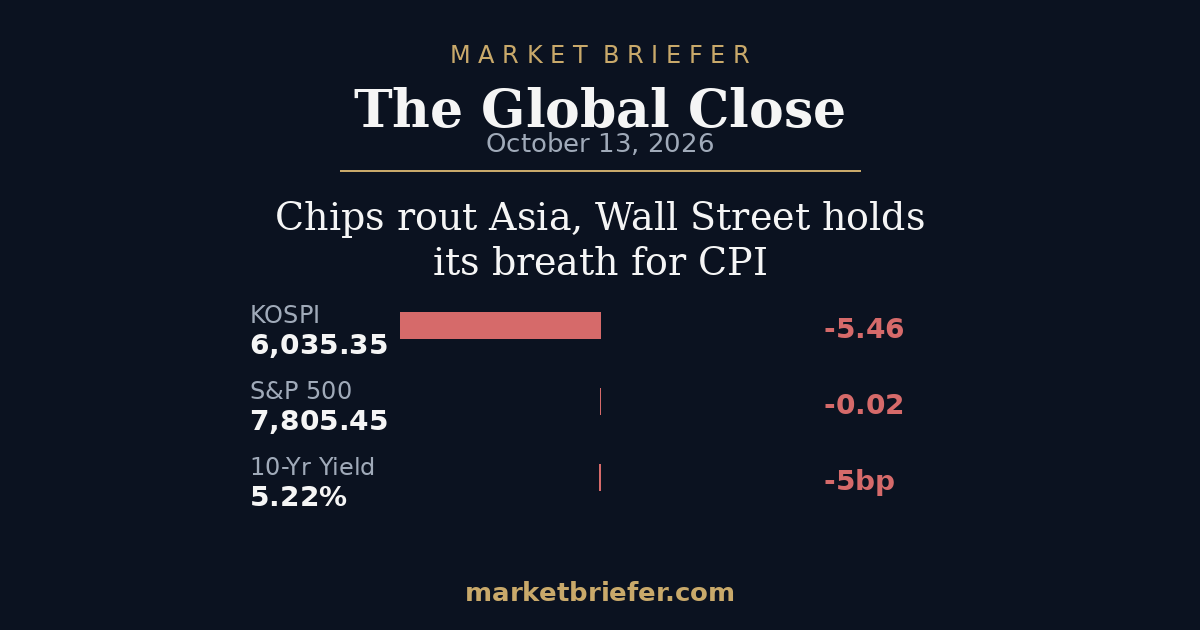
S&P 500 slipped 0.02% to 7,805.45 and the Dow fell 0.35% as a CXMT-driven memory-chip rout sank the KOSPI 5.46% and the Nikkei 1.82%, with markets waiting on Wednesday's September CPI.
The 60-Second Brief
- WHAT MOVED: U.S. indexes barely moved — S&P 500 -0.02% to 7,805.45, Nasdaq Composite -0.15% to 27,204.38, Dow -0.35% to 51,670.10 — while Asia’s chip rout was severe: South Korea’s KOSPI -5.46% and Japan’s Nikkei 225 -1.82% to 67,777.52.
- WHY: Reports of a denser memory-chip design from China’s CXMT hit memory makers worldwide, and mixed big-bank earnings gave U.S. buyers no reason to chase prices ahead of inflation data.
- WHAT IT MEANS: The damage was concentrated in one crowded trade — memory and AI-linked hardware — not spread across markets, which is why the broad U.S. indexes finished almost flat.
- WHO IS AFFECTED: Borrowers and homebuyers, indirectly: with the 10-year Treasury yield still near 5.22% and oil above $105, the cost of money stays high until inflation data gives the Federal Reserve a different story.
- WHAT TO WATCH: September CPI on Wednesday, October 14 at 8:30 a.m. ET — consensus near 3.6% year over year, up from 3.4% in August — the last inflation print before the Fed’s October 27–28 meeting.
The Number That Matters: 5.46% — the KOSPI’s fall
The single most consequential number of the day was not in New York. South Korea’s KOSPI fell 5.46% to 6,035.35, its lowest close since late July, after an intraday drop that triggered a sell-side sidecar halt. That move matters more than the flat U.S. close because it repriced the memory-chip trade at its source: Samsung Electronics fell about 7.4% and SK hynix about 10% as investors questioned whether Chinese competition and high financing costs compress the margins underpinning the AI hardware boom. The signal transmits from Seoul to Tokyo to the Nasdaq’s memory names, and from there to the valuations of the entire AI spending chain. A decisive stabilization in Korean chip shares, or a soft CPI print that pulls yields down, would make the inflation number the more important signal instead.
The day in one paragraph: a technology shock that started in Asia met an earnings season that started in America, and the result was a split market — steep losses where memory chips are made, near-silence where they are merely owned, and every major decision deferred to Wednesday’s inflation report.
United States
The S&P 500 slipped 1.79 points, or 0.02%, to 7,805.45. The Nasdaq Composite fell 41.52 points, or 0.15%, to 27,204.38, and the Dow Jones Industrial Average fell 180.45 points, or 0.35%, to 51,670.10, giving back an early gain of nearly 0.9%. The Russell 2000 fell 0.39% to 2,783.56. Energy led the S&P 500 sectors as crude held its gains, while industrials and health care trailed, according to market-close reports.
Earnings set the individual stories. Johnson & Johnson fell about 6% after its MedTech division missed sales estimates, overshadowing a profit beat. Micron Technology fell 3.62% and Sandisk eased 0.34% as the CXMT memory report rippled through U.S. chip names; Applied Materials also came under pressure, while Meta Platforms rose nearly 3%. Caterpillar fell more than 3% and was the Dow’s biggest drag. Bank results were mixed: Goldman Sachs posted higher profits helped by a sharp rise in stock-trading revenue and stronger investment banking fees, while JPMorgan Chase’s profit rose from a year earlier but missed analyst expectations. Blackstone fell 4.18% as high yields and analyst target cuts weighed on the shares.
Europe
European shares gave back early gains as the Asian tech sell-off and questions about AI valuations reached the close. The pan-regional STOXX 600 fell 0.10% to 635.01. Germany’s DAX fell 0.07% to 25,259.90, France’s CAC 40 fell 0.07% to 7,827.63, and Britain’s FTSE 100 fell 0.06% to 10,650.33. The International Monetary Fund lifted its 2026 global growth forecast slightly to 3.1%, crediting AI investment while warning that wars and higher energy prices would weigh on progress — a summary that matched the session: the AI trade is now both the growth engine and the risk. More on the region’s data desks is in our Markets coverage.
Asia
Japan reopened after a long weekend to the full force of the chip sell-off: the Nikkei 225 fell 1,253.40 points, or 1.82%, to 67,777.52, with SoftBank Group down about 8.5%. Korea’s KOSPI was the epicenter, down 5.46%. Hong Kong’s Hang Seng rose 74.02 points, or 0.30%, to 24,345.22, and the Shanghai Composite rose 0.10% to 3,800.86, even as reports that China will cut the VAT export rebate on new energy vehicles from 13% to 9% weighed on auto names. The pattern was precise: markets most exposed to memory-chip production fell hardest, while mainland and Hong Kong indexes — home to the competitor causing the disruption — held steady.
Currencies & rates
Treasury trading resumed after Monday’s Columbus Day bond-market holiday. The 10-year yield eased about 5 basis points to 5.22% on the site’s delayed feed, down from last week’s peak near 5.36% — a level reports described as the highest since 2002. The dollar index slipped to about 102.24–102.39, retreating from its highest level since April last year. The euro rose to about $1.1197, sterling to about $1.3248, and the dollar eased to about 158.37 yen after Japanese wholesale prices rose 6.8% in the year to September, keeping Bank of Japan rate-hike expectations alive. See our Currencies desk for the full board.
Credit
No verified closing print for ICE BofA investment-grade or high-yield spreads was available from FRED or the market-close reports reviewed for this edition, so no spread figure is published here rather than estimated. The day’s credit-relevant signal came through equities and rates instead: bank trading and dealmaking revenue held up in the first earnings reports, while rate-sensitive financial names such as Blackstone sold off as yields stayed above 5%.
Commodities
Brent crude settled near $105.81 a barrel, down 0.8% in European close reports, while WTI was about 0.2% higher near $93.94. Oil stayed elevated on Middle East supply risk — including attacks on Saudi Arabia and threats to Strait of Hormuz shipping — partly offset by reports of additional Russian diesel supply and an unconfirmed Russia-Ukraine energy truce. Gold eased 0.21% to $4,181.80 at the U.S. close, capped below $4,200 as energy-driven inflation risk kept real-rate expectations high. Copper rose on the site’s delayed feed to about $6.73. The full board is on our Commodities desk.
Crypto
Bitcoin held above $83,000 after an early drop below $81,000, trading near $83,495 (+0.84%) on the site’s CoinGecko feed, while Ethereum traded near $2,520 (-0.46%). CoinDesk reported crypto decoupled from the tumbling Korean market as the session wore on, with traders positioning ahead of the U.S. inflation print rather than cutting exposure. Our Crypto desk tracks the board.
The news behind the numbers
Three developments tied the day together. First, CXMT’s reported progress on denser server memory directly challenged the margin story of incumbent makers — the concrete transmission from a technology headline to a 5.46% index fall in Seoul and a below-50-day-average close for Micron. Second, the IMF’s upgraded 2026 growth forecast rested on the same AI investment the chip sell-off was questioning, a tension that will run through this earnings season. Third, energy: with Brent above $105, every central bank’s inflation path runs through oil, which is why Wednesday’s CPI — expected at 3.6% year over year — matters more than any single earnings report. For background on how yields transmit to valuations, see our Explainers.
What Would Change This Read
This interpretation would weaken if Korean and Japanese chip shares stabilize or rebound while U.S. memory names keep falling, suggesting today’s pressure is a U.S. positioning story rather than a global repricing of memory competition. In particular, watch Wednesday’s CPI because it would distinguish between the current interpretation — a sector shock contained by a flat index — and an alternative explanation, that high yields and energy prices are quietly tightening conditions for the whole market.
What to watch tomorrow
Wednesday brings September CPI at 8:30 a.m. ET (consensus about 3.6% year over year; core about 2.5%), the Federal Reserve’s Beige Book at 2:00 p.m. ET, and continued bank and chip earnings, including ASML in Europe. Asia’s open will show whether the KOSPI can hold the 6,000 level after its worst session since July.
This is not investment advice. The Global Close is AI-assisted market research produced with automated data checks; figures are verified against market-close reports and the site’s delayed data feeds at publication time.