The Global Close: October 12, 2026 — Rotation out of chips lifts Dow, drags Nasdaq
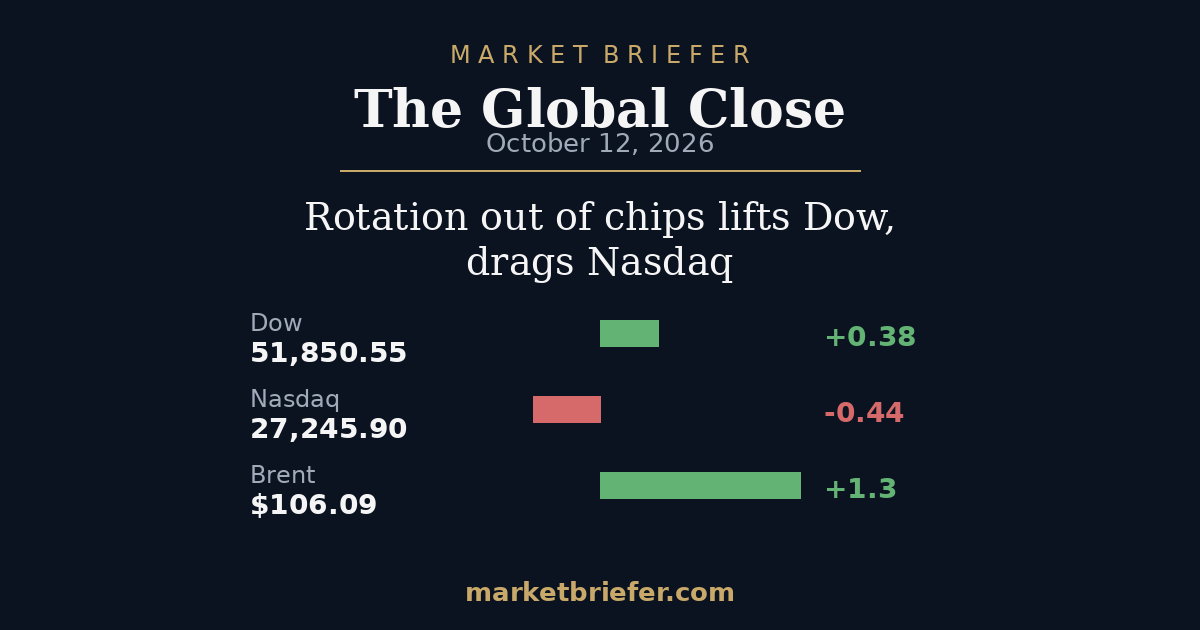
Dow rose 0.38% to 51,850.55 as rotation out of chips dragged the Nasdaq 0.44% lower in holiday-thin trade; Brent rose to $106.09 and the U.S. bond market was closed.
The 60-Second Brief
- WHAT MOVED: The Dow rose 195.60 points (+0.38%) to 51,850.55, while the S&P 500 slipped 4.30 points (-0.06%) to 7,807.24 and the Nasdaq fell 120.27 points (-0.44%) to 27,245.90. Europe closed higher; Brent crude rose 1.3% to $106.09.
- WHY: Memory and chip stocks sold off on competition and valuation concerns — the semiconductor ETF fell 2.6% — while money rotated into energy, staples and communication services. Higher oil, after Houthi attacks on Saudi Arabia, kept inflation pressure in focus.
- WHAT IT MEANS: Eight of 11 S&P 500 sectors rose and the benchmark finished just 0.15% below its October 6 record close of 7,818.93 — breadth was healthier than the headline, but with the cash bond market closed there was no rate signal to confirm the move.
- WHO IS AFFECTED: Borrowers and homebuyers get no relief yet — the last Treasury print, Friday’s 10-year yield at 5.24%, still anchors borrowing costs near 24-year highs, and Tuesday’s reopening will set the next read.
- WHAT TO WATCH: Bank earnings before Tuesday’s open — JPMorgan Chase, Goldman Sachs, Wells Fargo and Citigroup, plus Johnson & Johnson and UnitedHealth — then September CPI on Wednesday.
The Number That Matters: 5.24% — the 10-year Treasury yield, unchanged only because the U.S. cash bond market was closed for Columbus Day. It matters precisely because it did not move: equities, the dollar and oil all traded Monday without the one price that has disciplined every rally this year, the yield that sat within seven basis points of a 24-year high last week and sets discount rates for technology stocks and mortgage rates for households. The dollar’s climb to 102.60 and Brent’s rise above $106 both point to renewed rate pressure when cash trading resumes. A decisive move in Wednesday’s CPI — hot enough to push the 10-year above 5.35% — would make inflation, not earnings, the number that matters instead.
The single most important story on Monday was rotation, not retreat. On a federal holiday with bond markets shut, thin volume — S&P 500 volume was reported 55% below its three-month average — and no U.S. economic releases, investors sold the year’s most crowded trade, memory and AI hardware, and bought energy, staples and beaten-down communication names. The result was a Dow at a near three-week high, a Nasdaq in the red, and an S&P 500 that barely moved — a market waiting for Tuesday’s earnings and Wednesday’s inflation data to give it a direction.
United States
The Dow Jones Industrial Average gained 195.60 points, or 0.38%, to 51,850.55. The S&P 500 fell 4.30 points, or 0.06%, to 7,807.24 — its third-highest close in history, just below the record 7,818.93 set on October 6. The Nasdaq Composite dropped 120.27 points, or 0.44%, to 27,245.90, and the Russell 2000 lost 0.45% to 2,794.48. Monday marked the fourth anniversary of the bull market that began on October 12, 2022; a Reuters analysis of LSEG data published Monday showed the rally remains narrow — more than four in 10 S&P 500 stocks are lower in 2026, and the median stock has gained barely 4% this year.
Energy led sectors, up 1.44%, followed by consumer staples at +1.16% and communication services at +0.94%; financials added 0.58%. Technology was the laggard, down 1.22%. The iShares Semiconductor ETF fell 2.6% and a memory-focused ETF dropped 4.3%. SanDisk tumbled more than 6% on memory competition concerns — reports of progress by China’s CXMT weighed on the complex, with Micron also down — while Lumentum fell almost 10% and Ciena, Coherent and Corning were among the biggest decliners. Marvell Technology fell 3.42%. On the upside, Salesforce rose about 2% after a double upgrade from Bank of America, helping the Dow. Meta Platforms gained 3.4% following the launch of Muse Wonder, its latest AI model, even as Amazon fell 1.1% after a Wall Street Journal report that it is in talks to buy software firm Decart for around $7 billion. Telecom carriers T-Mobile US, AT&T and Verizon bounced after Friday’s SpaceX spectrum-deal selloff. For individual movers, see the Stocks desk.
Europe
European shares closed firmly higher as banks led and eurozone bond yields eased. The pan-European STOXX 600 climbed 0.65%. Germany’s DAX rose 190.41 points, or 0.76%, to 25,277.68. London’s FTSE 100 gained 104.23 points, or 0.99%, to 10,656.28, with Lloyds Banking Group and HSBC Holdings each up about 2.35%. France’s CAC 40 added 29.55 points, or 0.38%, to 7,832.88. Reuters noted investors were looking through geopolitical uncertainty to earnings season — LVMH reported after the European close, with ASML due later this week — while traders priced the European Central Bank on hold in October with a quarter-point hike expected in December, according to LSEG data. Recruiter Hays fell about 8% after a 3% drop in first-quarter like-for-like net fees.
Asia
Asia was mixed in thin holiday conditions. Japan’s Nikkei 225 was closed for the Sports Day public holiday; its last close, carried forward from Friday, was 69,030.92. Hong Kong’s Hang Seng rose 59.85 points, or 0.25%, to 24,271.20, as banks and insurers advanced while chipmakers weakened; Xiaomi fell 4.9%. On the mainland, the Shanghai Composite fell 16.55 points, or 0.43%, to 3,797.24, and the large-cap CSI 300 dropped 0.7% to a 13-month closing low, with brokers citing anxiety over rising global yields and trade tensions. South Korea’s KOSPI plunged 3.65% to 6,384.24 as Samsung Electronics and SK Hynix dragged the index lower, with sentiment also hurt by North Korea’s latest missile launch. India’s Sensex fell 547.65 points, or 0.76%, to 71,924.68, after September inflation jumped to a two-year high of 5.5%; the Reserve Bank of India’s new measures to support the rupee were in focus. Australia’s ASX 200 rose 0.76% to 8,783.20, led by miners.
Currencies & rates
The dollar strengthened across the board. The Dollar Index rose 0.4% to 102.60. EUR/USD fell 0.41% to 1.1155 — a new low for the year, according to investingLive’s session wrap — while GBP/USD eased 0.21% to 1.3203 and USD/JPY rose 0.21% to 158.64. Higher oil weighed on energy-importing Europe’s currency, and thin holiday conditions may have amplified moves. See the Currencies desk for the full crosses.
In rates, there was no U.S. cash Treasury trading: the bond market was closed for Columbus Day, also observed as Indigenous Peoples’ Day. The last prints are Friday’s closes, carried forward exactly as published in the October 9 edition: the 10-year yield at 5.243% (quoted as 5.24% in Monday’s close reports). Cleveland Fed President Beth Hammack said Monday that strong growth and businesses’ ability to keep raising prices suggest rates may need to rise above the current range to bring inflation under control — comments the bond market will only be able to answer on Tuesday.
Credit
With U.S. cash bond markets closed for the holiday, there was no new cash trading in Treasuries, investment-grade or high-yield corporate debt on Monday, and no verifiable new spread print to report. Credit carried Friday’s backdrop into Tuesday: a market where, as last week’s FRED/ICE BofA data showed, compensation for the riskiest borrowers has risen far faster than for the broad market. No notable new large bond issues or Chapter 11 filings were sourced from market-close reports for Monday. Tuesday’s reopening, alongside bank earnings, will provide the first fresh credit signal of the week.
Commodities
Oil rose as supply risk returned. WTI crude gained 1.5% to $93.28 a barrel, and Brent rose 1.3% to $106.09. Saudi Arabia said it had intercepted missiles and drones launched by Iran-backed Houthi rebels in Yemen after deadly weekend attacks at Riyadh airport, where operations remain suspended. That sat uneasily alongside President Trump’s statement that Russia and Ukraine had agreed to an “energy ceasefire” — President Zelensky said Russia struck a major power plant in Kharkiv hours after the announcement, and the ceasefire hope that had eased oil in Europe’s morning gave way to gains by the U.S. close. Gold fell as the dollar firmed: spot gold declined about 0.64% to $4,167.56 an ounce, with futures down 0.6% to $4,192. Copper gained about 0.9%. Full detail is on the Commodities desk.
Crypto
Crypto eased with the speculative end of the market. Bitcoin traded at $82,462, down 1.15%, fading from overnight highs above $84,200, and Ethereum fell 1.44% to $2,488, according to CoinGecko data via the site’s feed. Solana dropped 3.47% to $106.63 and Cardano fell 5.51%. A firmer dollar, oil above $106 and the prospect of renewed Treasury selling on Tuesday left digital assets trading as the high-beta end of the growth basket. See the Crypto desk for live prices.
The news behind the numbers
Three threads ran through Monday’s session. First, geopolitics and energy: the Houthi attacks on Saudi Arabia and the disputed Russia-Ukraine energy ceasefire kept Brent above $100, feeding inflation concern just before Wednesday’s CPI — a direct cost pressure for airlines, shippers and energy-importing economies in Europe and Asia. Second, the AI trade’s concentration: the same memory and semiconductor names that have carried the index this year were Monday’s biggest drag, from SanDisk and Micron in New York to Samsung and SK Hynix in Seoul. Third, policy: Hammack’s hawkish comments and India’s inflation jump to 5.5% both pointed the same way — central banks are not done, and borrowers from homebuyers to small businesses face expensive money for longer. In China, the People’s Bank of China’s improved liquidity efforts did little to lift mainland sentiment against the yield backdrop. For background, see our Explainers desk.
What Would Change This Read: This interpretation — a rotation day with no rate signal, leaving earnings and CPI to decide direction — would weaken if the 10-year yield falls back below 5.10% when cash trading resumes on Tuesday while Brent holds above $100, suggesting Monday’s technology pressure was not primarily a rate-and-oil story. In particular, watch Tuesday’s Treasury reopening alongside the bank results, because it would distinguish between the current “holiday pause” interpretation and the alternative that investors are quietly de-risking ahead of a hot CPI print.
What to watch tomorrow
Tuesday restores full price discovery. Before the open, earnings season begins in earnest: JPMorgan Chase, Goldman Sachs, Wells Fargo and Citigroup report, along with Johnson & Johnson and UnitedHealth Group. The NFIB Small Business Optimism index and September existing home sales are due, Fed officials including Waller, Barkin and Collins are scheduled to speak, and the IMF publishes its World Economic Outlook. Asia reopens with Japan back from holiday. The week’s centrepiece remains Wednesday’s September CPI at 8:30 a.m. ET, followed by the Fed’s Beige Book, with PPI and retail sales on Thursday.
This is not investment advice. The Global Close is AI-assisted market research produced with automated data checks; figures are verified against market-close reports and the site’s delayed data feeds at publication time.