CPI Reaction: September 2026 Inflation Rose to 3.7% — October Fed Hike Back in Play
September CPI rose 3.7% year over year, above the 3.6% consensus, as gasoline jumped 9.1%. Core rose 2.6%. Yields climbed and October hike odds jumped — what it means for the Fed's Oct. 27–28 meeting.
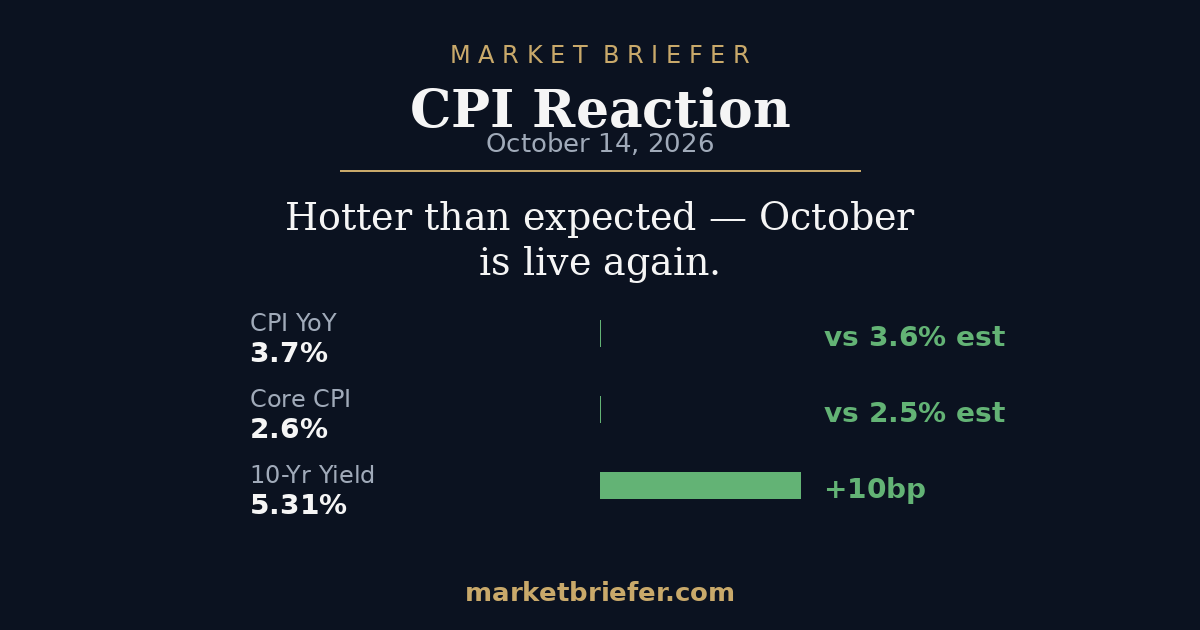
U.S. inflation accelerated in September, with the Consumer Price Index rising 3.7% from a year earlier, above the 3.6% consensus forecast and up from 3.4% in August. Prices rose 0.6% on the month, and core inflation — excluding food and energy — also came in firmer than expected at 2.6% year over year. The print, driven mainly by a surge in gasoline prices but with shelter costs firming too, put a Federal Reserve rate increase at its October 27–28 meeting back on the table.
Key Takeaways
- Headline CPI rose 3.7% year over year (+0.6% on the month), above the 3.6% consensus; core CPI rose 2.6% year over year (+0.3% on the month).
- Gasoline jumped 9.1% on the month and accounted for more than half of the monthly increase, but shelter also firmed to +0.4% — the pressure was not only energy.
- Treasury yields jumped, the dollar hit an 18-month high, and futures markets lifted the odds of an October rate hike from about 22% before the report to roughly 44–49%.
The print
The Bureau of Labor Statistics reported headline CPI up 0.6% in September after a 0.4% rise in August, taking the annual rate to 3.7% from 3.4%. Economists polled by Reuters had expected a 0.6% monthly gain and a 3.6% annual rate, so the monthly pace matched forecasts while the annual rate overshot.
Core CPI rose 0.3% on the month, matching August, and 2.6% over the year, up from 2.4% in August and above the roughly 2.5% consensus. That matters because core is the cleaner read on underlying pressure: a second straight 0.3% monthly gain is not the cooling pattern the Fed has been looking for.
Energy did most of the work in the headline. Energy prices rose 5.2% on the month after rising 2.1% in August, with gasoline up 9.1% — more than half of the all-items monthly increase on its own — and fuel oil up 15.3%. Electricity rose 0.2% and utility gas fell 0.3%. Food was flat on the month: grocery prices edged down 0.1% while restaurant prices rose 0.2%. Shelter, the largest single component, rose 0.4% after 0.3% in August and was up 3.2% from a year earlier. In short, gasoline explains the jump in the headline, but shelter’s firming helps explain why core moved up instead of down. For a plain-English walkthrough of how these pieces fit together, see our explainer on how inflation works.
The market reaction
Markets repriced quickly. In the initial reaction reported by Reuters, S&P 500 futures fell 0.4% and Nasdaq futures fell 0.7%. Treasury yields rose sharply: the 2-year yield climbed 14 basis points to 4.93%, and the benchmark 10-year yield rose 10 basis points to about 5.31%. The U.S. dollar index gained 0.55% to 102.75, an 18-month high, while gold fell 1.6% to $4,088 an ounce. Market data is delayed; live levels are on our U.S. Treasury yields page.
The pattern is a familiar one for a hot print: the front end of the curve moves most because it prices the Fed’s next decisions, rate-sensitive growth stocks take the first hit, and the dollar benefits from the prospect of higher U.S. rates for longer.
What it means for the Fed
The Fed raised its policy rate by 25 basis points in September to a 3.75%–4.00% range, its first increase in three years, and signaled that further increases could follow. Before this report, futures markets put the chance of another hike at the October 27–28 meeting at roughly 22%, with December seen as the more likely timing. After the print, CME FedWatch pricing reported during the morning put the October hike odds at roughly 44–49%.
That shift does not settle the decision. A hold in October paired with a December move remains a plausible path, and several analysts quoted after the release still leaned that way, noting that much of the headline surprise came from energy. But the firmer core reading — and shelter picking back up — could strengthen the case inside the committee that one more increase should not wait. The honest read is that October is now a live meeting in a way it was not yesterday, and the remaining data before October 27 will carry unusual weight.
What to watch next
The Federal Reserve’s Beige Book, its survey of economic conditions across the twelve districts, is released today at 2:00 p.m. ET and will show how businesses are describing price pressures on the ground. Tomorrow brings the September Producer Price Index and retail sales, which will test whether pipeline prices and consumer spending confirm today’s picture. Earnings season is also under way, with major bank results — including BlackRock, Bank of America and Morgan Stanley today — offering a read on credit quality and consumer health at current rate levels. More background explainers are on the Explainers desk.
This is not investment advice. Figures are from the BLS release and market-close reports; market data is delayed.