The Global Close: November 27, 2026 — Best week in over a year, bought at a higher price of money
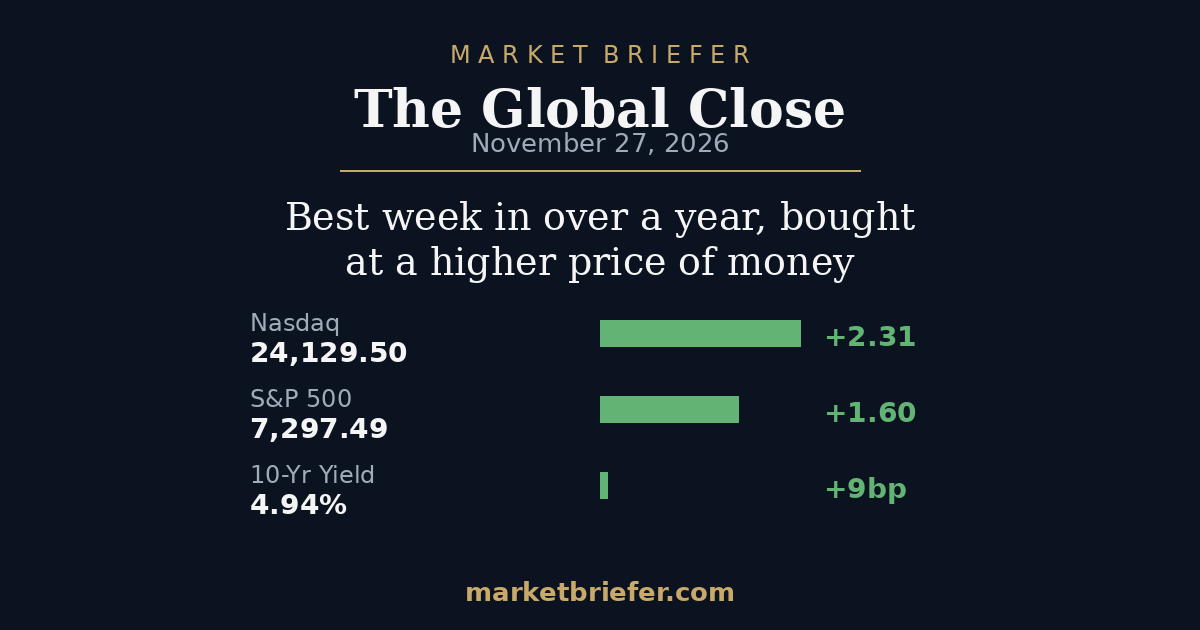
Wall Street posted its best week in over a year in a shortened Black Friday session — S&P 500 +1.60% to 7,297.49, Nasdaq +2.31% — even as the 10-year Treasury yield rose 9 basis points to 4.94% with a December Fed increase fully priced.
7 min read
Wall Street’s best week in more than a year was bought on a day when the bond market raised the price of money, not lowered it — equities advanced as if the financing question hanging over the artificial intelligence buildout had eased, while Treasury yields and a fully priced December rate increase said it had not. That tension travelled through the regional handoff in both directions: Asia and Europe bought the rebound first, with China adding its own policy support, Mumbai refused it outright on dearer oil and a weaker rupee, and New York then confirmed the advance in a shortened, thinly traded session whose verdict the coming week’s data will have to ratify.
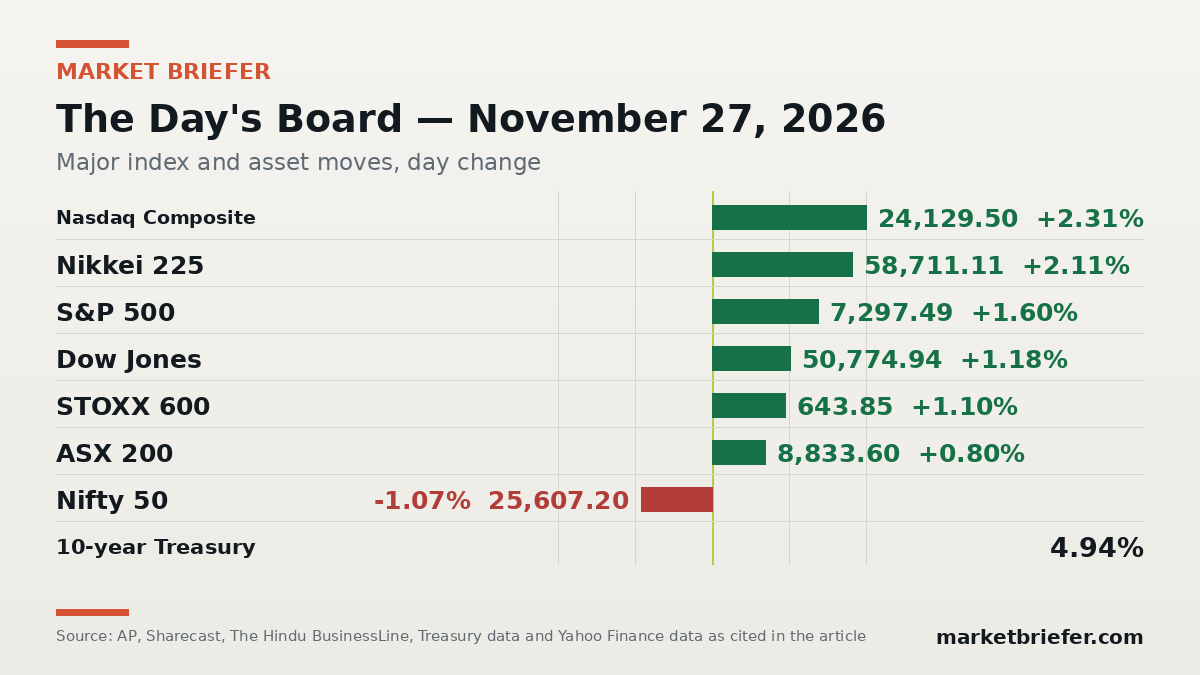
In a session that ended at 1 p.m. Eastern after the Thanksgiving closure, the S&P 500 rose 114.71 points, or 1.60%, to 7,297.49, the Nasdaq Composite climbed 543.70 points, or 2.31%, to 24,129.50, and the Dow Jones Industrial Average added 591.99 points, or 1.18%, to 50,774.94, according to the Associated Press. The weekly gains were the story behind the day: the S&P 500 rose 5.6% for the week, its strongest since April 2025, the Nasdaq gained 6.7% and the Dow 5.5%, its best week since October 2022, per CNBC figures reported by ETF.com. The advance was broad — four of every five U.S. stocks rose, the AP reported, and all eleven State Street sector funds finished higher — but it was led by the same technology and chip shares whose November selloff created the opening. We read this as a repricing of how much doubt investors require, not as evidence that the questions about AI returns have been answered: nothing in Friday’s data changed what those data centres will earn, and light volume — the SPDR S&P 500 fund traded about two-thirds of its average — means the conviction behind the move is still to be tested at full attendance.
The Number That Matters: 4.94% — the yield on the 10-year Treasury, which rose 9 basis points on Friday from 4.85% late Wednesday, according to Treasury data cited by ETF.com, while the 2-year yield rose 8 basis points to 4.69%. It is the key number because it prices everything the equity advance must overcome: a higher long yield raises the discount rate on distant AI earnings, lifts mortgage and corporate borrowing costs, and supports the dollar, and it rose on the same day stocks posted their best week in over a year, with traders fully pricing a quarter-point Federal Reserve increase at the December 8–9 meeting, per CME FedWatch figures cited by ETF.com. It matters more than the headline index gains because it identifies the recovery’s constraint — the rebound was bought at a higher price of money. A decisive fall in payrolls or wage growth on December 4 that pulled the 10-year back below 4.80% would make the labour data, not the yield, the more important signal.
A rebound on three continents, with one refusal
The day’s single most important story was the synchronised return of buyers to the shares sold hardest this month. In the United States, the iShares Semiconductor ETF rose 4.8% and SanDisk gained nearly 16%, Amazon rose about 4% as the holiday shopping season opened, Broadcom added 3.8% and Anthropic, the newly public AI laboratory, rose 11% to $91.88, while Nvidia added 0.8% and Microsoft 0.6%, according to the AP and ETF.com reports. Technology led the State Street sector funds with a 2.8% gain, while utilities and health care brought up the rear at 0.3% each — risk appetite, not defensiveness, set the day’s prices. For households, the split matters concretely: the same session that lifted retirement accounts left borrowing costs higher, because the yield move, not the index move, is what reaches mortgage quotes and card rates.
Europe had moved before New York opened. The benchmark STOXX 600 ended up 1.1% at 643.85, Germany’s DAX rose 0.9% to 25,441.24, France’s CAC 40 closed up 0.6% at 8,156.09 and London’s FTSE 100 gained 0.84% to 10,698.81, according to Sharecast’s European close report. Technology shares continued their recovery and basic resources advanced 3.6% as copper, gold and silver prices rose, Sharecast reported, even as the European Commission’s November sentiment indicator fell 0.7 points to 95.8, against expectations of a rise — the region’s markets are pricing the global AI and metals cycle more than their own domestic confidence data.
Asia set the tone earliest and widest. Japan’s Nikkei 225 rose 1,211.95 points, or 2.11%, to 58,711.11, Hong Kong’s Hang Seng gained 2.11% to 22,694.77, the Shanghai Composite advanced 3.7% to 3,606.49 after Beijing unveiled fresh measures to support the equity market, including a greater role for state-backed investors, and South Korea’s Kospi rose 4.3% to 4,915.68, according to the AP and Sharecast’s Asia report. Australia’s S&P/ASX 200 added 0.80% to 8,833.60. The refusal came from Mumbai: India’s Nifty 50 fell 277.30 points, or 1.07%, to 25,607.20, per The Hindu BusinessLine’s closing report, as rising crude prices, a weaker rupee and selling in information-technology and financial heavyweights ended a two-day advance. That divergence is the day’s most useful cross-border fact — the rebound was global, but it was not indiscriminate, and the market most exposed to imported energy priced the other side of the oil trade. Our markets desk carries the full regional board.
Rates, credit and the price of the rebound
Currencies confirmed the rates story rather than the equity story. The dollar index rose 0.36% to 104.05, the euro fell 0.35% to $1.0936 and the dollar rose 0.20% to 159.55 yen, according to Yahoo Finance data compiled by Globicus, while sterling was little changed near $1.3118, per Reuters. A dollar holding near a 22-month high while stocks advance tightens financial conditions for every borrower and importer priced in dollars, whatever their local index did on Friday. The yen’s position just below 160 per dollar, where talk of Japanese intervention gathers, and Tokyo core inflation of 2.9% in November, reported by Reuters, keep the Bank of Japan’s December meeting on the same calendar as the Fed’s.
Credit, the market that usually votes first on whether a rebound is sound, has not yet voted for it. The latest ICE BofA spreads published via FRED, dated November 26, put investment-grade corporate debt at 99 basis points over Treasuries, unchanged on the day, and high-yield debt at 377 basis points, also unchanged on the day but 25 basis points wider over the week. Those levels say lenders are still charging more for corporate risk than they did a month ago even as shareholders pay more for corporate earnings — the same tension as the Treasury market, expressed in a different instrument. In crypto, the hesitation was visible too: bitcoin was $61,615.60, up 1.56% over 24 hours, and ether was $1,730.73, up 2.11%, in CoinGecko data for November 27, yet U.S. spot bitcoin funds have recorded a record $5.39 billion of net withdrawals in November, per SoSoValue figures reported by The Block — prices steadied while the fund bid kept leaving. Our crypto desk tracks that split.
Commodities split along the same line. January Brent crude fell 0.9% to $90.84 a barrel, according to the AP, and WTI crude fell 0.72% to $83.08, per the Globicus compilation, with an OPEC+ meeting this weekend and Middle East supply risks keeping a floor under prices. The metals moved the other way: gold rose 3.75% to $3,668 an ounce and copper gained 5.03% to $5.60 a pound, per the same compilation, as the AI trade’s recovery lifted the metals used in data centres and power infrastructure. How yields transmit into equity valuations is set out in our explainers library.
What Would Change This Read: This interpretation would weaken if the 10-year yield falls back below 4.80% while technology shares hold their gains, suggesting Friday’s advance was a durable repricing of AI earnings rather than a thin-session recovery bought against a rising discount rate. In particular, watch the December 4 payrolls report and its wage figures, because they would distinguish between the current interpretation — a rebound whose constraint is the price of money — and the alternative that labour data, not yields, is now setting the market’s ceiling.
What to watch next week is a full calendar compressed into the Fed’s blackout period, which begins Saturday, November 28, so no official will interpret the data before the December 8–9 meeting. Tuesday, December 1 brings the November ISM manufacturing survey and October job openings; Wednesday brings the ADP private payrolls estimate; Thursday brings the ISM services survey; and Friday, December 4 brings the November jobs report, with economists polled by FactSet expecting 90,000 new jobs and unemployment steady at 4.1%, per ETF.com. CrowdStrike and Marvell report earnings on Tuesday and Salesforce on Wednesday. Asia opens Monday with the question Friday left open: whether Mumbai’s refusal or Shanghai’s policy-led advance is the better guide to the region’s week.
This is not investment advice. The Global Close is AI-assisted market research produced with automated data checks; figures are verified against market-close reports and the site’s delayed data feeds at publication time.
See Market Briefer first in Google
Add to Preferred Sources