The Global Close: November 25, 2026 — A 4% fall that ended at a quarter of a percent
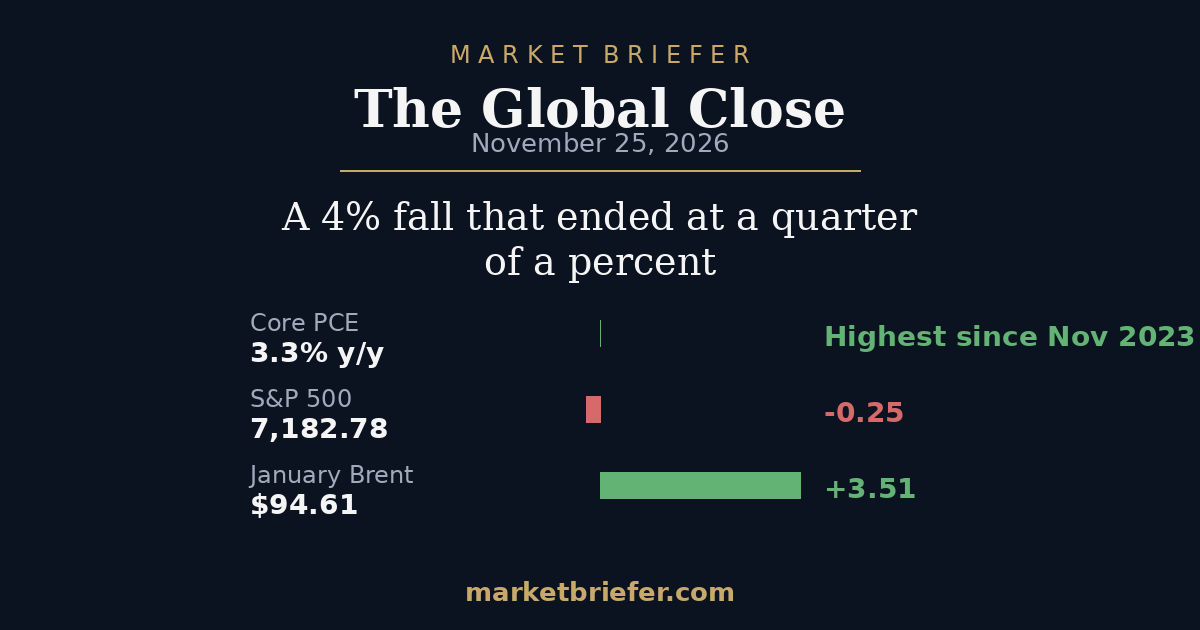
Wall Street recovered from a 4% intraday fall to close almost flat on November 25, 2026, as core PCE inflation rose to 3.3% and GDP was revised up to 4.3%. Asia fell on the chip trade, Mumbai rose 1.85%, and January Brent settled at $94.61.
7 min read
The pattern that broke on Wednesday was not the artificial intelligence trade’s decline, which is now a familiar sight, but the assumption that a hotter-than-expected inflation print and a 4% intraday fall in the Nasdaq would take the whole market down with them. Asia had already absorbed Tuesday’s chip losses in full and Europe handed the selling on, yet by the time New York closed the damage had narrowed back to the one complex where it began, leaving the Dow Jones Industrial Average higher on the day and the broader market almost flat.
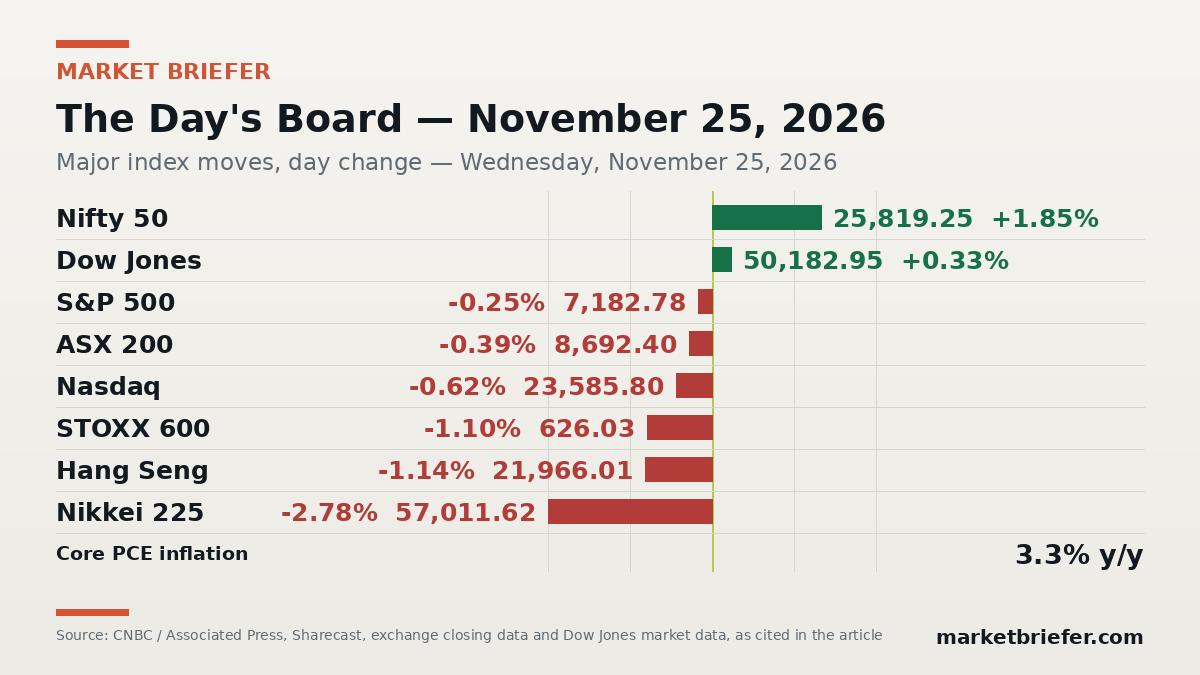
The Dow rose 164.25 points, or 0.33%, to 50,182.95, the S&P 500 fell 18.31 points, or 0.25%, to 7,182.78, and the Nasdaq Composite fell 147.73 points, or 0.62%, to 23,585.80, according to closing data reported by CNBC and the Associated Press. Those calm closing figures conceal the session inside them: at the lows the S&P 500 was down 3.21% and below 7,000, the Nasdaq was down 4.64% and the Dow had fallen more than 1,100 points, before buying that began around midday, led by Anthropic and Meta, carried all three back toward flat. Breadth at the close was positive, with 356 S&P 500 stocks advancing against 139 decliners, the small-cap Russell 2000 rose 0.71% to 2,704.06, and the VIX still rose 7.31% to 28.29 — the options market pricing the morning, not the afternoon. Readers can follow the full board on our markets desk.
The Number That Matters: 3.3%. That is October’s core PCE inflation rate, the Federal Reserve’s preferred measure, up from 3.1% in September, above the 3.2% forecast and the highest since November 2023, according to the Bureau of Economic Analysis. It is the key number because it arrived on the same morning that third-quarter GDP was revised up to a 4.3% annual rate, the fastest pace in three years: growth and inflation both running hot together is the combination that keeps policy tight, and futures markets priced a December rate increase as near certain. It matters more than the Nasdaq’s intraday fall because it explains the pressure on every long-duration asset at once, from chip valuations to the housing market. A decisive move in the 10-year Treasury yield back above 5% would make the bond market the more important signal.
The selloff that narrowed to one complex
In the United States, the morning’s selling had three stated causes, and the reports read in preparation of this edition name all of them: the core PCE surprise, proposed new U.S. tariffs, and the continuing unwind of the AI trade. Reuters reported that the USTR proposed Section 301 duties of 15% on Taiwan and South Korea and 20% on China, mostly within previously agreed caps and not before January, while chip stocks fell for a third session — Nvidia closed down 3.91%, Lam Research down 5.7%, SanDisk down 5.6% and Micron down 4.5%, with the Philadelphia Semiconductor Index down 0.65% at the close after falling nearly 8% intraday. Dell Technologies was the day’s cleanest test of the mood: it closed up just 0.60% at $297.06, according to Finnhub closing data, a day after reporting record revenue of $54.94 billion and a $132.3 billion AI server backlog — good AI news is currently not being paid for. Against that, HP rose 11.5% to $31.15 on its results, the S&P 500’s top gainer, Deere rose 4.4%, Meta rose 3.4%, and materials led the sectors with a gain of about 2%, while financials, staples and industrials also rose and technology fell about 0.8%. The data wall behind the session cut both ways: jobless claims fell 13,000 to 189,000, a four-month low, new home sales rose 14.2% to a ten-month high of 701,000, core capital goods orders rose 1.2%, and the Fed’s Beige Book reported growth in eight of twelve districts with prices rising moderately. We read this as a market that is repricing one crowded trade, not an economy: the indexes remain on track for their worst November since 2008, according to Reuters, yet the selling has not spread to credit, small caps or the Dow’s industrials, and a 4.3% growth rate with claims at a four-month low is not the backdrop against which broad selloffs usually sustain themselves. For borrowers, the cost is indirect but real — inflation at 3.3% core keeps the December decision pointed toward another increase, and mortgage and loan pricing follows the long end of the curve, not the equity close.
Asia takes the hit in full, Mumbai refuses it, Europe hands it on
Asia traded Tuesday’s New York session and took the chip decline undiluted. Japan’s Nikkei 225 fell 1,633.01 points, or 2.78%, to 57,011.62, South Korea’s Kospi fell 6.16% to 4,697.51 as Samsung Electronics and SK Hynix fell heavily, and Taiwan’s Taiex fell about 4.8%, according to Sharecast’s Asia report and exchange closing data. Hong Kong’s Hang Seng fell 253.64 points, or 1.14%, to 21,966.01, a seventh consecutive decline, the Shanghai Composite fell 71.90 points, or 2.03%, to 3,476.47, and the CSI 300 fell 65.59 points, or 1.7%, to 3,898.24. Australia’s S&P/ASX 200 fell 34.00 points, or 0.39%, to 8,692.40, as an Australian inflation reading of 4.9% raised the odds of a Reserve Bank increase. India was the exception that proved the regional rule: returning from Tuesday’s holiday, the Nifty 50 rose 469.60 points, or 1.85%, to 25,819.25, according to HDFC Sky’s closing report, winning back all of Monday’s fall in one session on foreign institutional buying, led by banks and consumer names rather than the chip complex Asia was selling.
Europe, trading alongside New York’s morning, closed lower but without the intraday drama. The pan-European STOXX 600 fell 1.1% to 626.03, Germany’s DAX fell 315.68 points, or 1.26%, to 24,702.13, France’s CAC 40 fell 59.92 points, or 0.75%, to 7,980.57, and London’s FTSE 100 fell 40.13 points, or 0.38%, to 10,426.94, according to Sharecast’s European close report — a session attributed to the returning AI concerns, the tariff proposals and the U.S. inflation reading that firmed expectations of a December increase.
Rates fall, oil rises, and the calendar empties
Rates moved the other way from the inflation print. The 10-year Treasury yield fell 3.4 basis points to 4.868% and the 2-year fell 1.9 basis points to 4.652%, according to investingLive’s closing wrap — demand for Treasuries during the equity selloff outweighing the PCE surprise, which tells its own story about how much tightening is already priced. The Dollar Index fell 0.12% to 103.70; the euro rose to $1.0973, sterling was little changed at $1.3119 and the dollar slipped to 159.19 yen. In credit, on the latest available FRED figures, for November 24, the ICE BofA high-yield spread widened 9 basis points to 372 basis points — wider than earlier in the month, at a level that describes caution rather than a funding problem, and notably not confirming the equity morning’s alarm. In commodities, January Brent settled up $3.21, or 3.51%, at $94.61 a barrel and January WTI settled up about 2% at $83.68, according to Dow Jones market data reported by the Wall Street Journal, as a Houthi claim of a strike on Saudi Arabia’s Ras Tanura refinery and continuing Hormuz tensions outweighed surplus expectations ahead of Sunday’s OPEC+ meeting on 2027 output; our oil prices explainer sets out how that supply risk is priced. Spot gold rose 0.80% to $3,584.66 an ounce, recovering from below $3,500 intraday as yields fell. Crypto followed the afternoon equity recovery rather than the morning: bitcoin traded near $60,331, up about 1%, and ether traded near $1,685.
What Would Change This Read: This interpretation would weaken if Friday’s shortened session gives back the recovery — in particular if the semiconductor index closes below its Wednesday intraday low while high-yield spreads widen decisively above 400 basis points — suggesting the selling is becoming a credit event rather than a valuation reset in one complex. In particular, watch Dell and Nvidia on Friday, because they would distinguish between the current interpretation — demand intact, prices questioned — and the alternative that investors are discounting the AI buildout itself.
What to watch next is shaped by the holiday. U.S. markets are closed Thursday for Thanksgiving and trade a shortened session on Friday, closing at 1 p.m. Eastern, so Wednesday’s data wall is the week’s last full information set before the Federal Reserve’s December meeting. Asia opens Thursday with New York’s recovery, rather than its morning fall, as the lead, and oil traders face the OPEC+ meeting on Sunday, which will set output quotas for early 2027 against a market that has just paid $3.21 more for a barrel of Brent on supply risk alone.
This is not investment advice. The Global Close is AI-assisted market research produced with automated data checks; figures are verified against market-close reports and the site’s delayed data feeds at publication time.
See Market Briefer first in Google
Add to Preferred Sources