The Global Close: November 24, 2026 — The Dow crosses 50,000 as the chip trade gives back Monday
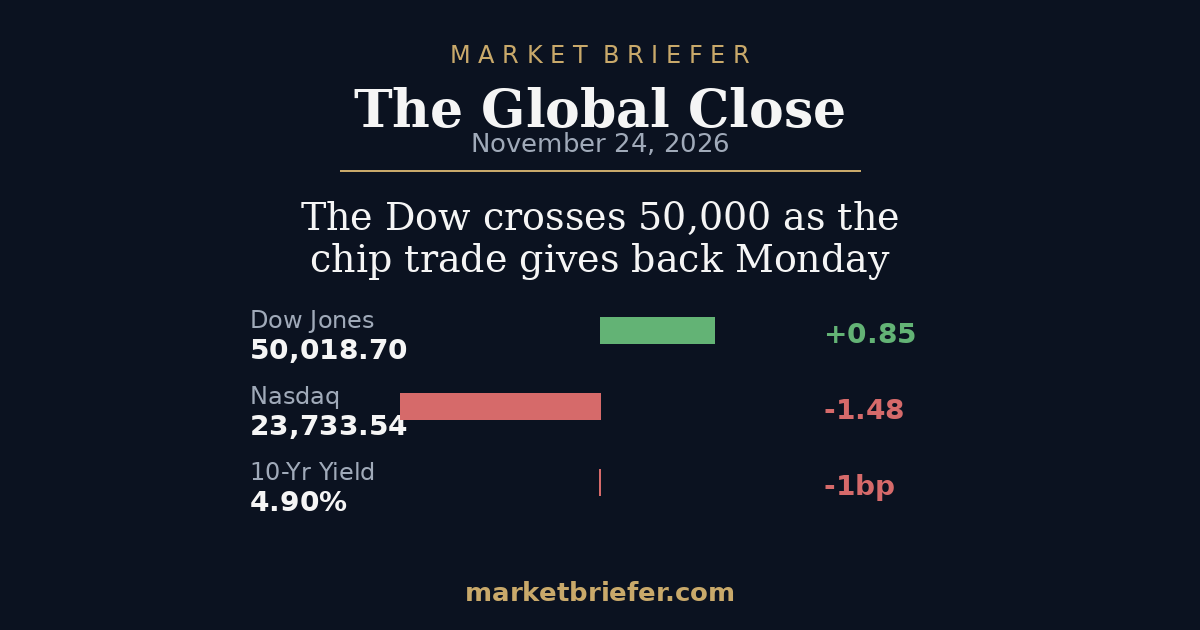
The Dow closed above 50,000 for the first time as chips gave back Monday's gains, Asia caught the rally in full and Europe closed lower ahead of Wednesday's PCE reading.
7 min read
Monday’s advance rested on one company’s boardroom, and Tuesday showed what happens when that single support is tested: the chip trade gave back a large part of its gain while the rest of the market quietly moved higher. The split travelled around the world in reverse order — Asia, trading on Monday’s news, caught the advance in full, with Tokyo rising nearly 4% on its return from a holiday, while Europe, trading Tuesday’s doubt, closed lower and New York ended the day divided against itself.
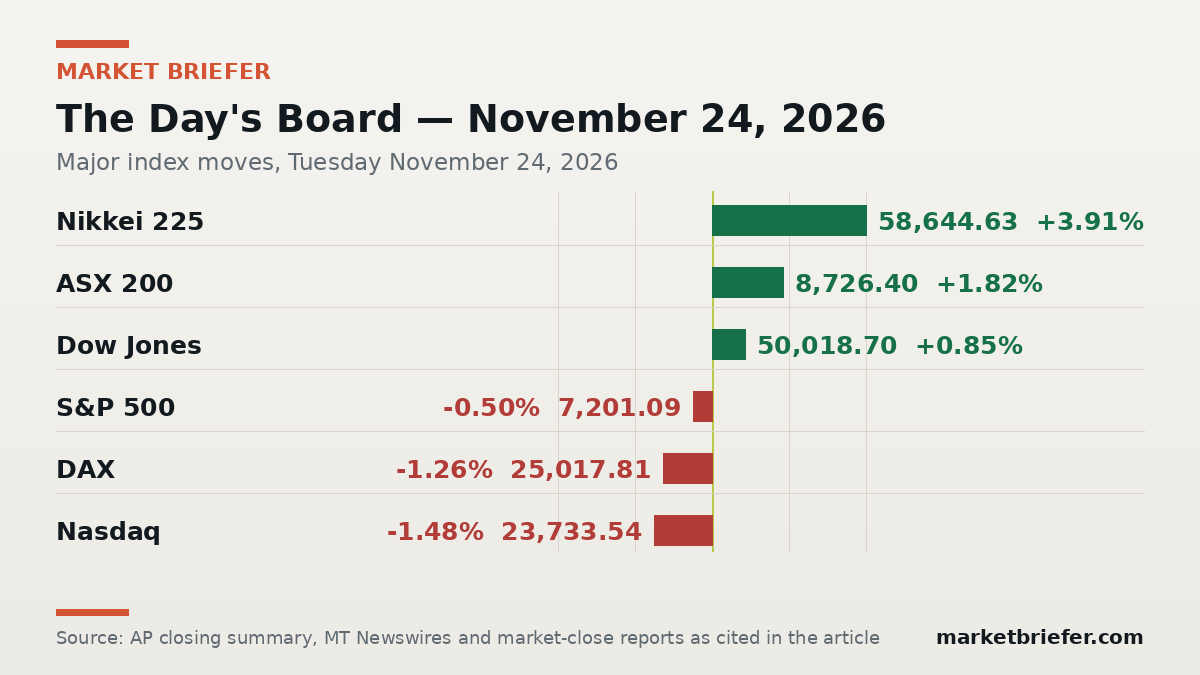
The Dow Jones Industrial Average rose 423.39 points, or 0.85%, to 50,018.70, its first close above 50,000, according to the Associated Press closing summary. The S&P 500 fell 36.08 points, or 0.50%, to 7,201.09, and the Nasdaq Composite fell 356.02 points, or 1.48%, to 23,733.54. Beneath the headline split, breadth was positive: 321 S&P 500 stocks rose and 175 fell, the equal-weight index gained about 0.5%, and the small-cap Russell 2000 rose 0.57% to 2,684.94. The Philadelphia Semiconductor Index fell 7.88%, and the VIX eased about 1% to 26.36. Readers can follow the full board on our markets desk.
The Number That Matters: 50,018.70. That is the Dow’s first close above 50,000, and it is the key number because of what it says about where the market’s weight now sits: on a day when the semiconductor index fell nearly 8% and the Nasdaq lost 1.48%, thirty large industrial, health-care and retail names carried the oldest U.S. benchmark to a milestone. It matters more than the S&P 500’s 0.50% decline because it separates two markets that have been moving as one — the concentrated AI trade, which fell, and the broader economy trade, which rose on the strongest consumer confidence reading in nearly two years. A decisive October PCE reading on Wednesday that pushed the 10-year yield back above 5% would make the bond market the more important signal.
The rotation: chips fall, the rest of the market rises
In the United States, the give-back was concentrated exactly where Monday’s gain had been. Nvidia fell 5.86% to $155.38, a day after its 31.5% rise, according to closing data reported by Investopedia, and the selling spread across the complex: Analog Devices fell about 17% to lead S&P 500 decliners despite reporting record quarterly revenue of $4.37 billion late Monday, Hewlett Packard Enterprise fell about 16% even after better-than-expected results and raised guidance, Micron and SK Hynix fell roughly 10% each, and Advanced Micro Devices, Intel and Marvell each fell more than 8%. Dell Technologies fell 11.83% to $295.28 ahead of its earnings — and then answered the day’s central question after the close. Dell reported record third-quarter revenue of $54.94 billion against expectations of $49.32 billion, adjusted earnings of $9.45 a share against $6.59 expected, and a record AI server backlog of $132.3 billion, and raised its full-year revenue forecast to $202 billion from $192 billion, according to Reuters; its shares rose about 3% in after-hours trading. Anthropic fell 6.5% to just under $82, below its $83 offer price.
Outside technology, the day belonged to health care and retail. The Conference Board’s consumer confidence index rose 11.4 points to 103.3 in November, well above the 92.2 forecast and its highest since January 2025, and retailers responded ahead of Black Friday: Abercrombie & Fitch rose about 20%, Kohl’s about 19%, Dick’s Sporting Goods about 15% and Dollar Tree about 11% after results and raised outlooks. Nike and Amgen each gained more than 5% to pace the Dow, and Insmed rose about 14% after France’s Sanofi agreed to acquire it in a transaction valued at $41 billion. We read this as the market narrowing its objection, not abandoning the AI buildout: Dell’s after-hours numbers — a $132.3 billion backlog is orders, not projections — say enterprise demand is intact, while the regular session’s selling says investors will no longer pay Monday’s prices for that demand without seeing each company’s margins. For the workers and suppliers attached to the buildout, that distinction matters: the spending programme survived Tuesday; the valuations attached to it did not, entirely.
Two clouds sat over the rotation. Reuters reported that the Trump administration is preparing to release findings of a probe into alleged excess industrial capacity in 16 major trading partners, with new import duties on a wide range of goods expected — a direct cost question for the same retailers and manufacturers who led the Dow higher. And the day’s confidence reading cuts both ways: households reporting the strongest sentiment in nearly two years, on optimism about the labour market after the midterm elections, is good news for spending and awkward news for anyone hoping the Federal Reserve eases policy soon.
Asia catches Monday, Europe hands it back, and Mumbai sits out
Asia traded Monday’s story and caught it in full. Japan’s Nikkei 225 rose 2,207.98 points, or 3.91%, to 58,644.63 on its return from the Labour Thanksgiving Day holiday — the gain measured against Friday’s close of 56,436.65, as published in our November 20 edition — according to MT Newswires closing data. South Korea’s Kospi rose 297.49 points, or 6.32%, to 5,006.03, and Taiwan’s Taiex rose 8.99% to 40,122.35, as the region’s chip suppliers followed Nvidia’s Monday move. Australia’s S&P/ASX 200 rose 155.80 points, or 1.82%, to 8,726.40, ending an eight-session losing streak. Hong Kong moved the other way: the Hang Seng fell 164.09 points, or 0.73%, to 22,219.65, on unresolved U.S.–China trade tensions, while the Shanghai Composite rose 9.42 points, or 0.27%, to 3,548.37 and the CSI 300 edged up 5.53 points, or 0.14%, to 3,963.82. India’s market was shut for Guru Nanak Jayanti, so the Nifty 50’s last close remains Monday’s 25,349.65, down 1.75%, as published in our November 23 edition.
Europe, trading after Asia and alongside New York’s opening doubt, closed lower. The pan-European STOXX 600 fell 0.66%, Germany’s DAX fell 319.46 points, or 1.26%, to 25,017.81, France’s CAC 40 eased 4.35 points, or 0.05%, to 8,040.49, and London’s FTSE 100 eased 13.75 points, or 0.13%, to 10,467.07, according to RTTNews and market-close data — a session the reports attributed to caution about the AI trade and the prospect of new U.S. tariffs. Sanofi’s $41 billion agreement for Insmed was Europe’s largest corporate story, lifting its U.S.-traded shares about 10%.
Rates and currencies moved against the equity anxiety. The 10-year Treasury yield fell 1 basis point to 4.90% and the Dollar Index fell 0.50% to 103.82, according to closing market data; the euro rose 0.59% to $1.0967 and sterling rose 0.67% to $1.3119. For borrowers, a 10-year yield holding just under 5% keeps the cost of money near its recent highs even on a day when the dollar softened — the relief, such as it was, came in currencies, not in credit. On the latest available FRED figures, for November 20, ICE BofA spreads stood at 98 basis points for investment-grade debt and 376 basis points for high-yield — wider at the speculative end than earlier in the month, but at levels that describe strain rather than a funding problem. In commodities, January WTI rose 1.82% to $81.63 a barrel, recovering part of Monday’s fall, while January Brent traded below $87 a barrel in late trading, according to CoinDesk, near three-month lows as crude continued to flow out of the Persian Gulf; our oil prices explainer sets out how that supply picture is priced. Gold futures fell 2.75% to $3,551.10 an ounce, back near a fourteen-month low. Crypto followed the chip trade rather than the Dow: bitcoin fell 2.01% to $59,979, back below $60,000 after reaching above $64,000 on Monday, and ether traded near $1,706.
What Would Change This Read: This interpretation would weaken if Wednesday’s October PCE reading comes in hot enough to lift the 10-year yield back above 5% while the Dow’s non-technology leadership also fails — suggesting Tuesday’s breadth was a one-day rotation rather than a broadening advance. In particular, watch Dell’s shares in Wednesday’s regular session, because they would distinguish between the current interpretation — demand intact, valuations questioned — and the alternative that investors are discounting the AI server cycle itself, backlog notwithstanding.
What to watch on Wednesday is the week’s centre of gravity, compressed into one morning before Thursday’s Thanksgiving closure: the October PCE price index, the Federal Reserve’s preferred inflation gauge, alongside the second estimate of third-quarter GDP, durable goods orders, weekly jobless claims and the Fed’s Beige Book. U.S. markets are closed Thursday and trade a shortened session Friday, so Wednesday’s data will set the tone for a thin week — and Asia opens Wednesday with Dell’s after-hours verdict, rather than Monday’s boardroom news, as its lead.
This is not investment advice. The Global Close is AI-assisted market research produced with automated data checks; figures are verified against market-close reports and the site’s delayed data feeds at publication time.
See Market Briefer first in Google
Add to Preferred Sources