The Global Close: November 23, 2026 — One board decision ends a correction
Nvidia rose 31.5% as Jensen Huang was reinstated, lifting the S&P 500 4.73% out of correction, while Asia closed lower and Mumbai's Nifty 50 fell 1.75%.
7 min read
A seven-day fall that had carried the S&P 500 into a correction was not ended by better data, lower yields or a central bank — it was ended by a single board reversing itself, and a market that had priced the loss of one executive discovered how much of its value rested on that one person. The reversal travelled unevenly: Europe’s chip shares caught it in full before New York opened and Wall Street amplified it, but Asia, which had traded hours before the announcement, closed mostly lower, and Mumbai fell sharply on its own banking stocks.
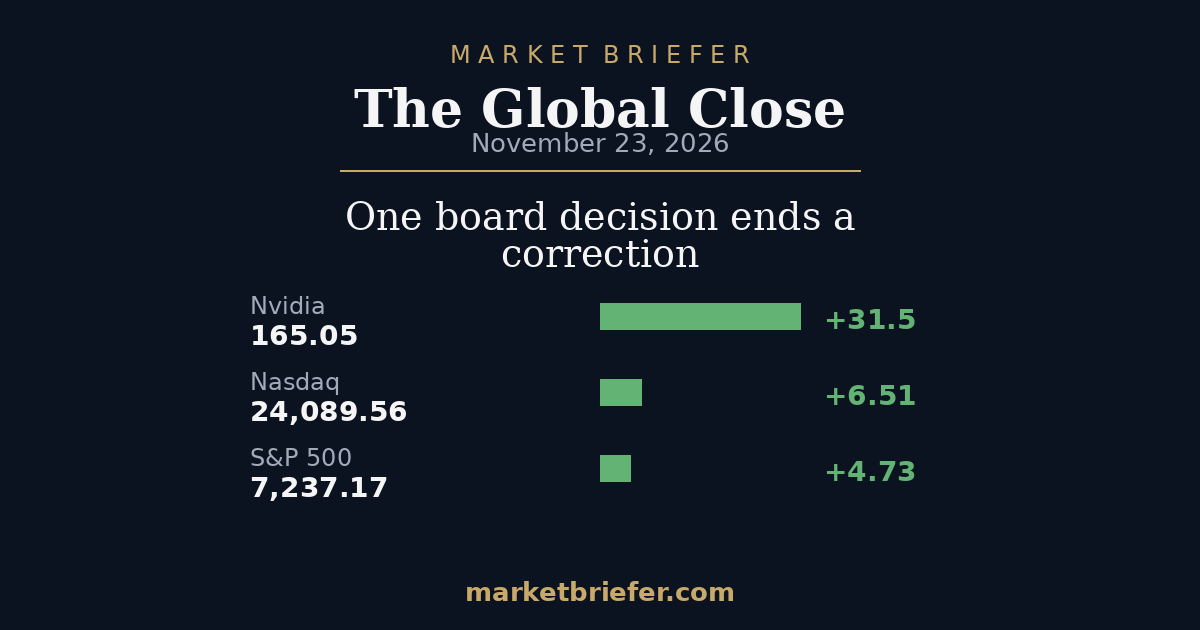
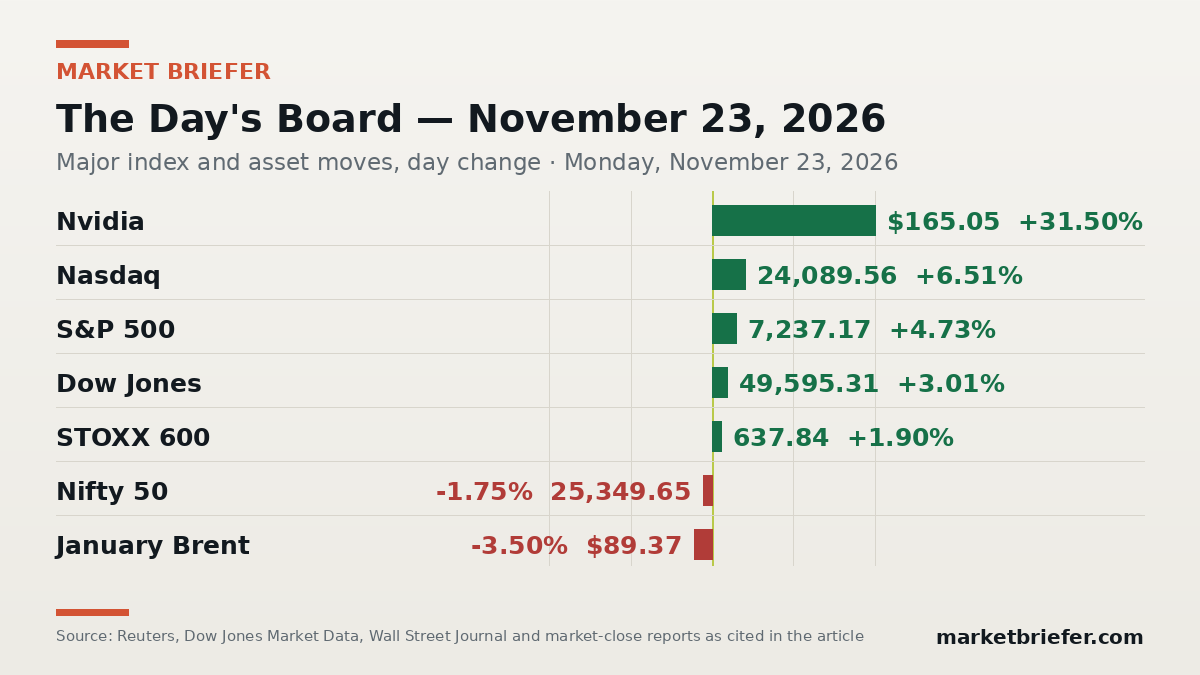
U.S. stocks rose sharply, ending a seven-session losing streak. The S&P 500 rose 326.78 points, or 4.73%, to 7,237.17, its best session since April 2025, according to Dow Jones Market Data figures reported by Investor’s Business Daily. The Nasdaq Composite rose 1,471.83 points, or 6.51%, to 24,089.56, its second-largest one-day points gain on record, and the Dow Jones Industrial Average rose 1,447.98 points, or 3.01%, to 49,595.31. Both the S&P 500 and the Dow moved back out of correction territory, and the VIX fell about 26% to 26.62 from Friday’s 35.89. The cause was specific: Nvidia’s board reinstated Jensen Huang as president and chief executive, eleven days after his resignation, and Nvidia shares rose 31.5% to $165.05 — the stock’s largest one-day gain since May 2003, when it rose 33.06%, according to Dow Jones Market Data. President Trump told CNBC he had convinced the board to act. Readers can follow the full board on our markets desk.
The Number That Matters: 31.5%. That is Nvidia’s one-day rise, and it is the key number because of how much of Monday it explains: by one index attribution, Nvidia alone contributed roughly a third of the S&P 500’s 473-basis-point gain, and the Philadelphia Semiconductor Index rose about 14% behind it. A move of that size in the market’s largest company transmits everywhere at once, which is why a governance decision, not an economic release, set the day’s prices on three continents. It matters more than the headline gains because it identifies the recovery’s foundation: one company’s leadership, restored by the same board that had said last week it was not considering his return. Dell’s earnings on Tuesday, or a decisive October PCE reading on Wednesday, would make fundamentals the more important signal.
United States: nine sectors higher, and the advance had one engine
In the United States, nine of the eleven S&P 500 sectors rose, according to Reuters’ Trading Day report: technology gained about 9% and communication services about 5%, while energy and consumer staples fell. The chip complex led by a wide margin: Micron Technology rose about 19%, Marvell Technology about 18%, Intel about 16%, Advanced Micro Devices about 7% and Broadcom about 3%. Nvidia’s partners followed — Dell Technologies rose about 20%, CoreWeave about 22% and Nebius about 20%. Among the largest companies, Tesla rose about 11%, Alphabet 6.3% and Meta Platforms about 6%, and Boeing added about 4% after President Trump said he expects China to buy an additional 250 Boeing aircraft. The day’s notable faller was CrowdStrike, down about 9% after announcing an all-stock acquisition of Zscaler valued at roughly $44 billion; Zscaler shares rose about 18%. Anthropic fell 1.4% to around $87, just above its $83 offer price.
We read this as a repricing of a specific risk, not a verdict that the questions of the past two weeks have been answered. Friday’s edition argued the selloff was about the prices investors would pay for AI earnings that have not yet arrived; nothing on Monday changed those earnings. What changed is that the leadership uncertainty hanging over the company at the centre of the buildout was removed — and the removal was worth more, in one session, than the entire previous week’s argument about valuations. That matters for the companies planning AI investment and the workers and suppliers attached to those plans: spending that was being second-guessed on Friday is likelier to proceed, but it now rests visibly on one executive’s position, which Congress examines in early December.
Europe catches the move, Asia does not, and India falls on its banks
Europe traded after the announcement and caught the move. The pan-European STOXX 600 closed 1.9% higher at 637.84, its biggest daily gain since early May, according to Reuters, with the technology index up 4.7% as ASML rose about 10%, BE Semiconductor 9.2% and Aixtron 8.9%. Germany’s DAX rose 560.92 points, or 2.26%, to 25,363.70, France’s CAC 40 rose 117.09 points, or 1.48%, to 8,044.84, and London’s FTSE 100 rose 134.48 points, or 1.30%, to 10,480.82. Europe’s own data split along the familiar line: Germany’s flash composite purchasing managers’ index rose to 55.0 in November, while France’s fell to 46.2.
Asia had closed before the announcement and kept Friday’s story. Japanese markets were shut for Labour Thanksgiving Day, so the Nikkei 225’s last close remains Friday’s 56,436.65, down 5.06% as published in our November 20 edition. Hong Kong’s Hang Seng eased 27.06 points, or 0.12%, to 22,383.74, while China’s CSI 300 edged up 3.73 points, or 0.09%, to 3,958.29 after China’s exchanges moved to ease margin requirements for leveraged buying. South Korea’s Kospi fell 3.31% to 4,708.54, Taiwan’s Taiex rose 2.2% to 36,811.89, and Australia’s S&P/ASX 200 slipped 22.00 points, or 0.26%, to 8,570.60, its eighth straight decline. India moved against Friday’s strength: the Nifty 50 fell 450.95 points, or 1.75%, to 25,349.65, dragged by banks and metals after a four-week advance — the Nifty Bank index fell 3.17%, Tata Steel lost more than 8% and Axis Bank about 4%, while Tata Consultancy Services rose about 3%, according to Indian market-close reporting.
Rates, currencies, credit, commodities and crypto
Bond markets did not share the equity market’s relief. The 2-year Treasury yield rose 4.7 basis points to 4.658% and the 10-year rose 1.0 basis point to 4.919%, according to the Wall Street Journal’s closing report — a bear flattening that says rate expectations, not growth optimism, did the moving. CME FedWatch put the probability of a December Federal Reserve rate increase at about 93%. The Dollar Index rose 0.25% to 104.07, near a 19-month high: the euro fell to $1.0887, sterling to $1.3017, and the dollar rose 0.4% against the yen to 159.18. For borrowers, the combination is the day’s quiet story — equities recovered, but the cost of money did not fall with them.
Credit, on the latest available figures, describes strain rather than stress. The ICE BofA spreads available through FRED, for November 20, stood at 98 basis points for investment-grade debt and 376 basis points for high-yield, 24 basis points wider on the day at the speculative end — levels well below those that accompany a funding problem. Monday’s largest corporate transaction, CrowdStrike’s $44 billion acquisition of Zscaler, was all-stock, adding no new debt. In commodities, January WTI settled down 3.9% at $80.17 a barrel, its lowest since August 7, and January Brent settled down 3.5% at $89.37, its lowest close since August 28, as crude continued to flow out of the Persian Gulf despite continued attacks on shipping, according to the Wall Street Journal — the same January Brent contract that settled at $92.57 on Friday, so the move is like-for-like; our oil prices explainer sets out how that supply risk is priced. Gold futures rose 3.4% to $3,635 an ounce, recovering part of Friday’s fall to a fourteen-month low, and copper rose about 2.5% to $5.62 a pound. Crypto steadied rather than joined the advance: bitcoin traded near $61,300 in late trading, back above $60,000 after falling below $58,000 on Friday, and ether traded near $1,720.
What Would Change This Read: This interpretation would weaken if Nvidia gives back a large part of Monday’s gain while the broader index holds — suggesting the advance was broad relief rather than a single-stock event — or if Wednesday’s October PCE reading comes in hot enough to push the 10-year yield back above 5% alongside a renewed fall in technology shares. In particular, watch Dell’s earnings after Tuesday’s close, because they would distinguish between the current interpretation — a leadership risk removed from an intact AI buildout — and the alternative that the buildout’s economics themselves are now in question.
What to watch on Tuesday begins in Asia, where Japan reopens after its holiday, alongside Germany’s Ifo business survey. In the United States, the Conference Board’s November consumer confidence index is the day’s main release, and earnings arrive from Analog Devices and, after the close, Dell Technologies — the first large test of AI server demand since the selloff. Wednesday brings the week’s centre of gravity: the October PCE price index, the second estimate of third-quarter GDP, durable goods orders, jobless claims and the Federal Reserve’s Beige Book, ahead of Thursday’s Thanksgiving closure.
This is not investment advice. The Global Close is AI-assisted market research produced with automated data checks; figures are verified against market-close reports and the site’s delayed data feeds at publication time.
See Market Briefer first in Google
Add to Preferred Sources