Corporate America: November 25, 2026 — Deere Misses, Nvidia Slides as the Dow Erases a 1,100-Point Fall
Deere missed earnings but rose 4.4% as the Dow erased a 1,100-point fall on November 25, 2026; Nvidia slid 3.9% as Congress pressed on Huang's return, Li Auto beat, and GDP was revised up to 4.3%.
6 min read
Corporate America went into the Thanksgiving break the hard way on Wednesday, November 25. Wall Street opened to a rout in artificial intelligence shares and reports of fresh U.S. tariff proposals, with the Nasdaq down as much as 4.6% at its low and the Dow Jones Industrial Average down more than 1,100 points, before bargain hunting pulled the market most of the way back. The Dow closed up 0.33% at 50,182.95, the S&P 500 slipped 0.25% to 7,182.78 and the Nasdaq Composite fell 0.62% to 23,585.80. Underneath the index drama, the day’s company news told a steadier story: Deere & Company missed earnings expectations yet rose as investors decided the farm cycle had bottomed, Li Auto beat on revenue and narrowed its loss, and the week’s defining corporate saga, the fall and return of Nvidia chief Jensen Huang, moved into a new phase of congressional scrutiny. The full run of the day’s moves is tracked on our Corporate America desk.
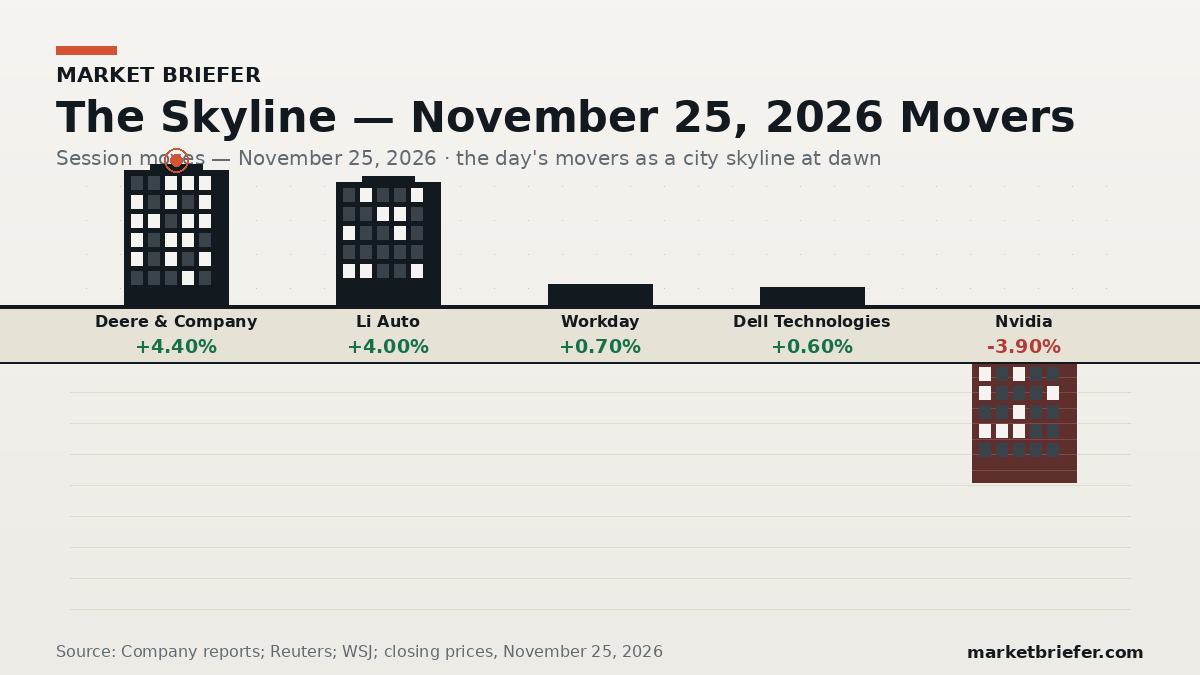
Deere set the earnings tone before the opening bell. The Moline, Illinois machinery maker reported fiscal fourth-quarter net income of $1.051 billion, or $3.89 a share, down from $1.065 billion, or $3.93 a share, a year earlier and short of the $4.03 a share analysts polled by FactSet had expected. Worldwide net sales and revenues fell 2% to $12.115 billion, though equipment net sales of $10.514 billion came in ahead of the $10.38 billion analysts had pencilled in. The split inside the business was stark: production and precision agriculture sales fell 15% to $4.02 billion and that segment’s operating profit dropped 33% to $406 million on lower shipment volumes, while construction and forestry sales rose 12% to $3.79 billion and small agriculture and turf sales rose 10% to $2.70 billion, with operating profit there jumping to $233 million from $25 million. For the full year, net income was $4.860 billion, or $17.95 a share, on revenues up 4% to $47.704 billion. Deere forecast fiscal 2027 net income of $4.50 billion to $5.25 billion, a range that includes an estimated one-time, non-cash pension settlement charge of $250 million to $400 million, and Chief Executive John May said the company is seeing early signs of improvement in large agriculture, led by North America. Investors took the guidance as a bottoming signal rather than a warning, and Deere rose 4.4% on the session.
The other earnings name of the day came from the electric vehicle industry. Li Auto, the Beijing automaker listed in New York, reported third-quarter revenue of RMB28.8 billion, or $4.3 billion, up 5.4% from a year earlier and ahead of expectations, on deliveries of 99,964 vehicles, up 7.2%. Its net loss narrowed to RMB309.7 million, or $46.2 million, from RMB624.4 million a year earlier, its non-GAAP net loss narrowed to RMB112.9 million, and its vehicle margin recovered to 15.3% from 9.4% in the second quarter as it returned to positive free cash flow. The outlook was softer than the quarter: Li Auto guided fourth-quarter deliveries to between 110,000 and 115,000 vehicles and revenue to between RMB31.7 billion and RMB33.1 billion, below what analysts had modelled, yet its U.S.-listed shares still rose 4.0% to $11.12, in the pattern our Earnings Season Playbook describes, where the direction of the numbers matters more than any single guide. The laggard in the auto complex was Polestar, the Swedish electric vehicle maker, which posted a wider third-quarter net loss of $403 million, against $365 million a year earlier, as revenue fell more than 14% to $642 million and its gross margin deteriorated to negative 18.1%, with pricing pressure and a weaker model mix to blame, according to Reuters.
Nvidia remained the market’s centre of gravity for a third straight session. Shares fell 3.9% to $149.30, extending Tuesday’s decline as the rally that followed Jensen Huang’s reinstatement as chief executive on Monday continued to fade, the Wall Street Journal reported. The leadership question, at least, is settled; the governance questions are not. Senator Cory Booker, the top Democrat on the Senate antitrust subcommittee, wrote to Nvidia on Wednesday demanding answers about Huang’s return, including the Trump administration’s communications with the board and assurances that Huang posed no national security threat, and asked the company to preserve board records and details of its independent investigation into export-control compliance, according to Reuters. The selling eased late in the session after reports that U.S. officials had told congressional staff in a classified briefing there was no evidence a Chinese technology executive linked to Huang had been directed by Chinese intelligence to spy on him. Two of Tuesday evening’s reporters steadied as well: Dell Technologies, whose record quarter built on AI servers had not spared it a double-digit fall in Tuesday’s regular session, rose 0.6%, and Workday rose 0.7%.
Deals and Capital Moves Stayed Industrial
Away from the index names, the day’s corporate transactions were measured rather than spectacular, and several had been set in motion earlier in the week. Terex’s agreement, announced Monday, to sell its Aerials segment, including the Genie aerial work platform brand, to Canada’s Linamar Corporation for approximately $1.4 billion in cash remained the largest industrial carve-out on the tape; the deal covers the segment’s intellectual property, manufacturing footprint and parts and service operations, is expected to close in 2027, and leaves Terex with three segments, environmental solutions, materials processing and specialty vehicles, which generated about $4.3 billion of sales and $711 million of adjusted EBITDA in the first nine months of 2026. In healthcare, Universal Health Services agreed to sell Aiken Regional Medical Centers in South Carolina to Piedmont Healthcare for approximately $500 million, with closing no earlier than January 31, 2027 and the hospital’s property still to be transferred from Universal Health Realty Income Trust. In capital markets, Peloton’s refinancing, priced earlier this month, framed the week’s consumer story: $700 million of 8.625% senior secured notes due 2032 replaced its term loan, alongside a new $200 million revolving facility and a board authorization, announced November 23, to repurchase up to $300 million of its shares. Cathay General Bancorp added a smaller capital return on Wednesday itself, announcing a $50 million increase to its share repurchase program. In biotechnology, Vertex Pharmaceuticals said the Food and Drug Administration had extended its review of povetacicept, the company’s kidney disease drug for IgA nephropathy, by up to three months, to a decision date no later than February 28, 2027, and its shares fell more than 6% in extended trading.
The economic backdrop gave executives something firmer to plan against, even as it complicated the Federal Reserve’s path. The Bureau of Economic Analysis revised third-quarter growth up to a 4.3% annual rate, from 3.4% in the advance estimate, on stronger investment and consumer spending, and reported corporate profits rose $206.0 billion in the quarter. October inflation ran hotter: the PCE price index rose 0.3% on the month and 3.8% from a year earlier, up from 3.6% in September, while core PCE inflation rose 3.3% year over year, the largest advance since November 2023. The labour market, by contrast, looked stable, with initial jobless claims falling 13,000 to 189,000 in the week ended November 21, and housing offered a bright spot as new home sales jumped 14.2% in October to an annual rate of 701,000 units, the highest since December 2025, as builders cut prices.
The one to watch comes after the holiday. U.S. markets are closed Thursday for Thanksgiving and trade a shortened session on Friday, so the earnings calendar pauses before a dense Monday, December 1, when Rubrik reports after the close on November 30 and a technology-heavy slate follows on December 1 itself: MongoDB, with analysts expecting earnings of $1.61 a share, Marvell Technology at $1.10 a share, Okta at $0.93 a share and CrowdStrike, alongside Copart, NetApp, GitLab and Box, according to the MarketBeat earnings calendar. How those software and chip names guide into 2027 will set the tone for the first full week of December.
This is not investment advice. Corporate America is AI-assisted research produced with automated data checks; figures are verified against the cited sources at publication time.
See Market Briefer first in Google
Add to Preferred Sources