Container Rates Keep Sliding as the Red Sea Return Stalls — Except Into the Mediterranean
2 min read
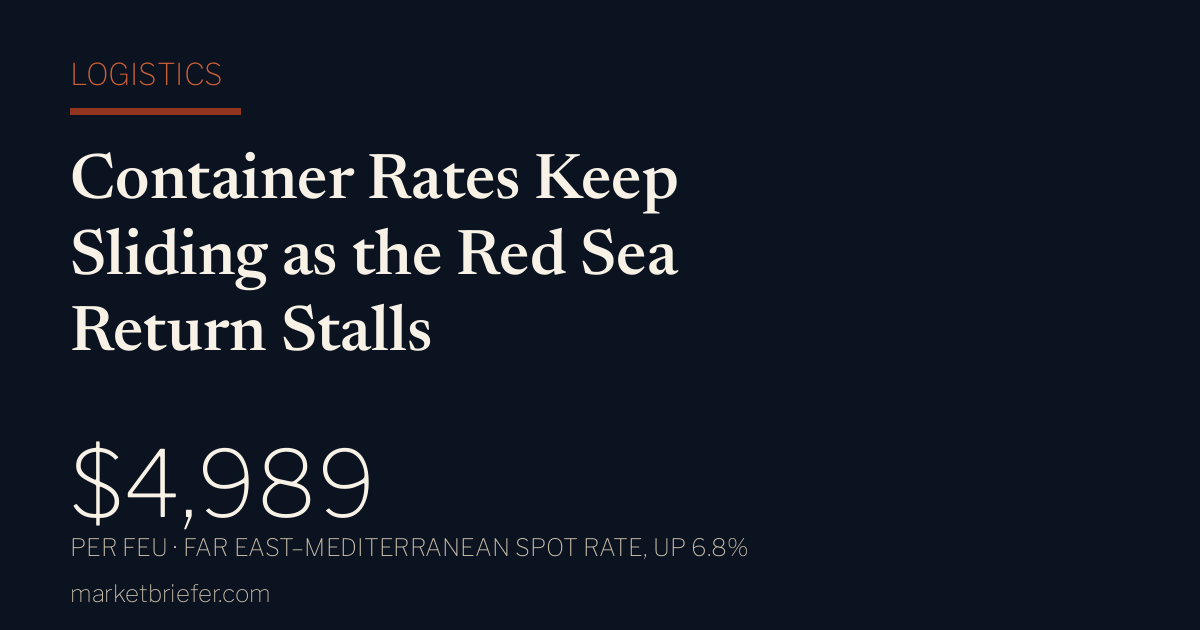
Container shipping rates fell again in the latest weekly assessment, but the market is no longer moving in one direction. Xeneta’s weekly update of November 20 put average spot rates from the Far East at $8,203 per FEU to the U.S. West Coast, $10,901 to the U.S. East Coast and $3,438 to North Europe, each down between 1.7% and 2.3% from a week earlier, while rates into the Mediterranean rose 6.8% to $4,989 per FEU — now $1,551 per FEU above the North Europe rate. For importers, carriers and freight forwarders, the split matters because it shows that the expected slide toward lower 2027 rates is real on most lanes but hostage to one chokepoint: the Red Sea.
The reason, according to Xeneta chief analyst Peter Sand, is that the return of container services to the Bab el-Mandeb Strait has stalled. Transits through the strait rose from 305 in August to 463 in October as carriers rebuilt Suez routings, but the seven-day average has since fallen 28%, from a peak of 16.6 transits a day on October 25 to 11.9 on November 19. Sand noted that disruption in the Red Sea is felt most acutely on Far East–Mediterranean trades because they are the most operationally exposed to the region, and he described the stall as a reminder that the path to lower freight rates in 2027 “will not be plain sailing,” with unexpected spikes likely along the way.
Capacity is doing the rest of the work on the softening lanes. Offered capacity out of the Far East was up 10.9% to the U.S. West Coast and 11.4% to the U.S. East Coast against a month earlier on Xeneta’s four-week rolling measure, against demand that has not kept pace. The volumes themselves remain historically strong: the Port of Los Angeles reported handling 1,026,872 TEU in October, a record for the month and the second-highest monthly total in its history, with loaded imports of 538,620 TEU up 25% year on year. The picture, in other words, is not weak cargo — it is more ships chasing it, which is why the rate direction on the transpacific and Asia–North Europe lanes points down even at record throughput.
Two watchpoints follow from that. The first is operational: congestion has migrated from the quay to the rail leg at the San Pedro Bay ports, where on-dock rail dwell times have run well above local cargo dwell, so importers’ costs into the U.S. interior can stay elevated even as ocean rates fall. The second is contractual: Xeneta’s Ocean Outlook 2027, released November 9, projects average global spot rates falling about 30% from third-quarter 2026 levels next year as fleet growth of 6.8% outpaces demand growth of 2.5% to 4% — the backdrop against which annual contract negotiations are now being priced. Shippers who treat the Mediterranean spike as noise and the broader decline as the trend are reading the data the way the market is currently presenting it; the Red Sea is the one variable that has already reversed once this quarter.
Educational coverage — not investment advice.
See Market Briefer first in Google
Add to Preferred Sources