Corporate America: November 20, 2026 — Nvidia’s 14% Fall Drags Wall Street Into Correction
Nvidia fell 14% as the SEC's accounting probe deepened the AI sell-off and pushed the S&P 500 into correction, while Global Payments jumped on a possible $50 billion GTCR buyout and BJ's beat earnings but fell.
5 min read
Corporate America ended the week in a full correction. The S&P 500 fell 265.44 points, or 3.70%, to 6,910.39 on Friday, its seventh straight decline and a close more than 10% below its October 6 record, while the Dow Jones Industrial Average dropped 949.73 points, or 1.93%, to 48,147.33 and the Nasdaq Composite lost 1,261.47 points, or 5.28%, to 22,617.73, erasing its gains for the year in its second-largest one-day points drop on record, according to the Associated Press. It was the S&P 500’s worst week since April 2025, and the selling was again led by the artificial intelligence trade that had carried the market all year, a reversal tracked throughout the session on our Corporate America desk. Treasury yields fell as investors sought safety, with the 10-year yield down to 4.93% from 5.04% late Thursday.
Nvidia was the day’s epicenter. The chipmaker fell 14.01% to $125.53, its ninth decline in the last ten sessions, according to Finnhub closing data, after Reuters reported that the Securities and Exchange Commission’s probe of the company is focused on potential accounting issues. Enforcement staff are scrutinizing the company, two people briefed on the matter told Reuters, with renewed attention on last year’s change in how Nvidia reports geographic revenue, a shift that removed Singapore from its breakdown even as sales there soared, and on the circular financing arrangements through which chipmakers help customers fund purchases of their own equipment. The SEC declined to comment and Nvidia did not immediately respond, and Reuters noted that investigations are not evidence of wrongdoing. On Tuesday’s earnings call, interim chief executive Colette Kress said Nvidia would be far more selective about AI industry financing deals, but the stock has now fallen more than 25% since the scandal over former chief executive Jensen Huang erupted earlier this month.
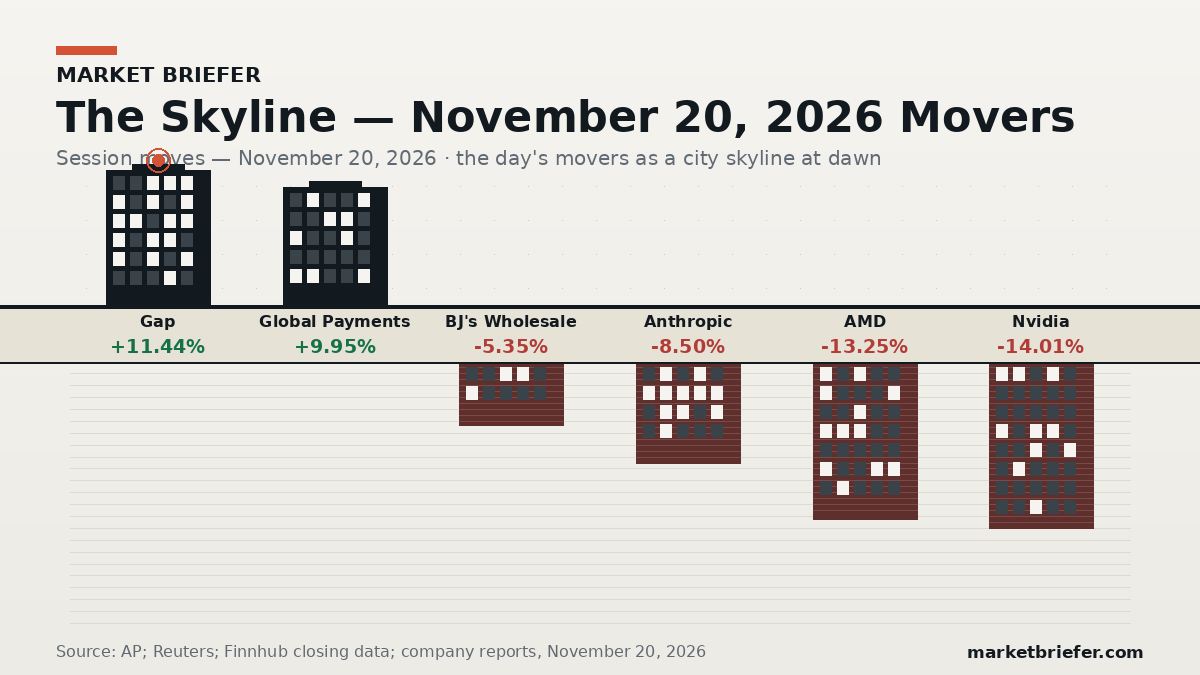
The damage spread across the whole AI complex. Advanced Micro Devices fell 13.25% to $424.39, Micron Technology and Broadcom also posted double-digit declines, and the PHLX Semiconductor Index sank 10.7%, the Associated Press reported. Anthropic, in only its second day of trading after Thursday’s record debut, fell 8.5% to $88.91, at one point trading within a few dollars of its $83 initial public offering price before holding above it at the close. The pattern is the one our Earnings Season Playbook describes: in a market repricing an entire theme, even a solid print — and Nvidia’s Tuesday report, with revenue up 103% to $115.8 billion, was far better than solid — cannot hold a stock whose story has changed.
Deals, Retail and the Day’s Exceptions
The day’s biggest corporate deal story ran in the opposite direction. Global Payments rose 9.95% to $91.83 after Reuters, citing Bloomberg News, reported that private equity firm GTCR is exploring a takeover of the payments processor worth about $50 billion including debt and a premium. GTCR, already Global Payments’ largest shareholder with a 16.35% stake, said in a filing that no definitive decision has been made, and it is working with other private equity firms to finance a potential deal, a person familiar with the matter told Reuters. The renewed interest comes only days after reports that GTCR and Clayton, Dubilier & Rice had dropped an earlier consortium pursuit, a reminder that in this market a shelved deal and a live one can be separated by a single week.
BJ’s Wholesale Club delivered the morning’s headline earnings and was punished for the fine print. Adjusted earnings of $1.73 a share easily beat the $1.26 analysts polled by FactSet expected, revenue rose 17.5% to $6.28 billion against expectations of $5.97 billion, comparable club sales excluding gasoline rose 4.1% against the 2.9% expected, and membership fee income rose 9.5% to $138.4 million, the company reported. BJ’s also raised its full-year adjusted earnings outlook to $5.10 to $5.30 a share, from $4.60 to $4.80. But the quarter carried a roughly $240 million pretax benefit from a credit-card interchange litigation settlement, partly offset by $95 million in related expenses, and a promotion that cost about $56 million pushed merchandise margins down 170 basis points, leaving JPMorgan analysts estimating underlying earnings closer to $1.20 a share. The stock fell 5.35% to $104.82. Gap was the retail exception, rising 11.44% to $20.94 as investors looked past a guidance cut already flagged on Thursday and rewarded signs of life at Old Navy, where sales rose 1% with flat comparable sales after a 4% comparable decline the prior quarter, while the Gap brand’s sales rose 11% with comparable sales up 9%, its twelfth straight positive quarter.
Power, Sentiment and a Strong Season Underneath
Away from the sell-off, corporate investment plans kept expanding. FirstEnergy said it would raise its 2026–2030 capital investment plan to $38 billion from $36 billion after West Virginia regulators on November 17 granted its Monongahela Power and Potomac Edison subsidiaries a certificate to build the Maidsville Energy Center, a combined-cycle gas plant, and approved a surcharge letting the companies recover financing costs during construction, Reuters reported. FirstEnergy expects to fund about 35% of the project with equity or equity-like securities, lifting its total equity financing needs for 2026–2030 to $2.8 billion from $2 billion, and it raised its expected core earnings growth to a compound annual rate of 7% to 9% through 2030, from 6% to 8%, targeting the upper half of the range. The consumer, meanwhile, ended the week sounding better than the tape: the University of Michigan’s final November sentiment index rose to 51.5 from 48.0 in October, and year-ahead inflation expectations fell to 3.7% from 4.7%. Underneath the rout, the season itself has been strong — with about 94% of U.S. large- and mid-cap companies reported, third-quarter earnings rose 40.2% from a year earlier and technology earnings grew 65%, according to LSEG data cited by Reuters, and investors still put a net $45.71 billion into U.S. equity funds in the week to November 18.
The one to watch is Monday, November 23, when the earnings calendar resumes after the weekend with Hewlett Packard Enterprise, Agilent Technologies, Jacobs Solutions, Zoom and Semtech all reporting after the close, followed on Tuesday by Dell Technologies and Analog Devices, whose results will be read as the next test of the AI trade, in a holiday-shortened week with markets closed Thursday for Thanksgiving and Black Friday spending next in focus.
This is not investment advice. Corporate America is AI-assisted research produced with automated data checks; figures are verified against the cited sources at publication time.
See Market Briefer first in Google
Add to Preferred Sources